
Introduction
The role of a PhD guide is central to doctoral research in India. A guide is not only a mentor but also a regulator of quality and ethics in research. Traditionally, the eligibility of guides was framed around faculty working in central or state universities. However, with the expansion of private universities across India, the question arises: Can faculty from private universities be recognised as PhD guides? This blog explores the regulatory framework, the conditions set by the University Grants Commission (UGC), and the practical realities surrounding the recognition of private university faculty as research supervisors.
UGC Regulations on Recognised PhD Guides
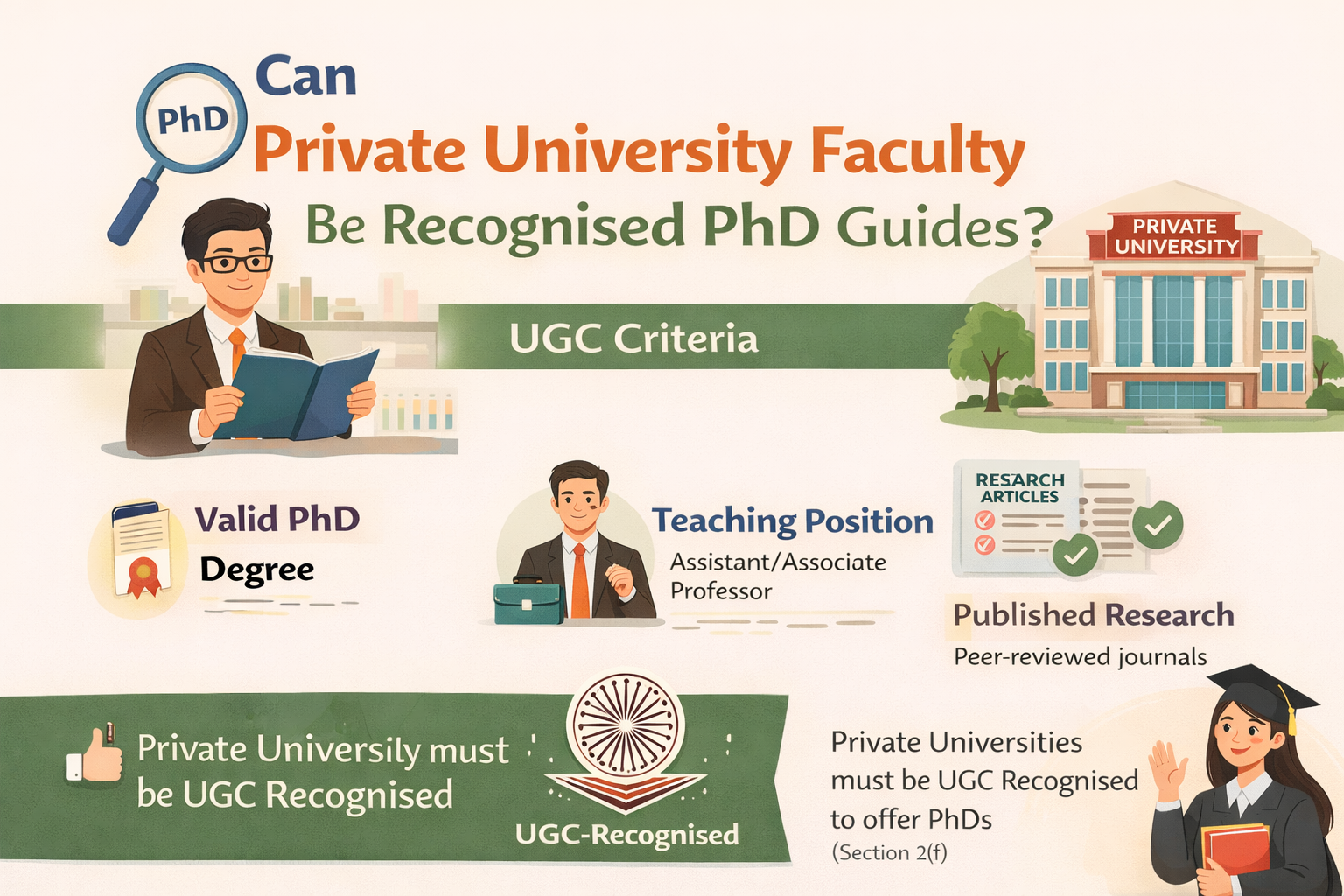
The UGC (Minimum Standards and Procedures for Award of Ph.D. Degree) Regulations, 2016 form the guiding document for doctoral research in India. According to these rules, only faculty members who meet the following criteria can be recognised as PhD supervisors:
- Possess a PhD degree in the relevant discipline.
- Hold a regular teaching position (Assistant Professor, Associate Professor, or Professor).
- Have a record of published research work in peer-reviewed or indexed journals.
The regulations do not explicitly exclude private university faculty. Instead, they emphasise academic qualifications, research contributions, and institutional recognition.
Private Universities and UGC Recognition
Private universities in India are established through state legislations and must be recognised by the UGC under Section 2(f) of the UGC Act, 1956. For these institutions, the authority to award PhD degrees is conditional upon UGC approval. Once a private university has UGC recognition and complies with UGC’s PhD regulations, its eligible faculty can serve as PhD supervisors.
Thus, the eligibility of a faculty member from a private university depends not on the “private” status of the institution, but on whether:
- The university is UGC-recognised.
- It follows the 2016 PhD regulations (and subsequent amendments).
- The concerned faculty member meets the minimum eligibility requirements.
Research Environment in Private Universities
Recognition as a PhD guide is also tied to the research environment available. For instance, UGC requires that doctoral research be supported by:
- A functional research advisory committee.
- Adequate laboratory facilities (for science and technology fields).
- Access to journals, databases, and library resources.
Some private universities have invested significantly in research infrastructure, enabling their faculty to be effective supervisors. Others, however, still face criticism for limited facilities and weaker research culture. This disparity sometimes leads to doubts about the recognition of guides from private universities.
Case Examples: Faculty as Guides in Private Universities
- High-ranked private institutions such as BITS Pilani or Ashoka University have well-established doctoral programmes, and their faculty are widely recognised as research guides.
- In newer or less reputed private universities, recognition may be more conditional. For example, a faculty member might be recognised as a supervisor only if the university has completed its first NAAC or NBA cycle and demonstrated adequate research capacity.
These examples show that recognition is not automatic but subject to institutional compliance and reputation.
The Issue of Quality Assurance
The inclusion of private university faculty as PhD guides raises important quality assurance concerns. Critics argue that some private universities prioritise revenue over rigorous research. To counter this, the UGC insists on:
- Regular research audits.
- Strict adherence to plagiarism checks.
- Transparent processes for admissions and supervision.
Therefore, while private university faculty can indeed be guides, their role is closely monitored through accreditation and inspections.
The Role of Co-Guides
In interdisciplinary or collaborative research, PhD scholars are often allowed to have a co-guide from another institution. This provision can strengthen private university supervision. For instance, a PhD student in a private university may work under a faculty member there but also have a co-guide from a reputed central or state university. Such arrangements help balance innovation with academic credibility.
Challenges Faced by Private University Faculty
Even though recognition is possible, private university faculty face certain challenges in being accepted as PhD supervisors:
- Perception Bias: Some scholars and evaluators assume public university supervisors are more credible.
- Limited Funding: Research funding opportunities for private universities are fewer compared to central universities.
- Workload Issues: Faculty in private universities often have heavier teaching loads, leaving less time for research supervision.
These factors can indirectly affect the recognition and functioning of private university faculty as guides.
Legal and Policy Safeguards
The UGC 2018 Notification reaffirmed that private universities must adhere to the same PhD regulations as public institutions. This ensures uniformity in standards. Furthermore, NAAC accreditation and NIRF rankings now evaluate research outputs, indirectly pressuring private universities to ensure that their guides meet acceptable standards.
Additionally, state governments often issue their own guidelines for private universities operating under their jurisdiction, adding another layer of scrutiny to the recognition process.
Conclusion
Yes, faculty from private universities can be recognised PhD guides in India, provided they and their institutions meet the UGC’s eligibility and regulatory requirements. The emphasis lies on qualifications, research contributions, and infrastructure rather than the ownership model of the university. While challenges such as perception bias and resource gaps remain, the increasing research output of reputed private universities is steadily changing the narrative.
For PhD aspirants, the key takeaway is this: before choosing a supervisor in a private university, check both the UGC recognition of the university and the academic record of the faculty member. Recognition is possible, but credibility depends on compliance, quality, and performance.