
Introduction
PhD supervision in India is no longer confined within the boundaries of a single university. With research increasingly becoming interdisciplinary and collaborative, scholars often benefit from the expertise of guides belonging to different institutions. Recognising this academic necessity, the University Grants Commission (UGC) has framed rules that allow co-guidance across institutions under specific conditions. These provisions ensure that while research scholars receive diverse mentorship, the process remains regulated, transparent, and aligned with quality standards.
This blog explains the UGC rules on co-guidance across institutions, their academic rationale, the practical challenges, and their significance for Indian PhD scholars and faculty.
What Does Co-Guidance Across Institutions Mean?
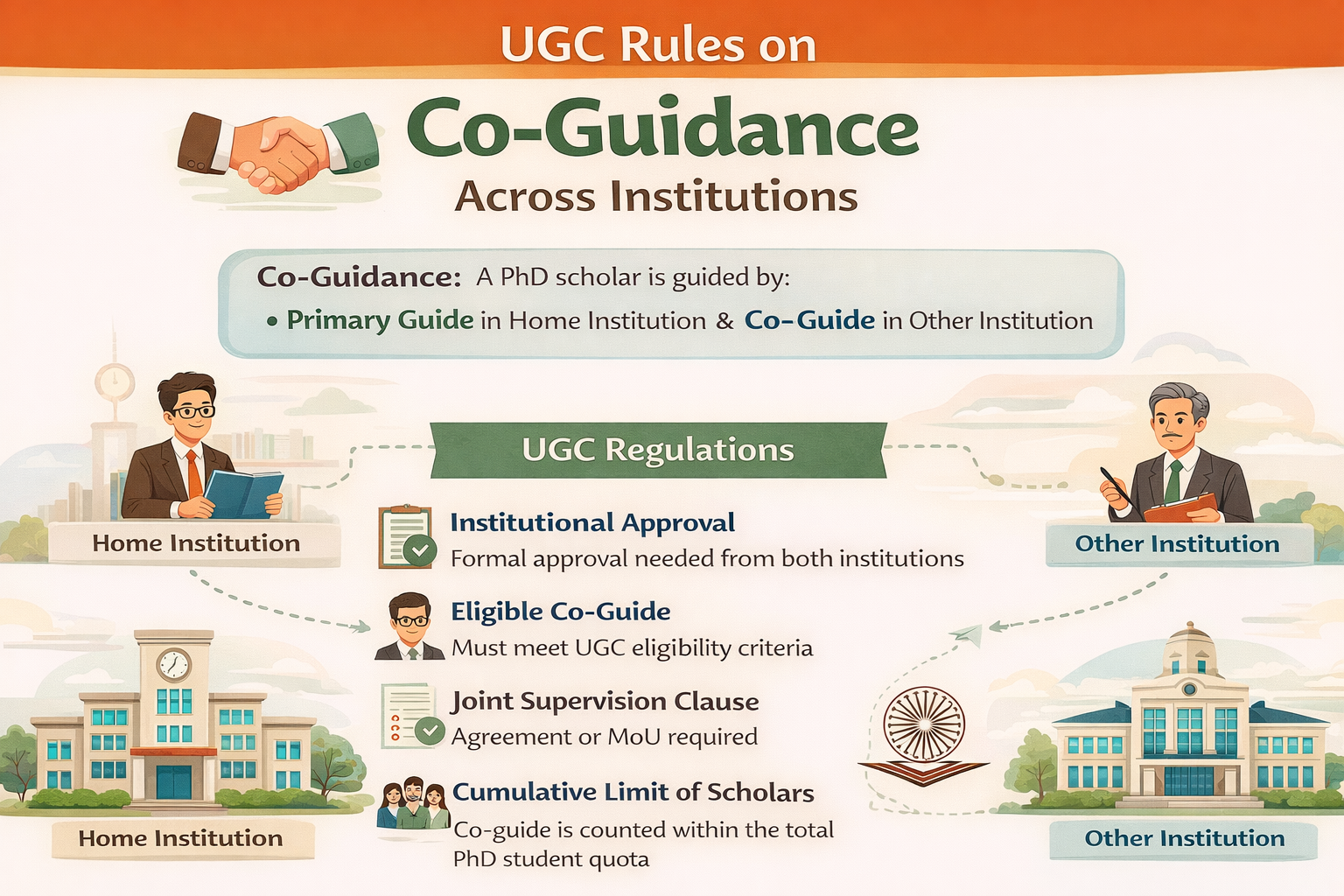
Co-guidance across institutions refers to a situation where a PhD scholar is officially supervised by a guide at their home university but also has a co-guide from another university, institute, or research organisation.
- The primary guide is usually from the scholar’s registered university.
- The co-guide may belong to another higher education institution (HEI), a national laboratory, or a recognised research centre.
- The co-guide contributes subject-specific expertise, particularly in interdisciplinary or applied research.
This arrangement is especially common in fields like biotechnology, data science, materials engineering, and social sciences, where collaboration between universities and research labs is essential.
UGC Regulations on Co-Guidance Across Institutions
The UGC’s 2016 Minimum Standards and Procedure for Award of PhD Degree Regulations (and subsequent amendments) outline the framework for such supervision.
Key provisions include:
- Institutional Approval:
- The scholar’s university must formally approve the appointment of an external co-guide.
- Both institutions should have a Memorandum of Understanding (MoU) or at least a written agreement for joint supervision.
- Eligibility of the Co-Guide:
- The external co-guide must meet the same eligibility norms as internal guides (generally a PhD with adequate publications and teaching/research experience).
- Industry experts with doctoral qualifications may also be considered, provided the university recognises their credentials.
- Maximum Number of Scholars:
- UGC limits the number of scholars a faculty can guide (usually 8 PhD scholars for Professors, 6 for Associate Professors, and 4 for Assistant Professors).
- This limit applies cumulatively, across both home and external institutions.
- Administrative Responsibility:
- The primary responsibility for progress monitoring, thesis submission, and evaluation rests with the home university guide.
- The co-guide contributes academically but does not override institutional regulations.
- Joint Supervision Clauses:
- In interdisciplinary topics, UGC recommends—but does not mandate—the inclusion of a co-guide from the secondary discipline.
- When scholars are involved in joint research projects across institutions, co-guidance is encouraged for formal accountability.
Why Co-Guidance Matters in Research
UGC’s flexibility in permitting co-guidance reflects larger trends in research practice:
- Access to Specialised Expertise: Scholars can work with domain experts not available in their home university.
- Interdisciplinary Collaboration: Encourages cross-pollination of ideas between different faculties, labs, and disciplines.
- Resource Sharing: Allows access to advanced labs, datasets, or field sites at external institutions.
- Industry-Academia Linkages: Strengthens research outcomes when industry professionals act as co-guides.
Challenges in Co-Guidance Across Institutions
Despite the benefits, co-guidance raises some operational concerns:
- Administrative Delays: Formal approvals and MoUs between universities can take time.
- Workload Management: External guides must balance commitments at their home institutions with additional responsibilities.
- Assessment and Credit: Disputes may arise regarding academic credit, authorship, or evaluation roles.
- Communication Gaps: Coordination between primary and co-guide is essential to avoid conflicting advice to the scholar.
Case Examples from Indian Universities
- Central Universities: Many central universities allow co-guides from national research institutes like CSIR, DRDO, or ISRO when research requires specialised facilities.
- State and Private Universities: These institutions increasingly appoint co-guides from industry to make research more application-oriented.
- Joint PhD Programs: Some universities have formal tie-ups enabling joint PhD degrees, where co-guidance is mandatory by regulation.
These examples demonstrate that while co-guidance is not uniformly practised, UGC provisions are adaptable to institutional needs.
Best Practices for Scholars and Faculty
To ensure smooth functioning of cross-institutional guidance, both scholars and faculty can follow certain best practices:
- Formalise Early: Scholars should secure institutional approval for co-guidance at the time of registration itself.
- Define Roles Clearly: Specify in writing what areas each guide will mentor, to avoid overlaps.
- Maintain Regular Communication: Joint meetings (physical or virtual) between both guides and the scholar help resolve conflicts early.
- Respect Institutional Limits: Both guides should track the number of supervisees they are handling to remain within UGC-prescribed caps.
- Ethical Research Practices: Publications must give due credit to both institutions and all supervising faculty.
Contemporary Relevance
In today’s context of global academic mobility and cross-sector collaboration, co-guidance rules are particularly significant. For Indian scholars aspiring to conduct cutting-edge research, this UGC provision opens doors to:
- Access to international collaborations (when MoUs exist with foreign universities).
- Strengthening India’s position in global research indices.
- Creating research that addresses complex, multi-dimensional societal problems.
Conclusion
The UGC rules on co-guidance across institutions reflect a balance between academic flexibility and regulatory accountability. By allowing scholars to work with experts from other universities, national labs, or even industry, the regulations acknowledge the collaborative nature of modern research. At the same time, institutional oversight ensures that doctoral standards are not compromised.
For Indian PhD scholars, co-guidance across institutions is both an opportunity and a responsibility—an opportunity to expand their academic horizons, and a responsibility to navigate approvals, coordination, and ethical research practices diligently.