
Introduction
The role of a PhD guide is deeply valued in Indian academia. Guides not only supervise research but also mentor scholars in developing critical thinking, academic writing, and professional ethics. A frequent question that arises is whether retired professors, who often have vast teaching and research experience, can continue as PhD supervisors. The University Grants Commission (UGC) and individual universities have established guidelines on this matter, balancing the expertise of retired faculty with administrative requirements.
This blog explores UGC’s position, university practices, and the practical realities faced by retired professors and their research students.
UGC Perspective on Retired Faculty as Guides
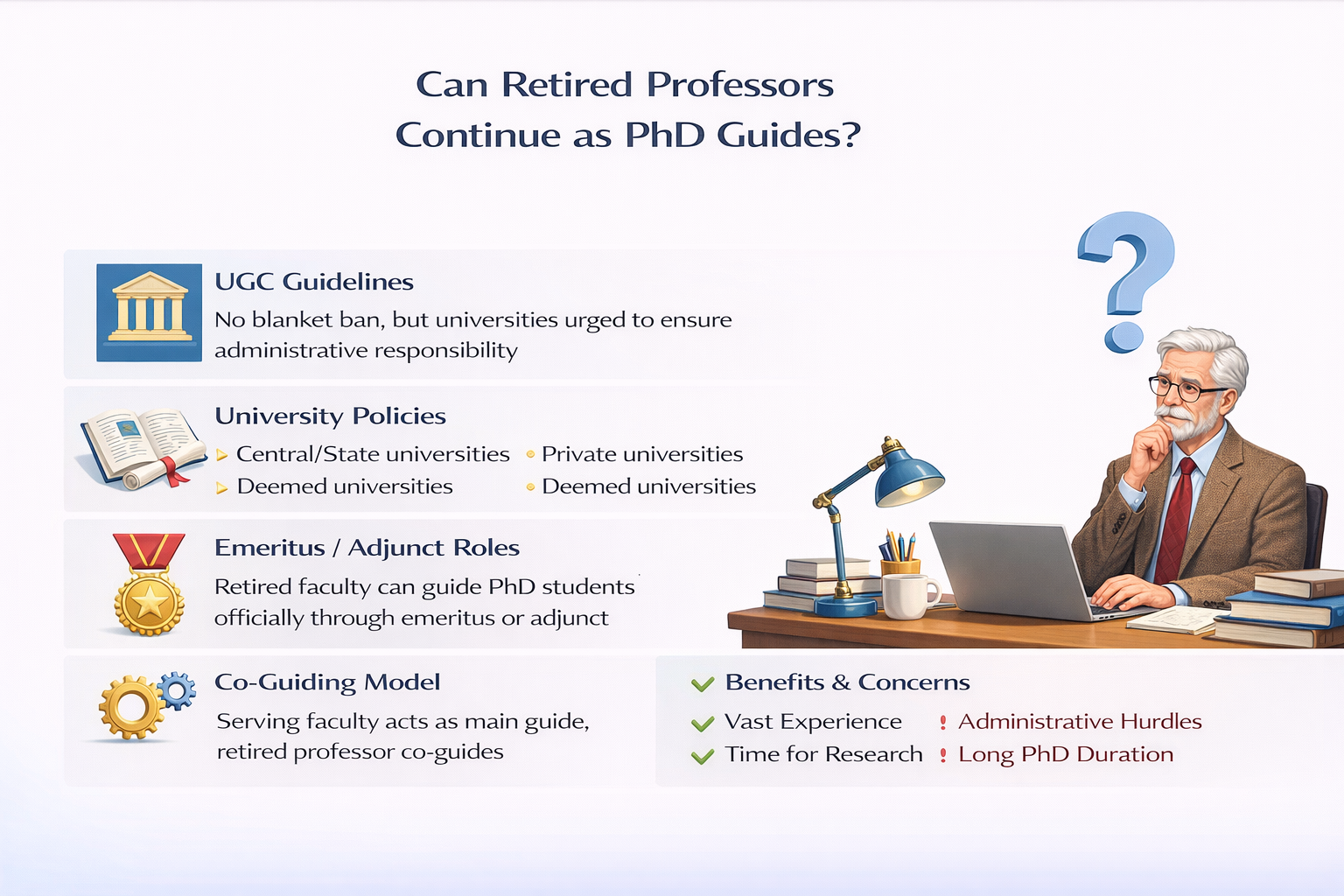
The UGC has not issued a blanket prohibition against retired professors serving as PhD guides. However, it has emphasized the need for active faculty members to take responsibility for ongoing doctoral supervision. This is because PhD guidance involves regular engagement with the student, paperwork related to progress reviews, and administrative approvals that retired professors may not always be able to access.
That said, universities have considerable autonomy under UGC guidelines. Many universities allow retired professors to continue supervising students under specific conditions, especially when their research expertise is crucial.
University-Level Practices in India
Policies differ significantly across universities in India:
- Central and State Universities: Some central universities allow retired professors to continue as guides if they had registered students before retirement. However, new PhD registrations under them may not be permitted after superannuation.
- Private Universities: Several private universities actively engage retired professors as adjunct or emeritus faculty, enabling them to continue supervising PhD students.
- Deemed Universities: Practices vary; some allow co-guidance roles for retired professors but require a full-time, serving faculty member as the main guide.
The decision is often left to the university’s Board of Research Studies or Doctoral Research Committee.
Emeritus Professors and Adjunct Faculty Roles
One formal pathway that enables retired professors to remain engaged is through emeritus professorships or adjunct appointments. Universities may confer these designations on distinguished retired faculty, usually for a fixed term, such as three to five years. During this tenure, they can officially guide or co-guide PhD scholars.
This model not only retains valuable expertise within the institution but also ensures compliance with university structures.
Practical Concerns in Continuing Guidance
While the experience of retired professors is invaluable, certain practical concerns arise when they continue as PhD guides:
- Availability for Regular Interaction: PhD supervision requires continuous discussion, feedback on drafts, and support in navigating challenges. Retired professors who relocate or reduce their academic involvement may find this demanding.
- Administrative Hurdles: Universities often require progress reports, examiner suggestions, and other paperwork that needs official sign-off. Retired faculty may lack the authority to handle these tasks independently.
- Long Duration of PhDs: Since a PhD typically spans three to six years, questions arise about whether a retired guide will be available throughout the scholar’s journey.
Student Perspective: Benefits and Challenges
From a PhD scholar’s viewpoint, having a retired professor as a guide offers both advantages and challenges:
- Advantages:
- Retired professors often have more time for research discussions since they are free from administrative duties.
- They bring decades of experience, extensive publication records, and strong academic networks.
- They can provide highly personalized mentoring.
- Challenges:
- Administrative delays if the retired professor is not officially affiliated with the university.
- Uncertainty if the guide disengages midway due to health, relocation, or other reasons.
- Difficulty in accessing research grants if funding agencies require the principal investigator to be a serving faculty member.
Co-Guidance as a Common Solution
To address these concerns, many universities adopt a co-guidance model. In this system:
- A retired professor may serve as a co-guide, bringing expertise and mentorship.
- A serving faculty member acts as the main guide, handling administrative tasks and ensuring continuity.
This approach safeguards the student’s academic journey while still utilizing the retired professor’s expertise.
Global Comparison
Internationally, practices differ but share similarities with the Indian context:
- In the UK, retired professors can supervise if they maintain an honorary affiliation with the university.
- In the US, emeritus professors frequently continue guiding PhD students, provided the university extends them formal status.
- In Australia and Europe, the practice of co-supervision by retired faculty is common, ensuring institutional responsibility.
These models highlight that India’s approach is not unique but part of a global effort to balance expertise with accountability.
Policy Recommendations
Based on current trends, some policy recommendations can be made for Indian universities:
- Formalize Adjunct/Emeritus Roles: Offering retired professors official designations ensures smooth administrative functioning.
- Mandate Co-Guides for New Registrations: To protect students, new PhD enrolments under retired professors should have a serving faculty as co-guide.
- Leverage Experience in Specialized Fields: Retired professors should be particularly encouraged to guide in niche or interdisciplinary fields where expertise is scarce.
- Digital Supervision Models: With the growth of online platforms, retired professors can engage in virtual supervision, expanding their accessibility.
Conclusion
Retired professors remain an invaluable academic resource in India. Their accumulated knowledge, mentoring skills, and professional networks can significantly enrich doctoral research. While UGC regulations and university rules emphasize the need for active faculty involvement, most institutions have devised mechanisms such as emeritus status or co-guidance to continue benefiting from retired academics.
For PhD scholars, having a retired professor as a guide can be both rewarding and challenging. The key lies in ensuring administrative clarity and continuity, often through a co-guidance model. Ultimately, retaining retired professors in doctoral supervision strengthens the academic ecosystem and preserves the wisdom of seasoned educators for future generations of researchers.