
Introduction
Indian higher education is steadily opening its doors to international collaboration. With research moving beyond geographical boundaries, many Indian universities are exploring ways to integrate global expertise into doctoral supervision. A common question is whether foreign faculty can officially serve as co-guides for PhD scholars in India. The University Grants Commission (UGC) and related regulatory bodies provide a framework for such recognition, but the implementation varies across institutions.
This blog examines the rules, practices, and challenges surrounding the recognition of foreign faculty as PhD co-guides in India.
UGC and Regulatory Context
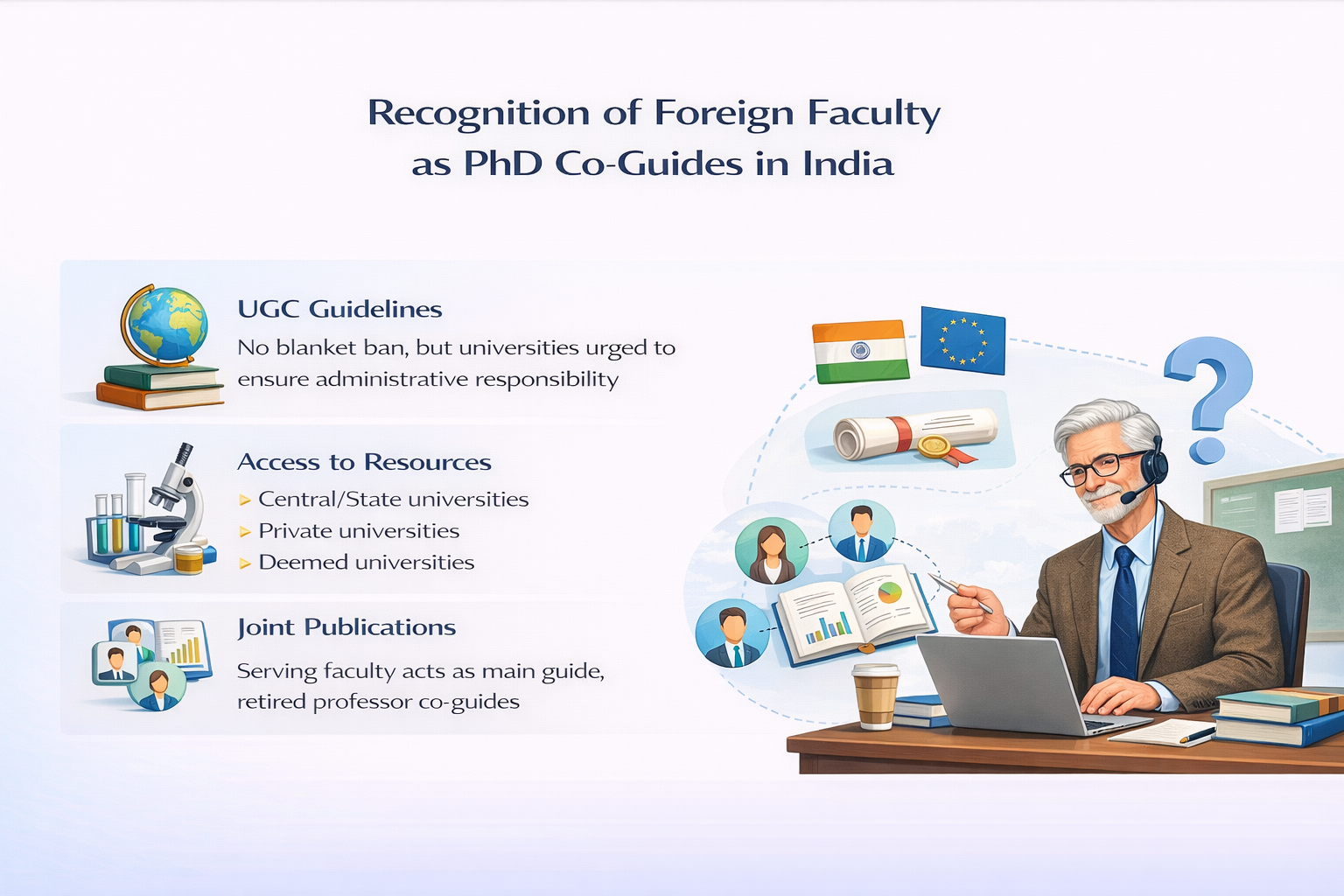
The UGC is the apex body that regulates doctoral education standards in India. Its 2016 Minimum Standards and Procedure for Award of PhD Regulations allow universities considerable autonomy in appointing supervisors and co-supervisors. While these regulations do not explicitly prohibit foreign faculty from serving as co-guides, they emphasize that:
- The principal supervisor (guide) must be a recognized faculty member of the Indian university where the student is enrolled.
- Co-supervision arrangements can be made, particularly in cases of interdisciplinary or collaborative research.
- Universities must establish their own ordinances or guidelines to approve and monitor such arrangements.
This means recognition of foreign faculty as co-guides is possible, but only if the host university explicitly allows it within its PhD regulations.
Institutional Practices in India
Many Indian universities—especially central universities, IITs, and private research-focused institutions—have begun encouraging joint supervision with foreign experts. Some key approaches include:
- Formal MoUs (Memorandums of Understanding)
Universities often sign MoUs with foreign institutions that allow shared research projects. These agreements typically recognize faculty from the partner university as eligible co-guides. - Cotutelle (Joint PhD) Programs
In cotutelle arrangements, a PhD scholar is jointly registered in two universities—one in India and one abroad. Here, a foreign professor is formally recognized as a co-guide alongside an Indian supervisor. - Case-by-Case Approval
Some universities allow recognition of a foreign co-guide if the research topic requires specialized expertise unavailable locally. Such approval usually comes from the Board of Research Studies or Doctoral Committee.
Advantages of Having a Foreign Co-Guide
The involvement of foreign faculty as co-guides can significantly enrich the doctoral journey:
- Global Perspective: Scholars benefit from international exposure to methodologies, literature, and debates.
- Access to Resources: Foreign co-guides can facilitate access to advanced labs, data sets, and research networks.
- Collaborative Publications: Co-authorship with international faculty enhances the global visibility of Indian PhD research.
- Career Opportunities: Guidance from foreign experts often leads to postdoctoral positions or academic networking abroad.
Challenges and Limitations
Despite the benefits, several practical challenges limit the widespread recognition of foreign co-guides:
- Regulatory Ambiguity
UGC regulations do not clearly outline a standardized process for approving foreign co-guides, leaving institutions to interpret rules differently. - Administrative Hurdles
Foreign faculty appointments must comply with visa rules, formal contracts, and academic recognition procedures, which can be bureaucratically slow. - Assessment and Accountability
Since the foreign co-guide is outside the jurisdiction of Indian regulations, monitoring their role in supervision becomes difficult. - Equity Concerns
Not all scholars get equal access to foreign supervision. This opportunity is often limited to elite universities or projects with international funding.
Examples from Indian Universities
- IIT Bombay and Monash University (Australia): Their joint PhD program formally recognizes faculty from both institutions as co-guides.
- JNU (Jawaharlal Nehru University): Some doctoral committees allow foreign faculty as co-guides if the scholar’s topic aligns with international collaboration projects.
- Private Universities (e.g., Amity, Ashoka): These institutions frequently establish partnerships with global universities and recognize foreign experts as co-supervisors under joint research schemes.
Approval Mechanisms
If a PhD scholar in India wishes to have a foreign faculty member as co-guide, the usual process involves:
- Proposal by the Scholar and Main Guide
The student and principal supervisor must submit a justification for the inclusion of a foreign co-guide. - Departmental Research Committee (DRC) Approval
The DRC evaluates the academic merit and feasibility of involving a foreign faculty member. - Board of Research/University Approval
The proposal is forwarded to the Board of Research Studies or the university’s doctoral council for final sanction. - Formal Agreement
If approved, the university may issue an official recognition letter or sign an MoU with the foreign institution.
Future Directions
As India aspires to be a global research hub, the recognition of foreign faculty as co-guides is likely to become more common. Policies aligned with the National Education Policy (NEP) 2020 encourage internationalization of higher education, which includes:
- Facilitating dual degree and joint PhD programs.
- Creating regulatory clarity for foreign faculty involvement.
- Strengthening digital collaboration platforms for remote supervision.
Conclusion
Recognition of foreign faculty as PhD co-guides in India is not only possible but increasingly encouraged under institutional collaborations. However, the system remains uneven, depending on individual university policies and administrative willingness. While UGC regulations ensure that the principal guide must be from the host Indian university, co-supervision by foreign experts is a valuable mechanism to enrich doctoral research.
For Indian PhD scholars, this recognition means access to global mentorship, better research quality, and stronger career pathways. For institutions, it signifies a step towards truly internationalizing Indian research.