
Introduction
For a PhD scholar in India, choosing a research guide is one of the most critical decisions in the academic journey. However, beyond academic expertise and compatibility, another crucial factor must be checked—whether the guide is officially recognised as a supervisor under University Grants Commission (UGC) regulations. Without this recognition, your PhD registration, thesis submission, and even award of degree can face delays or complications. This blog explains how scholars can verify if their guide is UGC recognised and why such recognition matters in the first place.
Why UGC Recognition of a Guide Matters
The UGC has laid down clear guidelines on who can supervise PhD candidates. These regulations ensure:
- Academic Standards – Only qualified and experienced faculty guide research, maintaining academic quality.
- Legitimacy of Degree – If your supervisor is not UGC approved, the PhD degree may be questioned during evaluation, job applications, or international recognition.
- Institutional Compliance – Universities must follow UGC rules to avoid regulatory issues during NAAC or UGC inspections.
Thus, verifying recognition is not a formality but a safeguard for your academic future.
Eligibility Conditions for PhD Guides (UGC Norms)
The UGC (Minimum Standards and Procedure for Award of PhD Degrees) Regulations 2022 define eligibility:
- A Professor can supervise up to 8 PhD scholars.
- An Associate Professor with at least 5 years of service and a PhD can supervise up to 6 scholars.
- An Assistant Professor with at least 5 years of service and a PhD can supervise up to 4 scholars.
- The faculty must be in a UGC-recognised university or institution with valid research programmes.
This means only faculty formally recognised by the university, based on UGC criteria, can serve as guides.
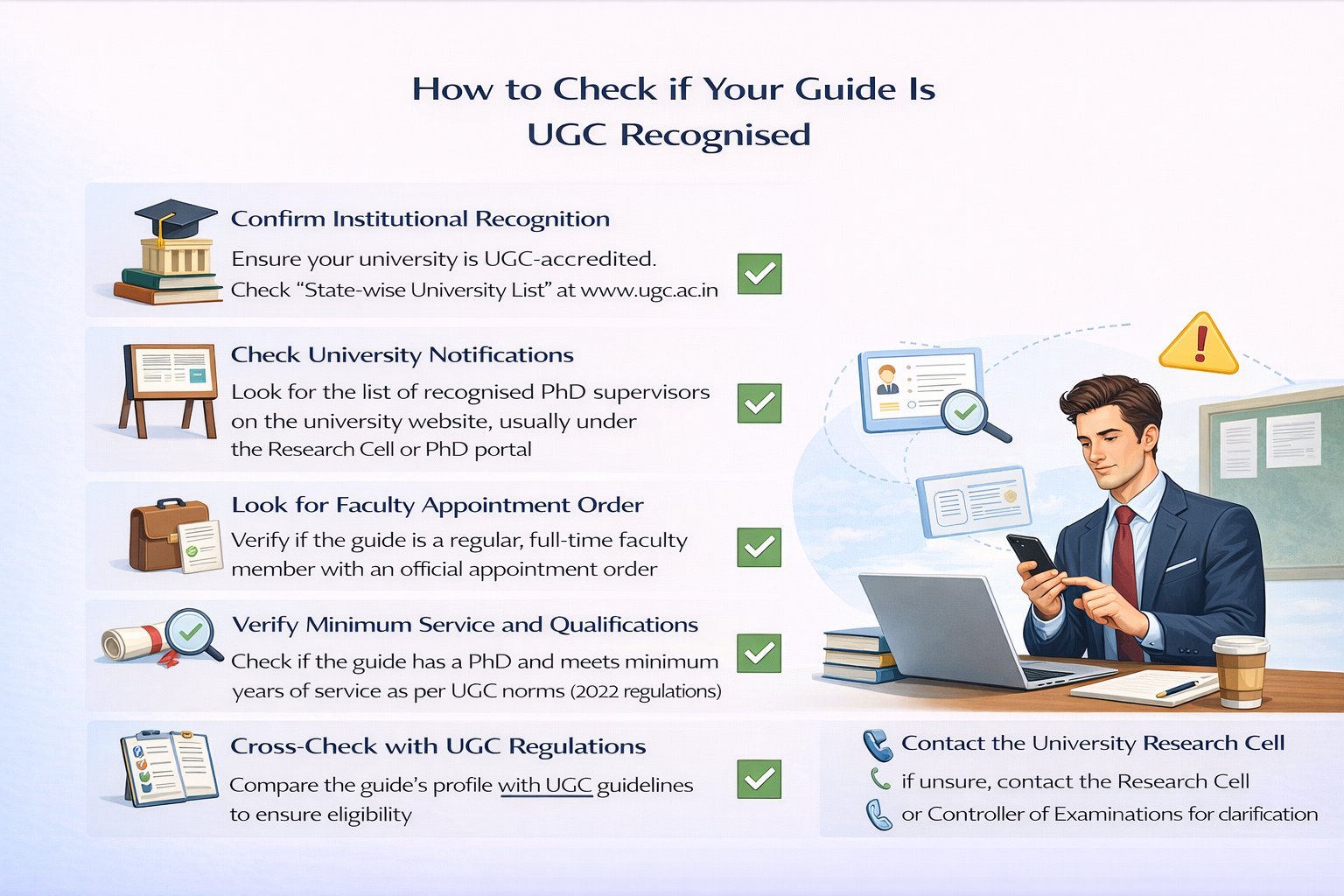
Steps to Check if Your Guide Is UGC Recognised
1. Confirm Institutional Recognition
- Ensure your university is recognised by the UGC. You can verify this on the UGC official website (www.ugc.ac.in) under the “State-wise University List”.
- If the university itself is unrecognised, even the guide’s recognition becomes irrelevant.
2. Check University Notifications
- Universities publish a list of approved PhD supervisors after scrutiny by their Research Committee or Board of Studies.
- This list is often available on the Research and Development Cell (RDC) or PhD portal of the university website.
3. Look for Faculty Appointment Order
- Guides must be regular, full-time faculty. Visiting faculty or contractual staff generally cannot act as supervisors.
- The appointment letter confirming their status in the university strengthens recognition.
4. Verify Minimum Service and Qualifications
- A PhD degree is mandatory for all supervisors.
- Check whether the faculty has 5 years of service in the case of Assistant or Associate Professors.
- Universities usually display faculty profiles with designations and years of experience online.
5. Cross-Check with UGC Regulations
- Compare the faculty’s profile with UGC guidelines (latest version: 2022 regulations).
- If eligibility criteria do not match, they cannot be formally recognised.
6. Ask for Research Committee Approval
- Every PhD scholar is allotted a guide through the Doctoral Research Committee (DRC) or equivalent body.
- The official letter of guide allotment is proof of recognition.
7. Contact the University Research Cell
- If in doubt, approach the Research Cell or Controller of Examinations of the university.
- They can provide the list of recognised guides and clarify recognition status.
Red Flags to Watch Out For
Sometimes faculty members claim to be PhD supervisors without fulfilling UGC criteria. Warning signs include:
- No PhD degree but claiming eligibility.
- Ad-hoc or part-time appointments instead of regular service.
- No inclusion in the official list of recognised supervisors on the university website.
- Exceeding guide–student ratio allowed by UGC.
If any of these apply, you must double-check with the university before registering under such a guide.
Difference Between Recognised and Unrecognised Guides
- Recognised Guide: Meets UGC eligibility, formally approved by the university, listed as a supervisor, and has authority to supervise, co-supervise, or submit research progress reports.
- Unrecognised Guide: May be academically qualified but lacks university approval. Their supervision will not be counted officially, and the scholar risks invalidation of the PhD.
Case of Co-Guides and External Experts
Sometimes a faculty member may not qualify as the main guide but may serve as a co-guide, especially in interdisciplinary or industry-linked research. In such cases:
- The main supervisor must be UGC recognised.
- External co-guides can contribute expertise but cannot replace the recognised supervisor.
Consequences of Choosing a Non-Recognised Guide
- Registration Rejection – University may not approve admission if the guide is ineligible.
- Delay in Thesis Submission – Examiners may question recognition status at the submission stage.
- Career Implications – A degree under an unrecognised guide can create issues during faculty promotions, postdoctoral applications, or international equivalence checks.
Best Practices for Scholars
- Always verify recognition before applying for PhD admission.
- Request an official guide allotment letter from the university.
- Keep copies of UGC guidelines handy to cross-check eligibility.
- In interdisciplinary projects, ensure at least one guide is UGC recognised.
- If uncertain, consult senior faculty or research cell officials instead of relying on hearsay.
Conclusion
The recognition of a PhD guide is not merely a bureaucratic requirement but a safeguard for academic legitimacy and professional growth. While many faculty members may be subject experts, only those fulfilling UGC criteria and approved by the university’s research committee are recognised supervisors. For PhD scholars, it is essential to cross-verify recognition through university notifications, UGC regulations, and institutional research cells. A little diligence at the start of your PhD journey can prevent years of regret later.