
Introduction
The eligibility of faculty members to act as PhD guides in India is a subject that often invites debate, especially in professional fields such as Law and Education. Unlike the natural sciences or engineering disciplines where laboratory facilities and technical expertise dominate, professional fields involve a combination of theoretical knowledge, applied research, and policy-oriented perspectives. The University Grants Commission (UGC) regulations lay down general conditions for PhD supervision, but individual universities and regulatory councils, such as the Bar Council of India (BCI) for Law or the National Council for Teacher Education (NCTE) for Education, may also influence recognition norms.
This blog explores the eligibility of guides in these two fields, highlighting UGC rules, professional standards, and institutional practices, while clarifying the responsibilities that guides in Law and Education carry.
General UGC Criteria for PhD Guides
The UGC regulations, revised in 2016 and 2018, provide the baseline eligibility for PhD supervision across disciplines. According to these rules:
- A PhD supervisor must be a regular, full-time faculty member of a recognized university or institution.
- They must hold a PhD degree in the relevant subject.
- Academic designation matters: Professors and Associate Professors with a PhD are automatically eligible. Assistant Professors with at least three years of experience and a PhD may also be considered, depending on institutional regulations.
- A supervisor is restricted by a guide–student ratio, ensuring quality of mentorship.
These baseline conditions apply equally to professional fields like Law and Education, but nuances arise from the nature of research in these domains.
PhD Guide Eligibility in Law
Law as a professional discipline has unique characteristics: it is regulated by the BCI and involves research that may span constitutional law, criminal law, corporate law, human rights, and socio-legal studies.
- PhD Requirement
- The guide must hold a PhD in Law or in a directly related legal area.
- Faculty with doctorates in allied fields such as Political Science or International Relations may sometimes serve as co-guides, but not as primary guides in most institutions.
- Designation and Experience
- Professors and Associate Professors in recognized law schools, central universities, and national law universities (NLUs) are typically approved.
- Assistant Professors may also be eligible, provided they have the required research credentials and institutional recognition.
- Additional Conditions in Law Schools
- Some NLUs emphasize publications in reputed legal journals, courtroom or policy research experience, and involvement in funded projects as desirable qualifications for PhD supervisors.
- BCI does not directly regulate PhD supervision but its standards for faculty appointments indirectly shape who becomes a recognized guide.
PhD Guide Eligibility in Education
Education as a discipline focuses on pedagogy, teacher training, curriculum design, and policy implementation. Its professional oversight comes from the NCTE, though PhD supervision is governed by UGC norms.
- PhD in Education
- The guide must hold a doctoral degree in Education or an allied area like Educational Psychology, Curriculum Studies, or Teacher Training.
- Scholars from Sociology, Psychology, or Philosophy may act as co-guides where interdisciplinary perspectives are needed.
- Institutional Recognition
- Universities with Faculties or Departments of Education set their own recognition committees to approve research guides.
- Criteria often include research publications in peer-reviewed educational journals and experience guiding MPhil or equivalent dissertations.
- Experience in Teacher Training
- Practical involvement in teacher education programmes is often valued, since PhD research in Education is expected to bridge theory and practice.
- Faculty from Colleges of Education, if part of a university system, may be recognized as supervisors provided they meet UGC requirements.
Key Similarities Between Law and Education
Despite their differences, both fields share some common eligibility conditions for guides:
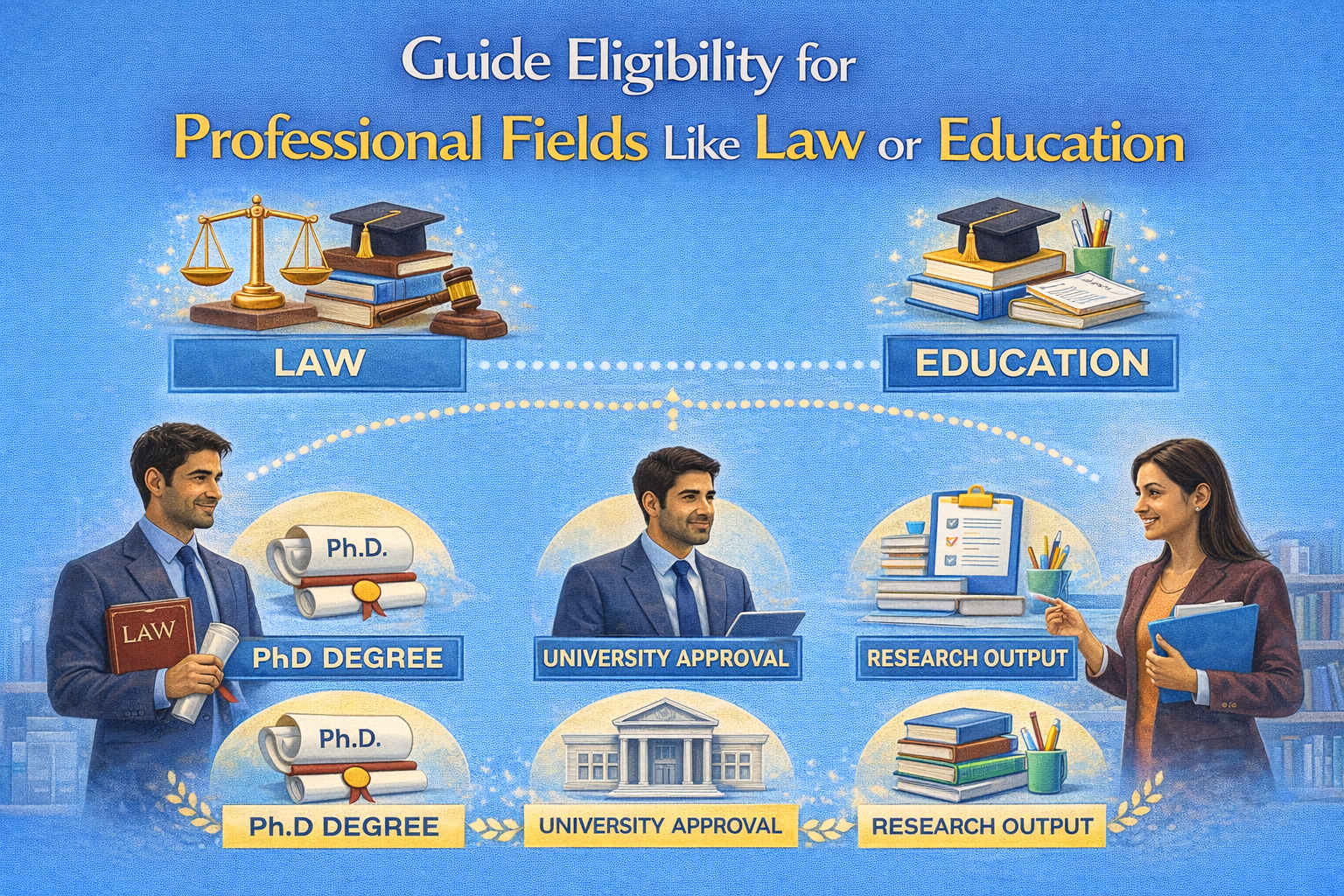
- Holding a PhD in the relevant subject is non-negotiable.
- Institutional approval is mandatory, even if UGC eligibility is satisfied.
- Research output—such as publications, projects, and prior supervision—strengthens a faculty member’s case for recognition.
- Co-guidance from allied disciplines is permitted in interdisciplinary projects.
Institutional Variations and Autonomy
While UGC provides overarching rules, universities retain autonomy in recognising PhD guides. For example:
- Some state universities require five years of post-PhD teaching experience before granting recognition.
- Private universities, while adhering to UGC norms, may impose additional expectations, such as a minimum number of Scopus- or UGC-CARE-listed publications.
- Deemed universities sometimes create panels of recognised guides, where selection is competitive and based on both academic output and professional contributions.
These variations mean that eligibility is not uniform across all institutions, even within Law and Education.
Challenges in Professional Fields
- Balancing Practice and Research
- In Law, many senior practitioners with excellent reputations may not hold PhDs, making them ineligible as formal guides despite their expertise.
- In Education, experienced teacher-trainers without PhDs are similarly excluded.
- Shortage of Recognised Guides
- Both fields face a scarcity of supervisors due to high demand and limited faculty with doctoral degrees, especially in regional universities.
- Interdisciplinary Needs
- Many research questions in Law involve sociology, political science, or economics. In Education, links with psychology or technology are growing. This increases reliance on co-guides and collaborative supervision.
Conclusion
Eligibility for PhD guides in professional fields like Law and Education is shaped by UGC regulations but interpreted through the lens of institutional requirements and professional expectations. A valid PhD, appropriate designation, and proven research credentials remain the baseline, but nuances—such as practice-oriented experience in Law or teacher-training expertise in Education—add depth to the criteria.
For scholars, it is important to verify whether their prospective supervisor is recognised by their university, beyond simply holding a PhD. For faculty, the path to becoming a guide requires not only fulfilling UGC requirements but also demonstrating sustained research engagement. Ultimately, ensuring quality supervision in these professional domains strengthens both academic scholarship and societal impact.