
Introduction
The relationship between a PhD scholar and their guide is central to the doctoral journey. A supportive supervisor can motivate, advise, and provide crucial direction, while a strained or mismatched relationship can lead to delays and frustrations. Many PhD scholars in India wonder if they can change their guide after registration, especially when issues of compatibility, academic support, or institutional circumstances arise. The University Grants Commission (UGC) provides rules, and individual universities implement procedures for such changes. This blog examines the circumstances, rules, and implications of guide changes in Indian PhD programmes.
Situations Leading to Change of Guide
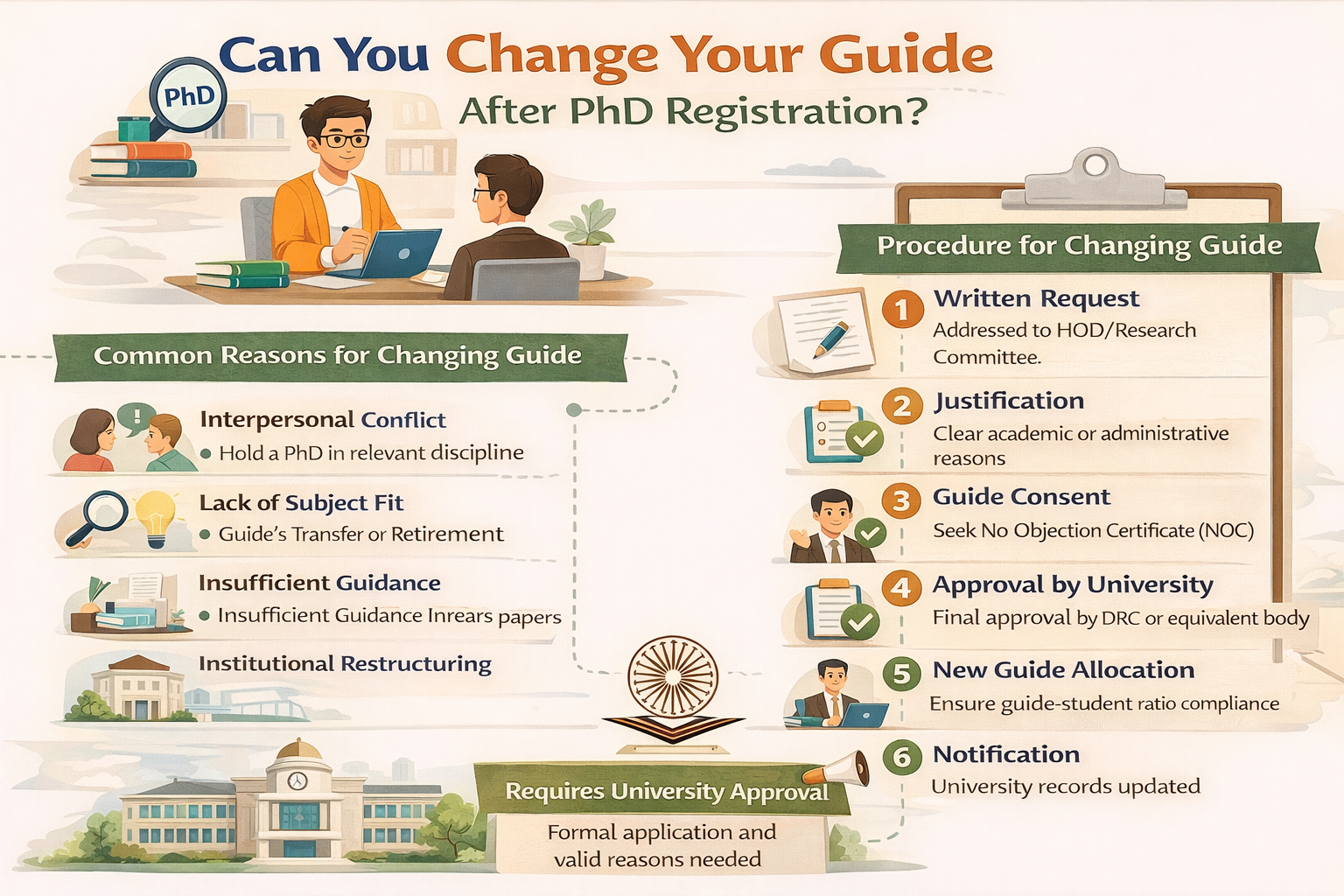
The need to change a guide usually arises from one of the following situations:
- Interpersonal Conflict – Differences in communication styles, expectations, or academic approaches can lead to incompatibility.
- Lack of Subject Fit – A scholar may realise that their research interests do not align with the expertise of the current guide.
- Guide’s Transfer or Retirement – Faculty members may move to another university, take administrative roles, or retire.
- Insufficient Guidance – In some cases, scholars may feel neglected or unsupported in research progress.
- Institutional Restructuring – Departments or research centres may reorganise, making a change in supervision necessary.
UGC Framework on Changing Guides
The UGC’s Minimum Standards and Procedure for Award of PhD Regulations (2022) does not prohibit a scholar from changing guides. However, it empowers individual universities to frame detailed rules. Broadly, the following principles apply:
- A guide change requires formal approval from the university’s Doctoral Research Committee (DRC) or equivalent body.
- The scholar must submit a written request, usually with valid reasons.
- A new supervisor must be available in the same discipline or related area to take responsibility.
- Both the outgoing and incoming guides may need to provide consent, unless the change is unavoidable (retirement, transfer, death, etc.).
University-Level Rules
While UGC sets the framework, procedures vary across institutions. For example:
- Central Universities – Often have structured application formats for guide change, requiring HOD and Dean approval.
- State Universities – May allow guide change only within the first two years of registration.
- Private Universities – Usually adopt flexible policies but require approval from their Research Advisory Committee.
Some universities charge a small administrative fee for re-allocation of supervisors.
When Guide Change Is Permitted
Based on common practices, guide changes are typically allowed under these conditions:
- Retirement or Demise of the Guide – Automatic need for reallocation.
- Transfer or Resignation – If the guide leaves the university, a new guide must be appointed.
- Non-availability – In cases where the guide is on long-term leave or unable to provide guidance.
- Academic Misfit – If the scholar’s research trajectory evolves into a different domain.
- Conflict Resolution – As a last resort, when mediation fails.
Process of Changing a Guide
Although details differ, the general process is as follows:
- Written Request by Scholar – Addressed to the Head of Department or Research Committee.
- Justification – Reasons must be clearly explained, whether academic or administrative.
- Consent from Current Guide – In most cases, a no-objection certificate (NOC) is sought.
- Approval from Authorities – HOD, Dean, and Doctoral Committee approval required.
- Allocation of New Guide – A suitable faculty member is appointed, ensuring UGC guide–student ratio compliance.
- Notification – The Registrar’s office formally updates the scholar’s records.
Implications of Guide Change
Changing a guide is not without consequences. Scholars should carefully weigh the following:
- Research Direction – A new guide may suggest modifications to the research plan.
- Delay in Progress – Administrative processes can consume valuable time.
- Relationship Strain – Requesting a change can create friction within the department.
- Fresh Expectations – The new guide may set higher or different standards.
Thus, scholars must be cautious and ensure that the decision is academically justified rather than personal or emotional.
Role of Co-Guides in Smooth Transition
Sometimes, instead of a complete change, universities allow a co-guide arrangement. This provides continuity from the old guide while introducing a new faculty member for added support. Co-guides are especially useful when the scholar’s research spans multiple disciplines.
Case Studies from Indian Universities
- Delhi University – Allows guide change only with DRC approval, and only if the replacement belongs to the same subject area.
- Osmania University – Permits change of guide due to transfer, retirement, or proven lack of supervision, but not for minor interpersonal conflicts.
- Private Universities (e.g., Amity, Sharda) – Tend to be flexible, prioritising scholar progress, but always ensure compliance with UGC ratio limits.
Challenges Faced by Scholars
Even when rules exist, scholars report difficulties:
- Delay in Approvals – Applications may remain pending for months.
- Reluctance of Authorities – Universities may avoid changes to maintain departmental harmony.
- Finding a Willing Guide – Not all eligible faculty members may agree to take additional scholars.
Practical Advice for Scholars
- Attempt Resolution First – Open communication with the guide can solve many misunderstandings.
- Seek Mediation – Departmental committees often mediate disputes before approving changes.
- Document Everything – Keep written records of correspondence in case of disputes.
- Consult Senior Scholars – Peer experiences can help in navigating the process.
- Avoid Frequent Changes – Universities frown upon repeated supervisor shifts.
Conclusion
Changing a PhD guide after registration is possible but must be approached with caution. While UGC leaves flexibility to universities, the process requires formal approval and valid reasons. It can safeguard a scholar’s research trajectory in cases of genuine academic mismatch or unavoidable circumstances. For PhD scholars in India, the decision should always be weighed in terms of research continuity, academic growth, and long-term career outcomes.