
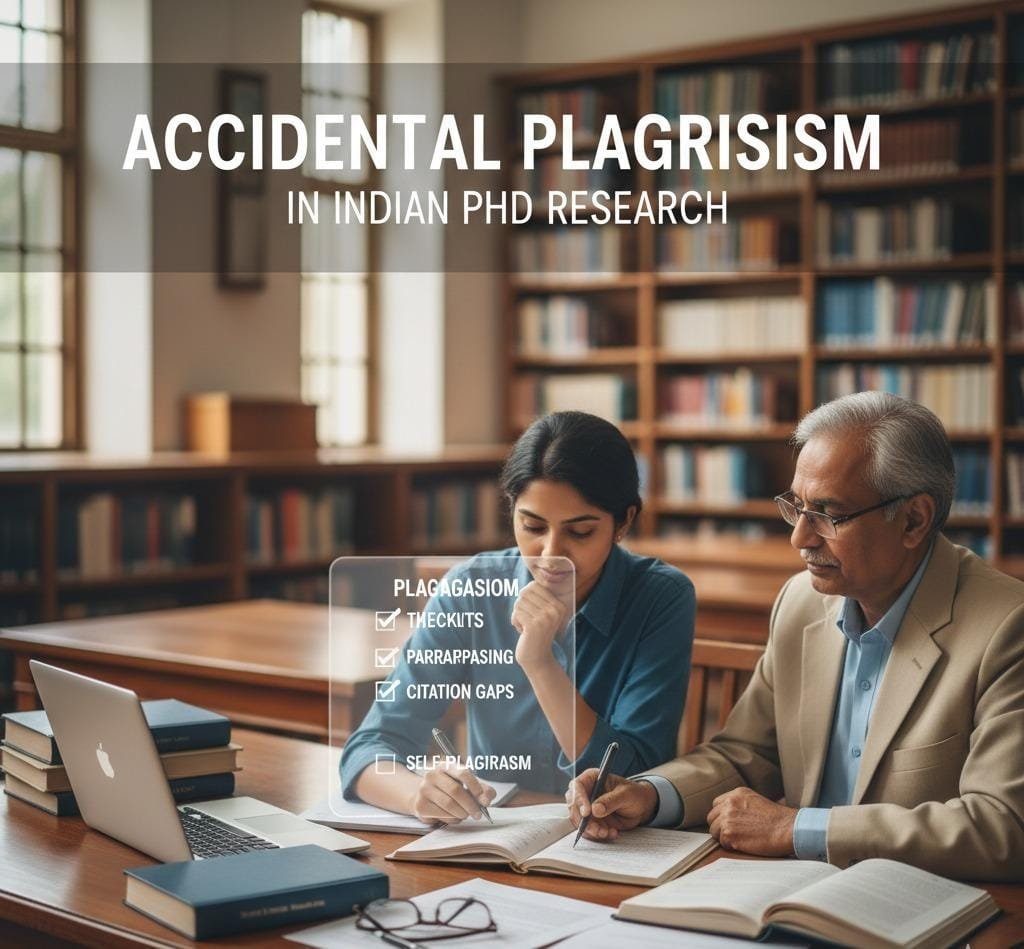
For many Indian PhD students, especially those new to research writing, plagiarism often feels like a deliberate act—copying without credit, using someone else’s words, or submitting a borrowed idea as one’s own. But what most scholars discover at some point in their journey is that plagiarism isn’t always intentional. Accidental plagiarism is one of the most common and misunderstood academic mistakes, and it can have serious consequences even when there is no intent to deceive. Understanding how it happens and how to avoid it is crucial, especially in the Indian academic setting where formal training in citation and academic writing is still evolving.
How Accidental Plagiarism Happens
Accidental plagiarism usually occurs when a researcher uses someone else’s words, data, or ideas without proper citation—often because they didn’t realise it was required or didn’t know how to do it correctly. This includes poorly paraphrased content, missing quotation marks, forgotten citations, or using notes without checking the original source. In a typical Indian PhD programme, especially in private universities, many students come from academic backgrounds where rote learning and repetition were rewarded. Shifting from that to an environment that requires originality and critical referencing is not always straightforward.
For instance, when writing a literature review, it’s easy to copy sentences from multiple sources and then forget which idea came from where. This is particularly common when students collect research materials over time and then merge them into a chapter later. Without a habit of tracking citations as they go, many scholars find themselves unintentionally passing off another author’s argument or phrase as their own.
Accidental plagiarism also happens when students paraphrase too closely to the original text. Simply changing a few words or sentence structure without crediting the source still counts as plagiarism. This is a common issue for students writing in English as a second or third language, where the pressure to “sound academic” often leads them to follow models too closely.
Why Indian Scholars Must Be Especially Cautious
In India, plagiarism has gained significant attention over the last decade, especially after the UGC introduced official regulations for higher education institutions. Most private universities have adopted these rules, and software tools like Turnitin are used to check thesis and dissertation submissions. The problem is that these tools do not distinguish between accidental and intentional plagiarism—both are flagged, and both can affect submission timelines or approval.
For PhD students, especially those in flexible or part-time programmes in private universities, the risk of accidental plagiarism increases due to time constraints and a lack of structured writing support. Many working professionals juggling careers and research don’t receive formal instruction on referencing or citation styles. Others rely heavily on pre-written material, downloaded samples, or previous student work to get started. While these practices might seem practical, they often lead to ethical issues if not carefully managed.
Moreover, cultural differences play a role. In many Indian classrooms, repeating what a teacher or textbook says has traditionally been encouraged. As a result, many researchers equate memorising with understanding. In the academic world, however, crediting sources and demonstrating one’s own interpretation of ideas is the standard. This shift in approach takes time to internalise, and mistakes along the way are common.
Building Better Habits to Prevent It
Avoiding accidental plagiarism isn’t just about using plagiarism-checking software—it requires better writing habits, academic training, and institutional support. One of the simplest but most effective practices is to develop a habit of note-taking with citation. Every time a student notes down an idea, they should also record the source, whether it’s a journal article, a blog post, or a conference paper. This habit helps ensure that sources aren’t lost during the drafting stage.
Students should also be taught to paraphrase correctly—not just by swapping words, but by genuinely rewriting ideas in their own voice while crediting the source. In Indian private universities, where thesis submission timelines are often tight, rushing through this process increases the risk of errors. Structured workshops, writing labs, or even peer-review groups can make a difference by reinforcing academic writing as a process rather than a product.
Supervisors also have a crucial role to play. Instead of assuming that students know how to cite or paraphrase, they can provide early-stage guidance, check drafts regularly, and discuss the similarity report in detail—not just as a formality, but as a learning tool. Some institutions are now encouraging students to run their drafts through Turnitin before formal submission, giving them a chance to identify and fix issues on their own.
For scholars who have already published, it’s also important to remember that self-plagiarism—reusing your own previously published work without citation—is treated similarly. Reusing paragraphs or research findings from earlier papers must also follow the same ethical standards.
Conclusion
Accidental plagiarism is not a sign of dishonesty—it is often a result of unclear academic expectations, limited training, or simple oversight. But its consequences are real, especially for Indian PhD students navigating complex submission requirements and evolving standards of research ethics. The key is to approach academic writing as a skill to be learned, not just a task to be completed. With proper habits, clear guidance, and institutional support, scholars can avoid accidental mistakes and build a foundation of research that is both credible and respected. In a scholarly journey, integrity is not just about following rules—it is about writing with awareness and responsibility.