
Introduction
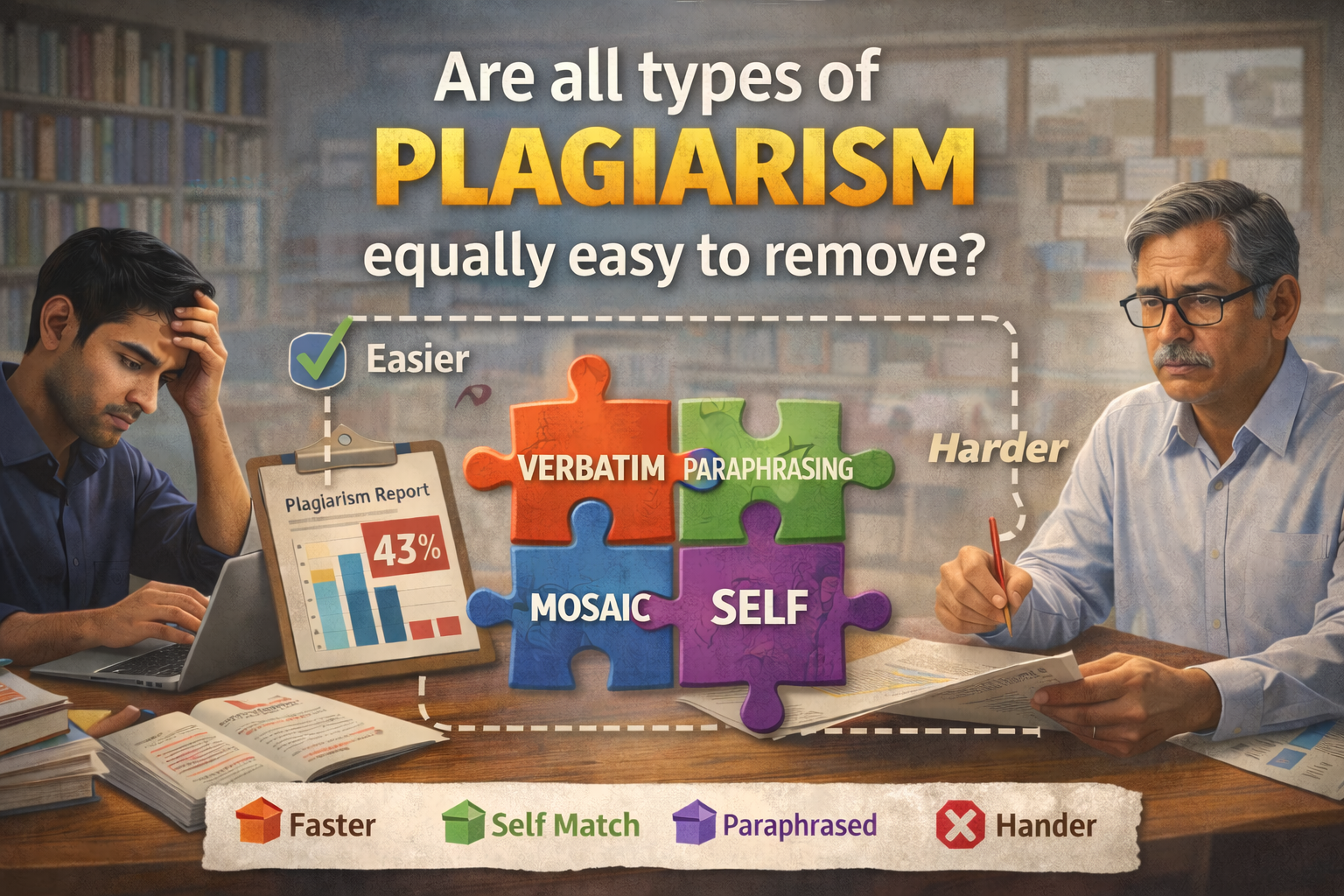
Plagiarism in academic writing is not a one-size-fits-all issue. Different forms of plagiarism arise from different causes—some intentional, others accidental. While the common goal is to reduce the similarity score and maintain academic integrity, the ease of removing plagiarism largely depends on its type. For Indian researchers working under strict submission norms, understanding these differences is essential for effective revision and compliance.
Understanding the Types of Plagiarism
Before discussing the difficulty of removal, it’s important to recognize the different forms plagiarism can take:
- Verbatim Plagiarism: Copying text word-for-word without citation
- Paraphrasing Plagiarism: Rewriting someone’s idea in your own words but without credit
- Self-Plagiarism: Reusing your previous work in a new submission without disclosure
- Mosaic Plagiarism: Blending copied phrases with original content
- Incorrect Citation: Mentioning sources inaccurately or incompletely
- Source-Based Plagiarism: Using non-existent or unrelated sources
Each type brings its own challenges during the removal process.
What’s Easy to Fix
Some plagiarism issues can be addressed relatively quickly with careful attention:
- Incorrect Citation: These are usually straightforward to correct once you identify missing or incomplete references. Properly formatted citations can drastically reduce similarity.
- Paraphrasing Plagiarism (Minor): If the original content is well-understood, it can be rephrased in your academic tone with accurate citation. This type is manageable with moderate effort.
- Self-Plagiarism (Small Sections): When limited to definitions or standard methodology, this can be resolved by rewording and adding a clear reference to your earlier work.
What’s Difficult to Remove
Some types of plagiarism require more than just editing:
- Verbatim Plagiarism (Extensive): If large sections are directly copied from sources, especially without quotation marks or citations, removal involves complete rephrasing and reorganization. It’s time-consuming and may require deep subject knowledge.
- Mosaic Plagiarism: This mixed style makes it hard to isolate borrowed ideas from original ones. Editors often need to rewrite entire paragraphs to preserve coherence while removing overlaps.
- Self-Plagiarism Across Chapters: If you’ve reused whole sections from a prior thesis or conference paper, it’s not enough to tweak a few sentences. Institutions may require an official declaration or even permissions.
- Plagiarism in Conceptual Frameworks: If borrowed ideas are embedded in your theoretical framework without acknowledgement, resolving this goes beyond wording—it requires you to reassess your foundation and include proper academic attribution.
Why Some Cases Need Expert Help
When the similarity is due to overlapping ideas rather than just text, researchers often struggle to revise without distorting the meaning. In such cases, subject-matter experts or academic editors can help rewrite content while keeping the research intent intact.
Also, institutions may reject papers even after similarity is lowered if the changes affect clarity or misrepresent the original meaning. This makes professional intervention especially valuable.
Academic Implications in the Indian Context
Indian universities and research bodies are increasingly strict about similarity thresholds, often capping it at 10–15% for PhD theses and 5–10% for journal articles. Certain sections like the literature review or methodology are naturally prone to higher similarity. But the type of plagiarism—especially in core content like analysis or findings—can influence how your work is assessed.
Therefore, understanding not just how much plagiarism exists, but what kind, helps in planning appropriate corrective action.
Conclusion
Not all types of plagiarism are equally easy to remove. Some require minor corrections, while others demand deeper revision or structural changes. Indian scholars navigating academic submissions must evaluate the type of overlap before choosing how to respond. Whether through careful self-editing or guided assistance, the key lies in preserving originality and adhering to ethical research standards.