
Introduction
Examinations are a crucial part of any academic program because they validate learning, provide credibility to a degree, and reassure employers and institutions about the competence of a student. For distance education in India, the mode of examinations has been a subject of constant curiosity and sometimes confusion. With digital tools changing how education is delivered, many distance learners wonder if they can take exams online from home or if they still need to appear at designated centres. The reality is that exam practices in Indian distance education are evolving, balancing regulatory guidelines, technology, and the need for credibility.
The Regulatory Context
The University Grants Commission (UGC) and its Distance Education Bureau (DEB) play the primary role in setting rules for examinations in distance programs. For many years, the emphasis was on physical exams at centres, as these were seen as the most reliable way to maintain academic integrity. However, with the growing acceptance of online and open distance learning (ODL), policies have started to evolve.
Today, UGC guidelines permit both offline and online assessment modes, provided institutions maintain proper verification, proctoring, and record-keeping systems. Universities are expected to ensure that the credibility of the degree is not compromised regardless of exam mode. This flexibility allows institutions to adopt practices that suit their student base and technological capacity.
Offline Exams: The Traditional Model
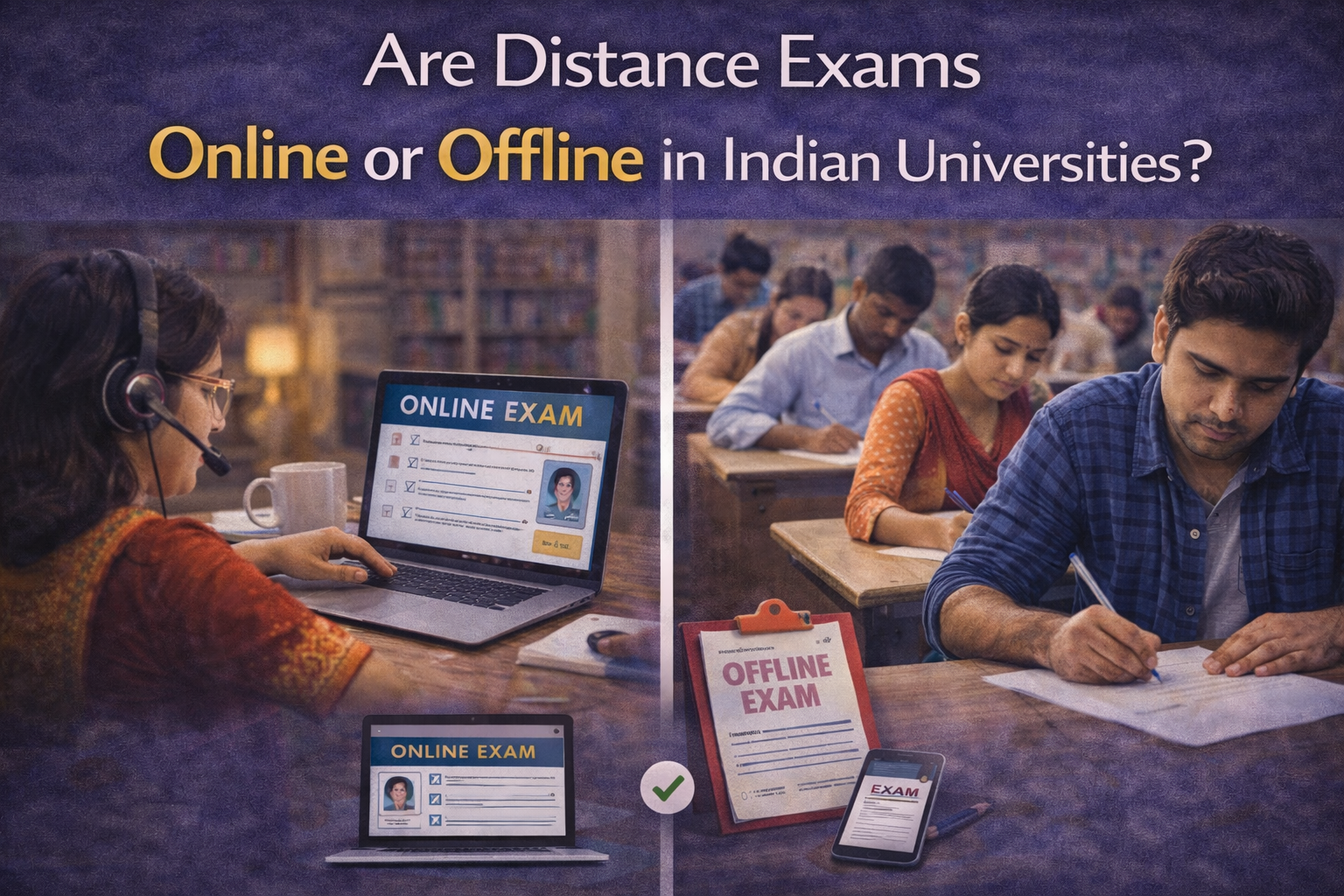
For a long time, offline exams were the only accepted format. Students enrolled in distance programs had to visit designated centres, usually located in major cities or regional hubs, to write their papers in a supervised environment. This ensured uniformity, minimized malpractice, and aligned with conventional academic expectations.
Even today, many universities continue to rely heavily on offline exams, particularly for postgraduate programs. This is because offline exams are often seen as more credible by employers and regulators. For students, however, they involve travel, accommodation, and sometimes taking leave from work, which can be stressful.
The Rise of Online Exams
In recent years, especially after the COVID-19 pandemic, online exams have become increasingly common in distance education. Many private universities and even some state institutions have adopted online proctored systems, where students can log in from their homes, show identification, and complete their exams under virtual supervision.
These exams often include AI-enabled monitoring tools, live video invigilation, and strict rules against malpractice. For objective subjects, universities use multiple-choice questions that can be auto-graded, while for theoretical papers, students may type or upload written responses. This approach reduces the need for physical travel and makes the system more inclusive for students in remote areas.
Hybrid Models in Practice
Interestingly, a growing number of universities now follow hybrid models. This means some parts of assessment are conducted online—such as internal assignments, quizzes, or mid-term tests—while final semester exams remain offline. This hybrid approach offers the best of both worlds: flexibility for routine evaluation and credibility for final certification.
For example, a student in a distance MBA program might complete case-study assignments and presentations online, but attend a designated centre for the end-term examination. This system ensures both accessibility and trustworthiness.
The Role of Technology in Maintaining Integrity
One major concern about online exams is academic dishonesty. Universities counter this with advanced tools like plagiarism checkers, online proctoring software, and real-time monitoring. Biometric verification, camera-enabled monitoring, and keystroke tracking are increasingly used to ensure that the person writing the exam is the enrolled student.
While such systems may feel intrusive to some, they have become necessary for balancing convenience with integrity. In fact, many employers now recognize online exams as credible because of these technological safeguards.
Student Experiences and Preferences
From the learner’s perspective, online exams provide convenience, reduce travel costs, and save time. For working professionals and students living in rural areas, this option is often the only practical way to complete assessments. However, not all students are comfortable with digital exams. Poor internet connectivity, lack of devices, or unfamiliarity with technology can create challenges.
On the other hand, offline exams give students a sense of formality and fairness, as everyone sits under the same conditions. Some students even prefer them because they mirror the traditional environment they are used to. Ultimately, preferences vary widely, and institutions must strike a balance.
The Employer and Institutional View
Employers in India generally accept degrees from both offline and online exam systems as long as the program is approved by UGC-DEB. What matters most is institutional recognition rather than the mode of exams. However, some traditional recruiters still perceive offline exams as more rigorous. Over time, as online systems become more common and secure, this distinction is expected to disappear.
For institutions, offering both formats increases inclusivity and helps attract a wider student base. Many private universities have realized that flexibility in exams is a strong selling point for their distance programs.
Conclusion
The question of whether distance exams in Indian universities are online or offline does not have a single answer—it depends on the institution, the program, and regulatory approvals. While offline exams remain the traditional choice for credibility, online and hybrid systems are rapidly gaining ground thanks to technological innovations and student demand.
For distance learners, the key is to verify the exam format before enrolling in a program and ensure it aligns with their personal and professional circumstances. What is clear, however, is that both online and offline exams now coexist in India’s distance education landscape, reflecting a shift toward inclusivity and flexibility without compromising academic standards.