
Introduction
In India, scholarships are more than just financial aid—they are instruments of social mobility, academic encouragement, and recognition of merit. For decades, they have helped students from disadvantaged backgrounds or those with strong academic potential to pursue higher education without financial strain. However, when it comes to distance education, students often wonder: Are we eligible for scholarships too? The question is not only practical but also symbolic, because it reflects how distance education is perceived within the larger academic ecosystem. With growing enrollments in open and distance learning (ODL) programs, this question has gained new relevance in 2025.
This blog explores the eligibility of distance learners for scholarships, examines policies by government and private institutions, and discusses how financial support can impact the future of distance education in India.
The Policy Framework: What UGC and Government Say
The University Grants Commission (UGC) and its Distance Education Bureau (DEB) are the main authorities regulating distance education in India. Both bodies have made it clear that degrees earned through recognised ODL programs are equivalent to regular degrees for employment and higher education purposes. By extension, this recognition allows distance students to apply for scholarships wherever eligibility criteria are based on academic qualification rather than mode of study.
However, not all scholarships automatically extend to distance learners. For example, central and state governments often frame specific schemes for regular students in universities and colleges that include hostel facilities, lab components, or attendance requirements. These do not naturally apply to distance learners. On the other hand, schemes focused on categories such as Scheduled Castes (SC), Scheduled Tribes (ST), Other Backward Classes (OBC), Economically Weaker Sections (EWS), or persons with disabilities generally remain open to distance learners as long as their course and institution are UGC-DEB approved.
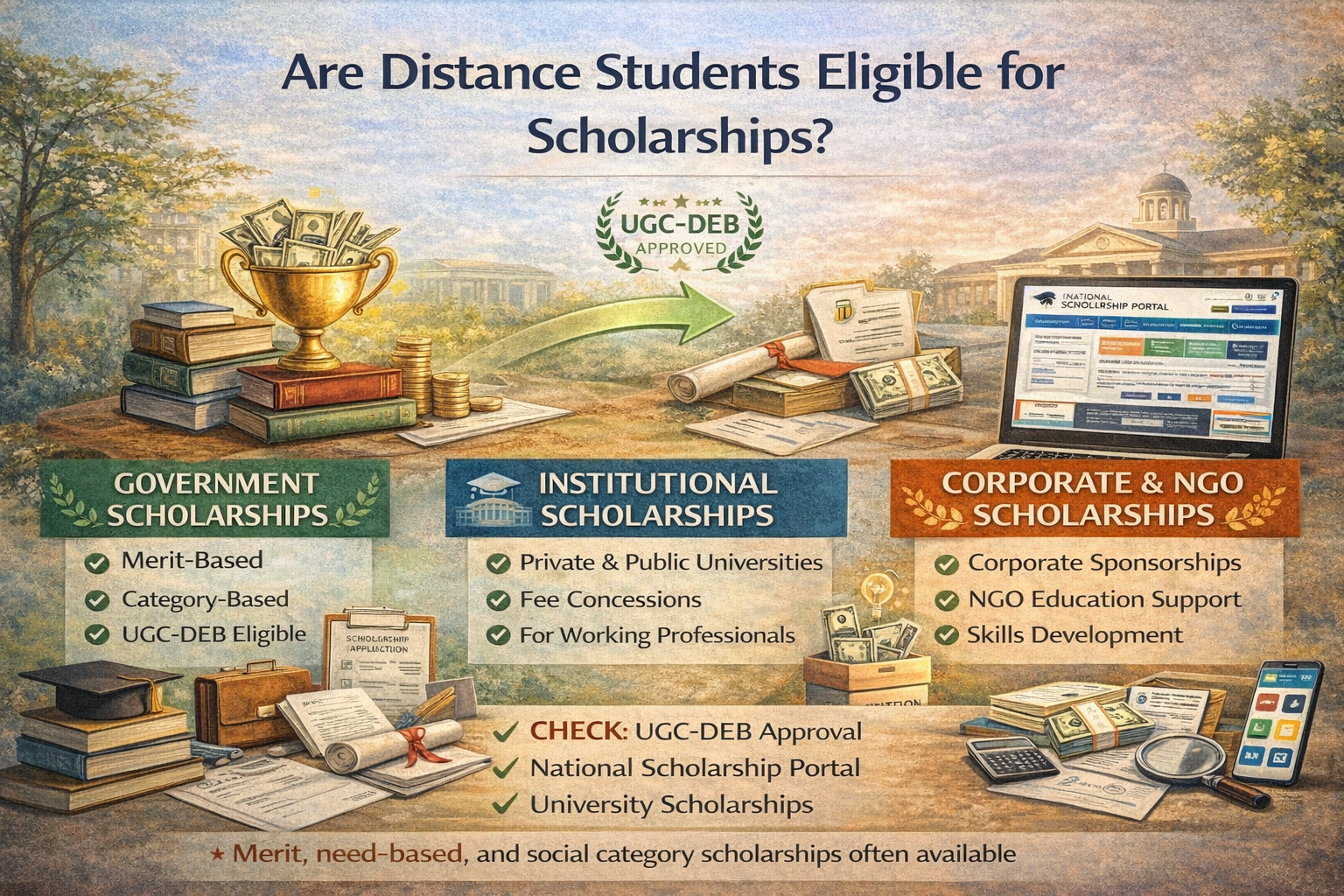
Types of Scholarships Available to Distance Learners
- Government Scholarships:
Several central and state government scholarships accept applications from distance learners. These include schemes based on merit-cum-means, minority status, or social category. For example, the National Scholarship Portal (NSP) lists schemes where eligibility is tied to income and academic performance, not the mode of education. - Institutional Scholarships:
Some universities offering distance programs—particularly private universities—have their own scholarship policies. These are often aimed at attracting working professionals, women returning to education, or students from rural areas. Discounts in tuition fees or instalment-based payment options function as indirect scholarships in many cases. - Corporate and NGO-Based Support:
Increasingly, companies and non-governmental organizations sponsor education for employees or community members. Many such initiatives explicitly include distance programs because they align with professional development without disrupting employment.
Why Scholarships Matter for Distance Learners
Distance learners often come from backgrounds where affordability is a key concern. Many are working professionals trying to upgrade qualifications, but others are homemakers, rural students, or those unable to attend regular classes due to personal responsibilities. Scholarships can make higher education accessible to them without imposing financial burdens.
Moreover, scholarships act as recognition. When a distance learner receives the same financial aid as a regular student, it sends a strong signal of equality between the two modes. This symbolic value can help reduce stigma and reinforce the credibility of distance education.
Challenges and Grey Areas
Despite policy recognition, practical challenges remain. Some government offices or institutions still hesitate to process scholarship applications from distance learners, citing doubts about eligibility. Students often face confusion due to lack of clear communication or outdated information on official websites.
Another challenge is competition. Many scholarships have limited seats and are distributed on the basis of merit. Distance learners, who may already be balancing jobs and family responsibilities, sometimes find themselves at a disadvantage in comparison to full-time regular students who can dedicate more time to academics.
There is also the issue of awareness. Distance learners are less likely to be on campus where scholarship notices are regularly circulated. As a result, they may miss deadlines or remain unaware of schemes that they are entitled to apply for.
The Role of Private Universities and EdTech Platforms
Private universities have been proactive in creating financial assistance programs tailored to distance learners. Many offer fee waivers for women, differently-abled students, or professionals from underprivileged regions. EdTech platforms collaborating with universities also provide scholarships in the form of discounts, referral bonuses, or need-based assistance.
This dual support—government-backed schemes and private initiatives—broadens the financial landscape for distance learners. It reflects a growing recognition that distance education is not a “second-class” option but an important part of India’s higher education system.
Global Perspective
Internationally, scholarships for online and distance learners are common. Universities in the United States, the UK, and Australia often have dedicated funds for students pursuing online degrees. This trend underscores the idea that financial aid should be based on merit and need, not mode of study. India’s gradual shift toward similar practices shows its integration into global educational norms.
What Students Should Do
For students, the key is proactive engagement. Checking the UGC-DEB approval status of the program, exploring the National Scholarship Portal, and contacting the university’s distance education office are important steps. Students should also look beyond government schemes and explore corporate or NGO-sponsored programs. Maintaining strong academic performance and timely documentation improves the chances of success in securing scholarships.
Conclusion
The eligibility of distance students for scholarships is not a closed door—it is an evolving space with expanding opportunities. While some schemes remain tied to regular education structures, many government, institutional, and private initiatives are increasingly including distance learners. The recognition of distance education as equal to regular education by UGC-DEB has paved the way for financial support, though practical challenges like awareness and clarity still exist.
For students, the message is clear: scholarships are within reach if pursued with diligence and awareness. For policymakers and universities, extending scholarships to distance learners is not just financial assistance—it is a statement of inclusion, equality, and trust in the future of India’s diverse higher education ecosystem.