
Introduction
Indian PhD scholars, especially those enrolled in private universities, often seek efficient ways to manage plagiarism during thesis writing. With the growing demands of doctoral admission in India, and the increasing volume of academic material to review, the idea of using browser extensions for plagiarism removal assistance has gained popularity. These tools promise to streamline the rewriting process, improve citation practices, and reduce similarity scores quickly. However, understanding their practical benefits and limitations is important before relying on them heavily.
In the busy lives of many Indian doctoral candidates, balancing research, family, and sometimes full-time work, browser extensions offer an appealing option. They integrate with web browsers to provide on-the-spot checks and rewriting suggestions, which can be useful in the early stages of drafting. Yet, their effectiveness depends on how they are used and whether scholars approach them as aids rather than shortcuts.
How Browser Extensions Support Plagiarism Removal
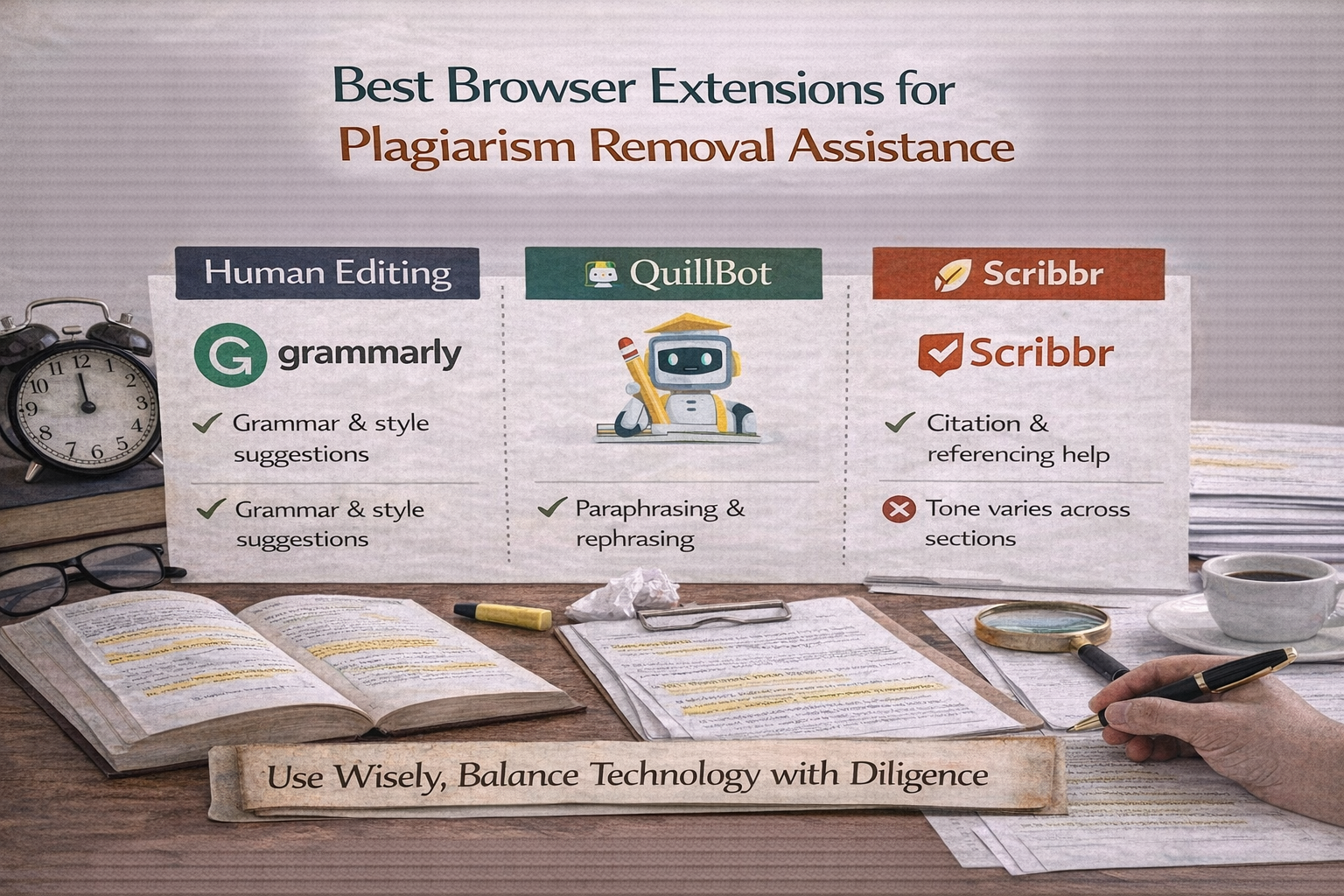
Browser extensions designed for plagiarism detection or rewriting work by scanning text against various online sources. Some popular extensions like Grammarly, QuillBot, and Scribbr provide instant feedback while users write or edit, helping catch unintentional similarities or awkward phrasing. For instance, a PhD scholar working on an interdisciplinary topic may use QuillBot’s paraphrasing feature to rephrase literature review sections, while Grammarly highlights grammar and style issues that could obscure originality.
These extensions also help maintain consistent citations by reminding writers to credit sources properly. For students in private universities, where thesis guidelines often emphasize proper referencing as a way to avoid plagiarism, this can be especially helpful. In addition, some extensions integrate with reference managers or offer suggestions for improving academic style, thus indirectly contributing to clearer and more original writing.
However, the depth of scanning varies significantly between extensions. Many browser tools rely on open web sources and do not access subscription journals or institutional repositories. This means that while they can identify obvious copied content, more subtle matches in academic databases might go undetected until university-level checks. For Indian PhD candidates, this is a critical limitation because institutional plagiarism software usually covers a wider range of academic publications and theses.
Balancing Tool Use with Academic Rigor
Browser extensions can be valuable assistants, but overreliance on them risks undermining the thoroughness required in doctoral research. Automated suggestions may not always fit the academic context, especially in fields requiring precise terminology or culturally nuanced language. For example, a term commonly used in Indian social sciences might be incorrectly flagged or rephrased in a way that loses its original meaning.
Additionally, using these tools without critically engaging with the content can lead to surface-level rewriting that fails to address deeper issues of plagiarism. Indian doctoral scholars, particularly those returning to study mid-career, often benefit from a deliberate process of understanding and re-expressing ideas rather than quick fixes. Browser extensions should therefore be seen as supplementary, supporting the writer’s effort rather than replacing it.
Finally, privacy and data security are concerns. When working on unpublished thesis material, scholars must ensure that browser extensions comply with data protection norms. Uploading sensitive research data to third-party servers may violate institutional policies or jeopardize intellectual property. Using institutionally recommended tools or offline software remains a safer choice when confidentiality is paramount.
Conclusion
Browser extensions for plagiarism removal assistance can be useful tools for Indian PhD students navigating the complexities of thesis writing, especially in private university settings where timelines and academic expectations intersect uniquely. When used wisely, they support clearer writing, improved citation, and early detection of copied content. Yet, their limitations mean they should complement—not replace—careful manual rewriting and institutional plagiarism checks. The most effective approach balances technology with scholarly diligence, ensuring that every word reflects both academic rigor and the researcher’s own voice.