
Introduction
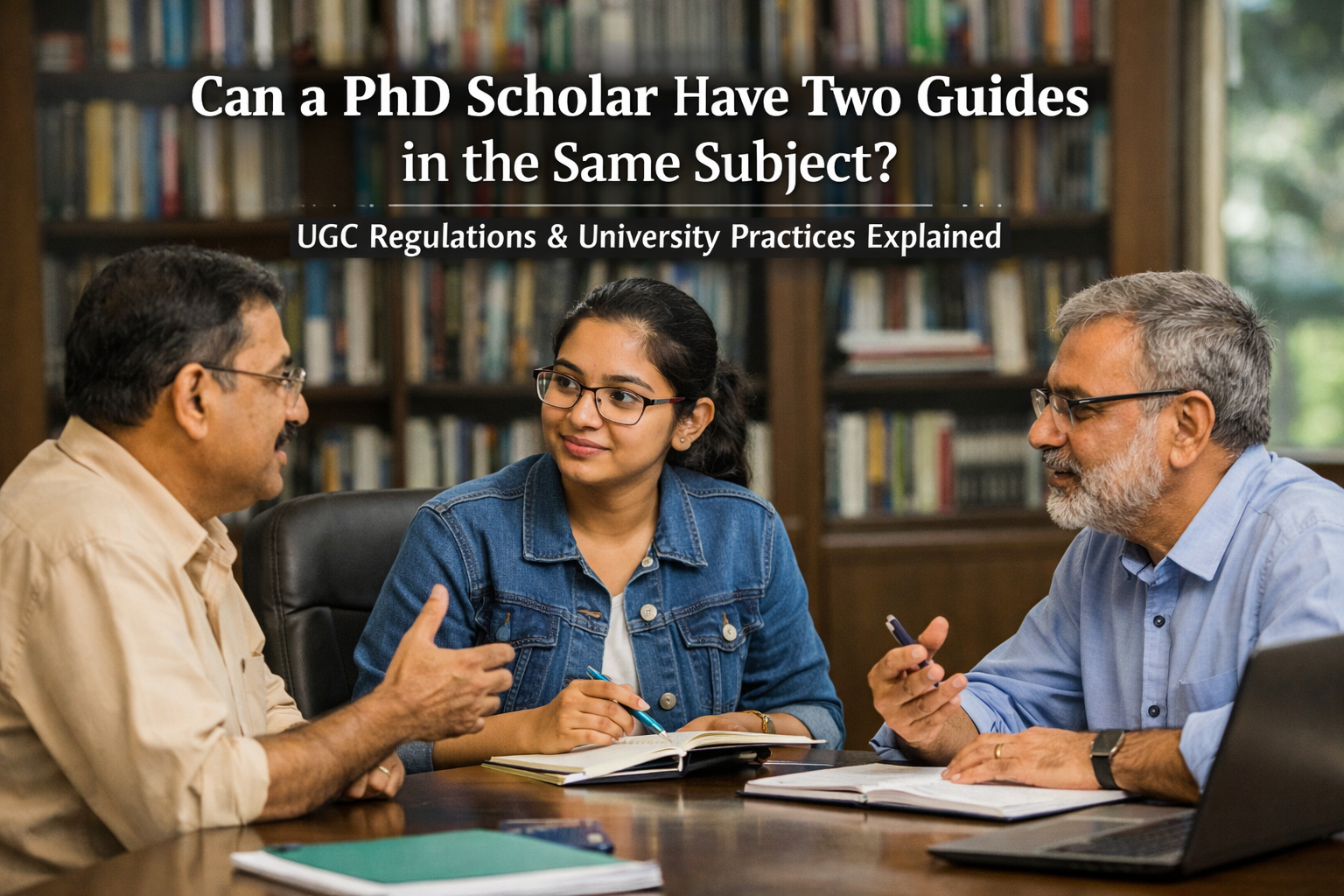
Doctoral research is a complex journey that requires guidance, mentorship, and continuous academic support. In India, the University Grants Commission (UGC) has laid down regulations to streamline the supervision process and ensure quality in doctoral education. One question that often arises among research aspirants is whether a scholar can have two guides in the same subject. While the concept of joint supervision is accepted in interdisciplinary or collaborative research, the scenario becomes less straightforward when both guides belong to the same discipline. This blog explores the UGC rules, university practices, and the practical implications of having dual supervision in a single subject domain.
UGC Regulations on Research Supervision
According to the UGC (Minimum Standards and Procedures for Award of PhD Degree) Regulations, 2022, every scholar must be assigned a supervisor (guide) from the beginning of their research journey. These supervisors are typically recognised faculty members with the minimum eligibility of holding a PhD degree and meeting specific research publication and teaching experience requirements.
The regulations allow for the appointment of co-supervisors (co-guides) particularly in cases involving interdisciplinary or multidisciplinary research. However, the language of the regulation primarily supports co-supervision when the scholar’s topic requires inputs beyond the expertise of a single supervisor. When it comes to having two supervisors within the same subject area, the rules are less explicit and tend to be left to the discretion of universities.
Institutional Autonomy in Appointing Supervisors
While UGC provides overarching regulations, universities enjoy autonomy in defining specific guidelines for PhD supervision. Some institutions allow two guides even in the same subject, provided there is a valid academic justification. For example, if a scholar’s research spans two specialisations within a discipline—such as molecular biology and computational biology in the life sciences—it may be beneficial to appoint two subject experts.
Other universities, however, may consider such arrangements unnecessary duplication. Their argument is that a single primary supervisor, with or without a co-guide from another field, suffices for effective mentoring. Thus, the answer to whether two supervisors from the same subject are allowed depends significantly on the policies of the affiliating university or research institution.
Academic Rationale for Dual Guidance in One Subject
There are genuine academic scenarios where having two guides from the same discipline can be advantageous.
- Subfield Expertise
A subject such as computer science has multiple specialisations—artificial intelligence, networks, VLSI, and cybersecurity. A scholar working on a research problem that spans two subfields may benefit from guidance from two supervisors within the same discipline but with complementary expertise. - Collaborative Research Projects
In projects funded by government bodies like the DST, ICSSR, or DBT, more than one faculty member may already be engaged. Appointing both as co-supervisors in the same subject ensures accountability and integration between project goals and doctoral work. - Division of Responsibility
Supervising a PhD is an intensive responsibility that includes designing methodology, reviewing literature, and overseeing thesis writing. Dual guidance in the same subject can share this workload and enhance quality feedback for the scholar.
Practical Challenges in Having Two Guides in One Subject
Despite potential benefits, dual supervision in the same subject area can also create challenges:
- Conflicting Guidance: Two supervisors from the same discipline may differ in methodology, research focus, or expectations, leading to confusion for the scholar.
- Administrative Complications: Universities must clarify who takes primary responsibility for progress reports, thesis submission, and viva voce arrangements.
- Dilution of Accountability: If both guides share equal responsibility, identifying accountability in case of delays or quality concerns becomes complex.
University Case Examples
- Central Universities: Many central universities restrict the number of guides to one per scholar within the same subject, permitting co-guides only when the second faculty is from another discipline.
- State Universities: Some state universities are flexible, especially in applied sciences and engineering, where projects often demand multiple subject experts.
- Private Universities: With greater academic freedom, private institutions sometimes allow two supervisors from the same subject, especially for industry-linked or collaborative projects.
Student Perspective: Does It Help?
From a scholar’s point of view, dual guidance can be a double-edged sword. On one hand, it provides access to diverse expertise, broader feedback, and potential networking opportunities. On the other hand, scholars may feel pulled in two directions if the supervisors’ academic philosophies differ.
Careful consideration must therefore be given before requesting two guides in the same subject. The decision should be based on genuine academic need rather than personal preference.
International Practices for Context
Globally, many universities in the US, UK, and Europe permit multiple supervisors, including within the same subject. The rationale is that modern research often overlaps multiple subfields even within a single discipline. For instance, an economics scholar may have one supervisor in microeconomics and another in econometrics, both formally recognised as guides.
India, while adopting international practices selectively, continues to place greater emphasis on single-supervisor models, with co-guides primarily in interdisciplinary areas.
Recommendations for Scholars
- Check University Rules: Always review your university’s PhD ordinance to confirm whether dual supervision in one subject is permitted.
- Justify Academically: If requesting two guides in the same subject, provide a strong justification linking their expertise to distinct components of your research.
- Seek Clarity: Ensure roles and responsibilities are clearly divided to avoid overlaps and conflicts.
- Document Approval: Obtain written approval from the Research Advisory Committee (RAC) or Doctoral Committee to formalise the arrangement.
Conclusion
The question of whether a PhD scholar can have two guides in the same subject has no single answer in India—it depends largely on the institutional regulations and academic context. While the UGC allows flexibility under its broad guidelines, universities interpret these provisions differently. For some, a single supervisor is sufficient, while others recognise the value of dual subject-specific guidance. Scholars considering such an arrangement should focus on academic necessity, institutional approval, and clarity in supervisory roles. Ultimately, the aim of supervision is not the number of guides, but the quality of mentorship and the scholarly output it enables.