
Introduction
AI is changing how we live, work, and even study. In Indian academic circles, especially among PhD scholars in private universities, tools like ChatGPT, Grammarly, and AI-based summarizers are becoming more common. Many scholars — particularly those managing teaching jobs, family duties, or gaps in English fluency — have begun using these platforms to speed up their research process.
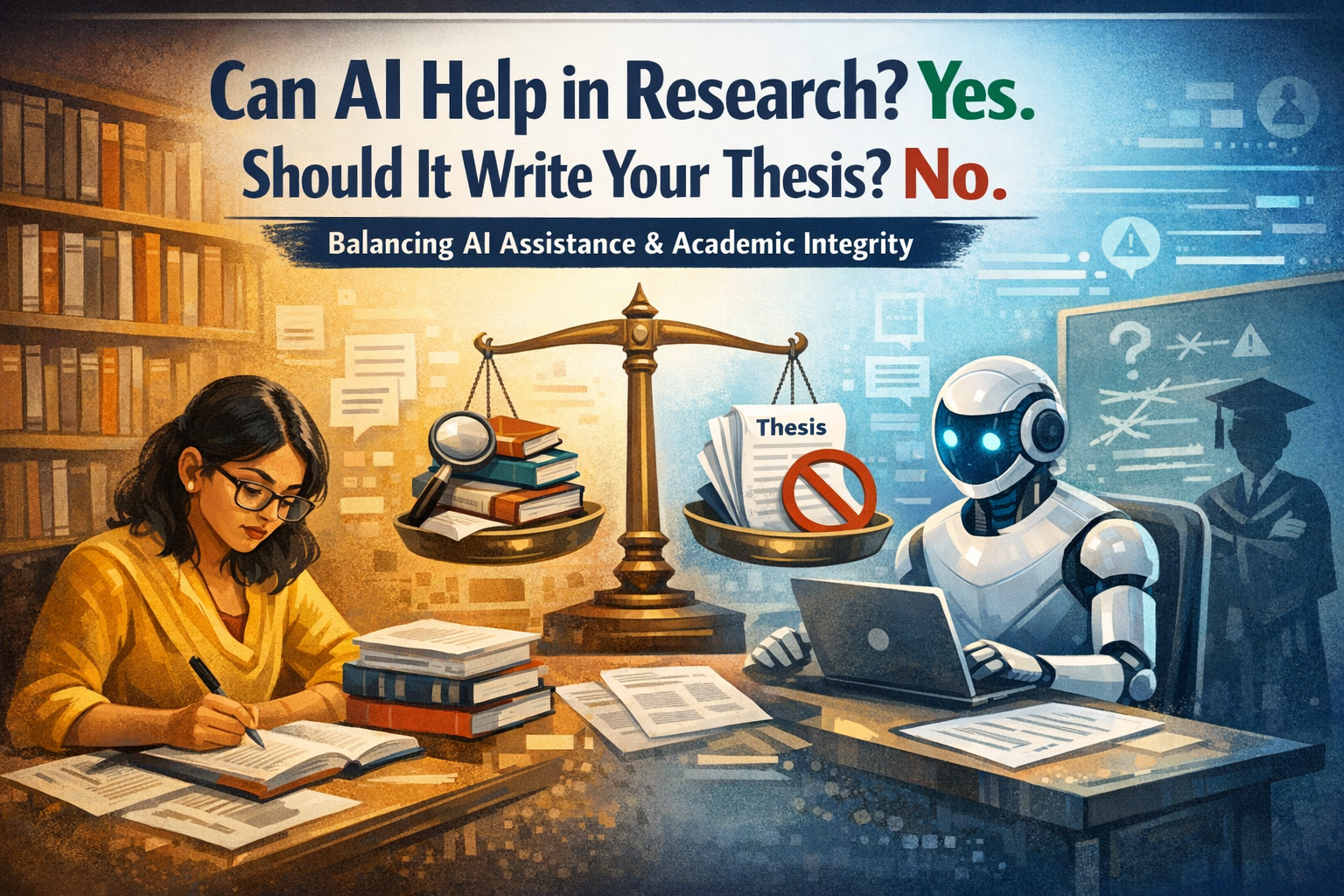
But there’s a clear line that many don’t see at first. AI can certainly assist in research — by offering quick language support, helping refine sentence structure, or summarising dense texts. However, when it comes to actually writing your thesis, the answer is different. A thesis is your intellectual contribution, not just a document to complete. Letting AI write large parts of it doesn’t just cross academic boundaries — it weakens your own voice and understanding. For Indian PhD students trying to balance support and self-reliance, recognising this boundary is key.
Where AI Can Support – Small Tasks That Still Matter
AI has its place in the research journey — especially for Indian scholars who may not always have access to institutional support. For example, grammar tools can be a huge relief for scholars writing in English as a second or third language. When used carefully, they can help you polish your expression without changing your argument.
Similarly, summarising tools can help break down long journal articles into digestible parts — useful for literature review preparation. Some scholars also use AI to generate potential research questions or explore theoretical keywords. These small forms of help, when used thoughtfully, can reduce stress without interfering with your academic integrity.
One PhD scholar from a private university in Hyderabad shared how she uses ChatGPT to explain complex economic terms she reads in international papers. It doesn’t replace her own analysis, but it gives her clarity and helps her keep pace with her coursework. This kind of usage stays within the ethical boundaries of academic assistance — it supports understanding without replacing critical thinking.
What AI Should Not Do – And Why It Undermines Your Thesis
Despite its usefulness, AI is not your co-author. It does not think, reflect, or argue — it only predicts what words should come next based on patterns in existing data. So when you ask it to “write” a paragraph, it gives you something that sounds right but may not be conceptually accurate or contextually grounded.
This is dangerous in a thesis. Research isn’t just about clean language — it’s about interpretation, logic, and scholarly voice. When AI writes your chapter, it doesn’t know your topic in depth. It can’t understand local context, can’t cite your data, and certainly can’t defend your work in a viva. At best, it produces generic content. At worst, it introduces false information, fake citations, and shallow arguments that collapse under review.
An engineering scholar from a Delhi-based university used AI to help write his methodology section. Though it looked impressive, his supervisor flagged inconsistencies in the approach and found two references that didn’t exist. The scholar later admitted that he didn’t understand what the AI had written. This led to delays, mistrust, and complete rewriting of the section — by the scholar himself, this time.
Indian universities are beginning to notice these shifts. Some guides now ask students to explain chapter drafts verbally. Others compare writing styles across submissions. And while plagiarism software may not always catch AI content, experienced supervisors can often tell when a scholar is not truly engaging with their own work.
Thesis Writing Is a Learning Process — Not a Task to Outsource
A thesis is more than a requirement — it is a training ground. It’s where you learn to analyse, structure arguments, connect theory and data, and write with precision. None of this can be automated. AI tools might offer surface-level fluency, but they can’t give you depth.
In the Indian research ecosystem, where support is often inconsistent, this temptation to “just get it done” with AI is understandable. But scholars must ask themselves: what am I here to learn? If you avoid the hard parts — like struggling through your literature review, forming your hypothesis, or interpreting your own results — you don’t just risk academic trouble. You miss the opportunity to grow.
A part-time scholar from a B.Ed. programme in West Bengal shared how she initially considered using AI to draft her discussion chapter. But after a colleague reminded her that she would face a viva, she chose to write it herself — slowly, with feedback from a consultant. When the time came, she was able to explain her analysis with confidence, something she says wouldn’t have been possible had she used AI to write it.
AI + Scholar = Ethical Collaboration, Not Substitution
The best way to approach AI in academia is to treat it as a support system — not a substitute. You can let it help you clean up a draft, brainstorm early ideas, or check spelling. But the thinking, the arguing, and the writing? That still needs to come from you.
Ethical use means being clear about where AI was used and why. If you use it to improve a sentence, that’s different from using it to generate a full paragraph. Scholars should remain involved — reviewing, editing, and most importantly, understanding every section they submit.
PhD consultants across India are also beginning to encourage this balanced model: using AI to handle language friction, while helping students take ownership of their ideas. This is a sustainable approach — one that supports real learning without compromising academic honesty.
Conclusion
Technology will keep evolving, and AI will become more powerful. But in research, the value still lies in human insight — in the scholar’s ability to read, reflect, question, and create meaning. AI can assist in small ways, but it cannot walk the academic path for you.
Indian PhD students, especially those navigating private university systems, face enough challenges already. Using AI responsibly can make the journey smoother — but using it blindly to write your thesis will only lead to confusion, mistrust, and missed learning. In research, shortcuts rarely take you forward. Thoughtful work does.