
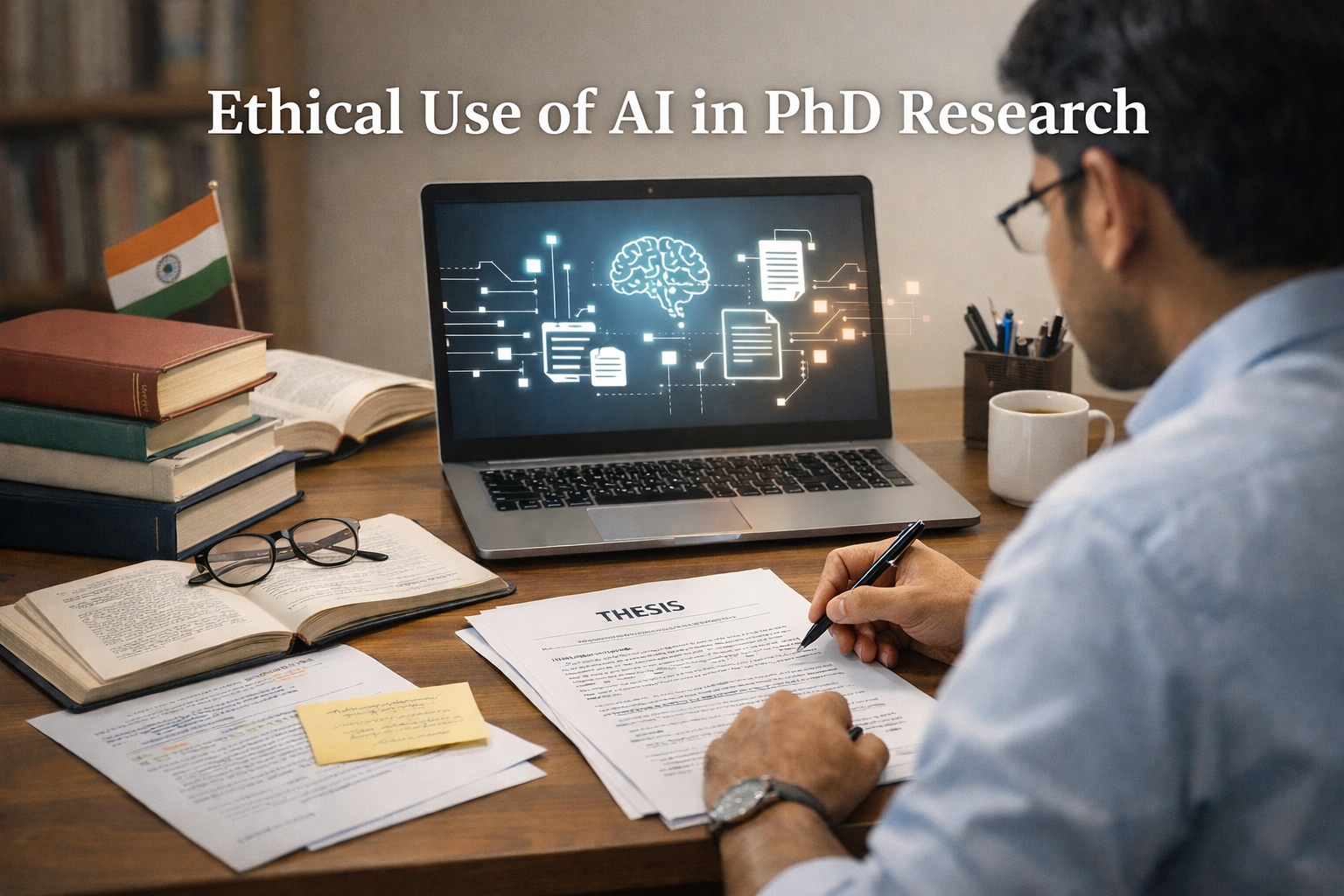
Introduction
With the rise of AI-based writing assistants, many Indian PhD candidates are beginning to wonder if these tools can be used to remove plagiarism from their research work. In private universities, where structured review cycles often require frequent revisions, the appeal of quickly rephrasing large sections of text is strong. AI models like ChatGPT are capable of generating alternative wordings, reorganising content, and even adjusting tone. But for doctoral admission in India, where academic integrity and UGC-approved formats are central, the question is not just whether AI can do it—but whether it should.
Plagiarism removal is more than a mechanical exercise. It involves retaining the accuracy of original ideas, honouring citations, and ensuring the rewritten content still reflects the researcher’s own academic voice. This is where AI tools present both opportunities and challenges.
Where AI Can Assist Effectively
AI tools like ChatGPT can be particularly useful for breaking down overly complex sentences, offering synonyms, and suggesting different ways to structure a paragraph. For example, a PhD scholar in sociology may feed in a heavily cited literature review section and receive a cleaner, simpler rewording that reduces similarity without losing the academic tone. Similarly, AI can help mid-career researchers—especially those juggling work and study—improve clarity and remove redundancy, which in turn may naturally lower similarity scores.
Another advantage is flexibility. AI can adapt to different writing styles, which is useful when a thesis needs to maintain a consistent voice across multiple chapters. It can also provide examples of how to paraphrase while retaining the same logical sequence, an approach that benefits those new to academic writing in English. In many cases, this can speed up the revision process and make it easier to meet deadlines without compromising on structure.
However, even the most advanced AI cannot fully understand the subject-specific nuances that a human researcher brings. In disciplines like law, philosophy, or advanced engineering, certain terms and conceptual relationships must remain intact to preserve meaning. Blindly accepting AI-generated rewrites risks introducing subtle errors that may go unnoticed until review.
Risks and Ethical Considerations
One of the main concerns with using AI for plagiarism removal in the Indian PhD context is that the rewritten text may still be flagged by plagiarism detection tools. This is because similarity scores are not based on exact word matches alone—they also consider sentence structure and conceptual overlap. AI might change the wording but leave the underlying structure too similar, resulting in a high match percentage.
There is also the issue of academic ownership. If a researcher relies too heavily on AI, the final work may reflect less of their personal analytical process and more of a generic rephrasing style. This can be noticed by supervisors who are familiar with the candidate’s earlier writing patterns. In the UGC-approved evaluation process, maintaining a consistent and authentic academic voice is valued more than achieving a near-zero similarity score.
Privacy is another consideration. When uploading thesis content to AI platforms, scholars must be aware of data storage policies. Using AI on confidential or unpublished research without checking platform terms could risk intellectual property exposure.
For these reasons, AI tools are best treated as assistants rather than primary rewriting engines. The researcher should always review, fact-check, and adjust AI output to ensure it aligns with both academic requirements and the original meaning. This approach safeguards not only the integrity of the thesis but also the credibility of the scholar.
Conclusion
AI tools like ChatGPT can help reduce plagiarism by offering alternative phrasings and structural suggestions, but they are not a complete solution. Their real strength lies in supporting clarity, organisation, and style, while the responsibility for accuracy, originality, and ethical compliance remains with the researcher. In the Indian PhD environment, where academic voice and intellectual contribution are closely scrutinised, AI can play a valuable role—provided it is used thoughtfully, sparingly, and under the guidance of a well-informed academic approach.