
Introduction
The release of ChatGPT has sparked both excitement and concern in Indian academic circles. From WhatsApp groups of research scholars to university faculty meetings, one question keeps coming up: Can ChatGPT write a thesis? For many struggling with thesis deadlines, language challenges, or limited supervisor access, the idea is tempting. An AI tool that can “generate” paragraphs, summarise literature, and even offer citations seems like a solution to academic pressure — especially in private universities where guidance can be irregular.
But this question needs more than a yes or no answer. Indian scholars must understand what ChatGPT can and cannot do — not just technically, but ethically, academically, and culturally. Writing a thesis is not about filling pages with grammatically correct text. It is about producing original thought, engaging deeply with sources, and contributing meaningfully to your field. And those are tasks no AI — not even the most advanced — can truly perform on your behalf.
What ChatGPT Can Do — and Where It Falls Short
There’s no doubt that ChatGPT is a powerful writing tool. It can help generate outlines, explain academic terms, and even write sample paragraphs on a given topic. Many Indian PhD scholars already use it for early drafts, grammar polishing, or breaking writer’s block. For those writing in English as a second or third language, it can be especially helpful in improving sentence structure or suggesting vocabulary.
However, using ChatGPT to write large parts of your thesis introduces several risks:
• Lack of academic depth: ChatGPT generates content based on patterns in existing data. It doesn’t understand your research topic the way you do. It may produce writing that sounds “academic” but lacks critical thinking or contextual insight.
• Inaccurate or fake references: One major issue with ChatGPT is that it often invents citations — creating names of authors, journals, or publication years that don’t exist. Relying on these can harm your credibility.
• Surface-level knowledge: Even when it gives accurate information, ChatGPT struggles with depth. It cannot analyse field data, interpret findings, or critique literature with scholarly precision.
• Generic writing: ChatGPT’s responses tend to be generic. For Indian PhD scholars working on localised, policy-based, or interdisciplinary topics, its responses may lack cultural and institutional relevance.
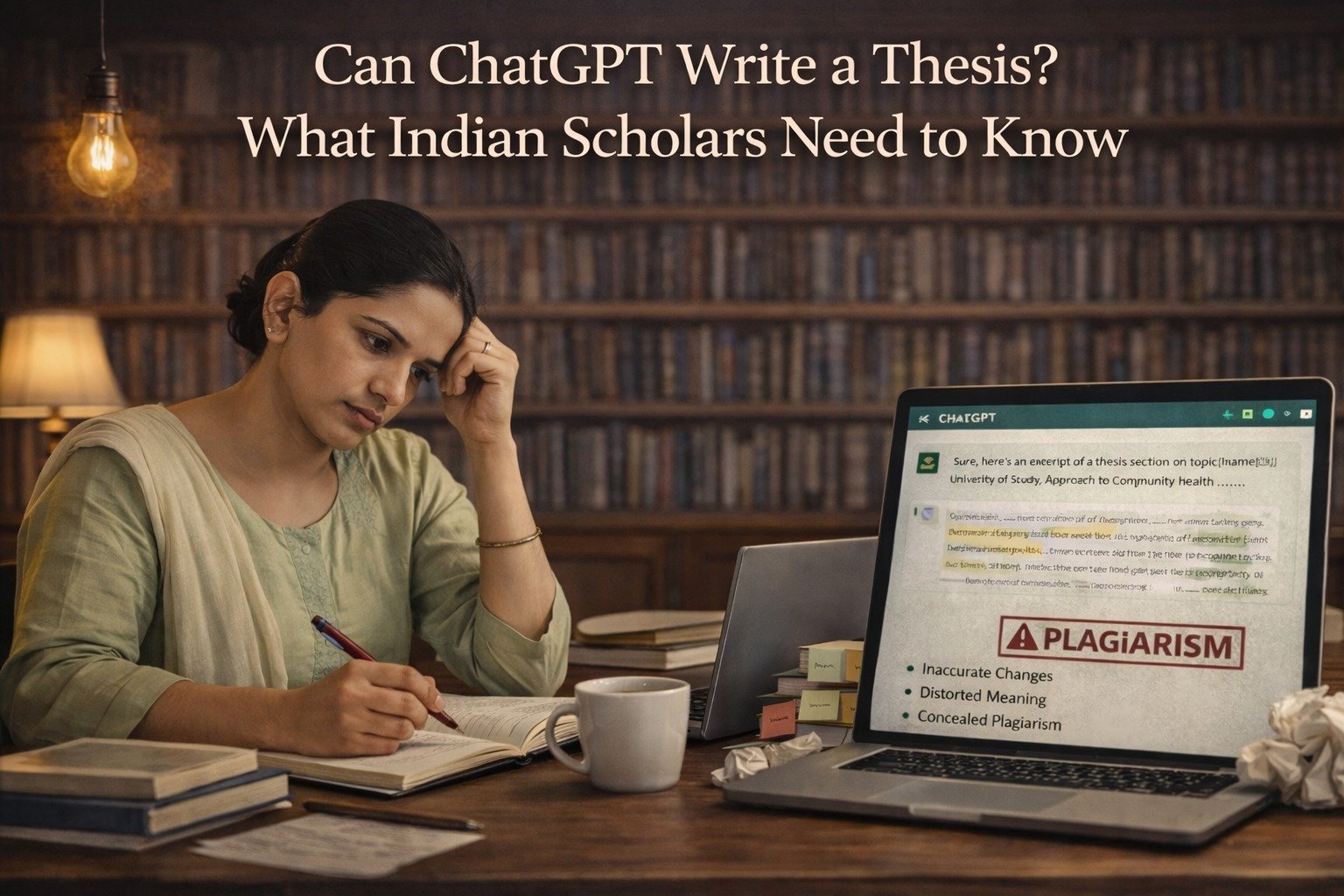
A scholar working on community health in rural Tamil Nadu shared how she used ChatGPT to write part of her literature review — only to discover that many references were fabricated and some assumptions about rural India were completely inaccurate.
Ethical Concerns in the Indian Academic Environment
Using ChatGPT for support is not illegal. But using it to write chapters without supervision or acknowledgment can create serious ethical problems. Most Indian universities now run thesis drafts through plagiarism software. While ChatGPT’s content may not trigger direct plagiarism flags, universities are increasingly training evaluators to spot AI-generated writing — especially when it doesn’t match the scholar’s voice or understanding.
During viva voce, you may be asked detailed questions about your conceptual framework, data interpretation, or the logic behind your arguments. If those ideas were generated by a tool and not understood by you, it shows. Examiners — especially experienced ones — can quickly identify gaps between what is written and what is understood.
A PhD candidate in economics from a Delhi-based private university had to rewrite two chapters after his supervisor discovered inconsistencies in terminology. When asked where the ideas came from, he admitted he’d used ChatGPT for framing arguments. While he wasn’t penalised formally, the trust deficit affected his entire submission timeline.
In India, where thesis submission involves multiple stages — guide approval, departmental reviews, and final defences — any suspicion of academic dishonesty can create lasting academic consequences.
The Human Element: What AI Can’t Replace
Research is not just about collecting data or summarising existing ideas. It’s about grappling with uncertainty, asking original questions, and defending your perspective with reason and evidence. ChatGPT doesn’t do fieldwork. It doesn’t wrestle with complex readings. It doesn’t interpret emotional cues from interviews or reflect on contradictory data.
A doctoral journey also includes learning how to write — slowly, painfully, and with feedback. It’s through rewriting and revision that your scholarly voice emerges. When AI tools are used to skip that learning process, the final work may look finished but feel hollow.
This is especially important in Indian contexts, where cultural nuance, policy understanding, and local data interpretation matter deeply. A thesis on farmer suicides in Maharashtra, or Dalit representation in higher education, or gendered migration in Assam requires more than well-phrased English. It needs cultural sensitivity, field knowledge, and academic accountability — none of which can be generated by algorithms.
Using ChatGPT Responsibly — A Middle Path
While ChatGPT cannot write your thesis, it can still be used ethically and meaningfully in limited ways:
• For outlining and brainstorming: Getting help framing research questions or building a chapter outline.
• For understanding academic jargon: Asking for explanations of dense terms or theoretical frameworks.
• For early-stage summaries: Summarising long articles to get a basic grasp — though these should not replace full reading.
• For grammar and language support: Polishing your own writing for clarity, especially if English is not your strength.
But all of these should remain secondary. The thinking, structuring, and argument-building must be done by you. AI can assist your expression — it cannot replace your intellect.
Conclusion
The question is not whether ChatGPT can write a thesis — but whether it should. For Indian scholars working within a complex educational system, often with limited support, AI tools can offer temporary relief. But they are not a substitute for your voice, your analysis, or your academic growth.
A PhD is more than a document — it is a journey of becoming a scholar. And while tools can support that journey, they must never lead it. Because what makes your thesis valuable is not how fast it was written, but how deeply it reflects your own understanding.