
Introduction
For many Indian students, the ultimate test of any degree is whether it helps in securing a government job. With the prestige, stability, and respect associated with public sector employment, families often weigh the value of education through the lens of eligibility for competitive exams and recruitment. This is why one of the most frequently asked questions about higher education is whether a degree earned through distance mode can be used for government job applications.
The answer is not as complicated as it may seem. The University Grants Commission (UGC) and its Distance Education Bureau (DEB) have laid down clear guidelines on recognition. However, misconceptions, incomplete information, and outdated attitudes often cloud the picture. Understanding the legal framework and practical realities can help students make confident decisions about pursuing distance education for career advancement.
Legal Recognition and Policy Clarity
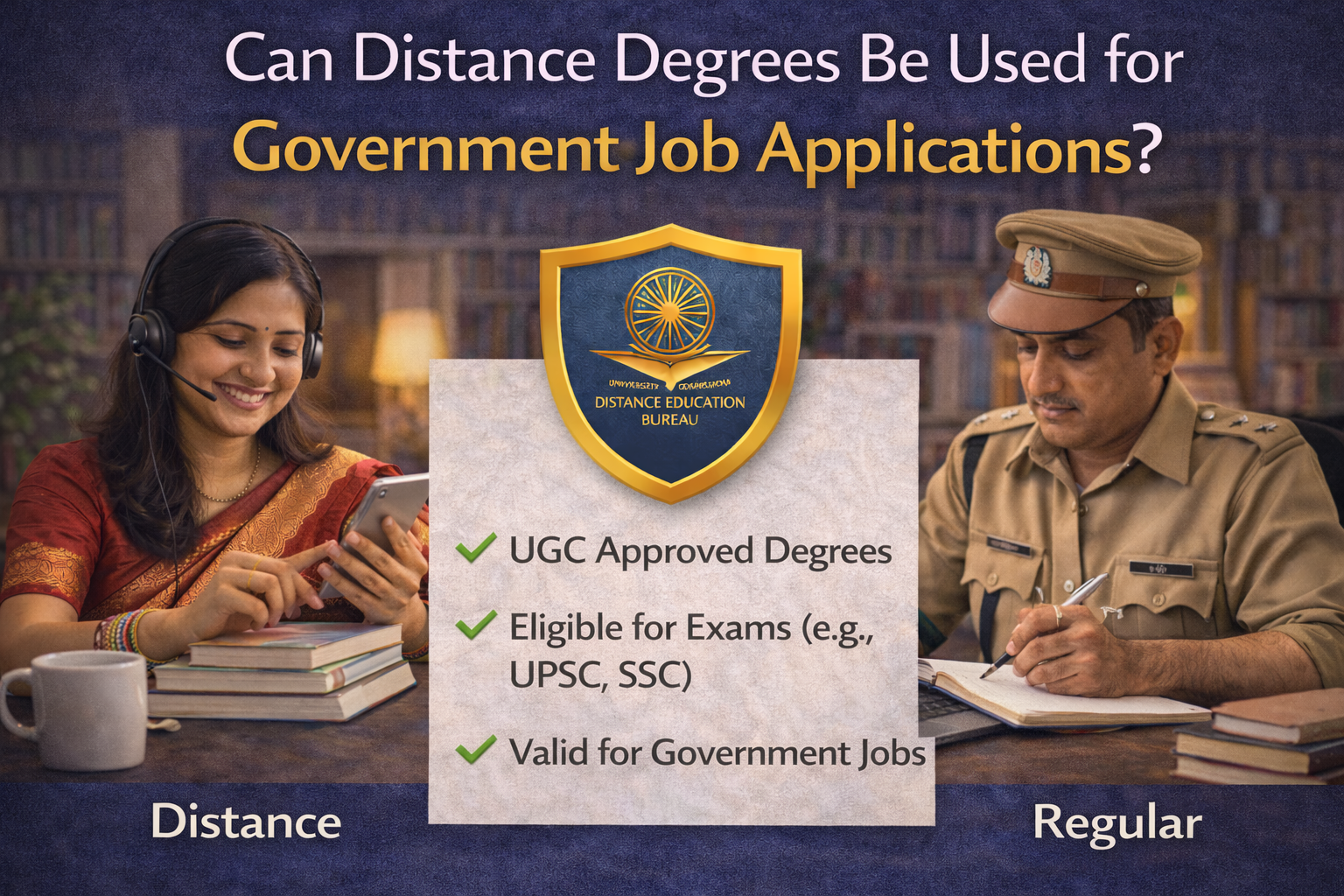
From a regulatory perspective, UGC-DEB has explicitly stated that degrees awarded by recognised universities through approved distance programs are valid for employment, including government jobs. This means that a student with a distance degree in an eligible subject can sit for competitive examinations such as UPSC, SSC, or state-level services, provided the program is offered by a university approved for that course.
For example, if a candidate has completed a distance BA or MA from a UGC-DEB recognised institution, the degree is treated on par with a regular program when applying for civil services or teaching positions. The only restriction lies in courses that require extensive practical or clinical training, such as medicine, law, and engineering, which are not permitted in distance mode.
How Government Recruitment Bodies Treat Distance Degrees
Government recruitment agencies in India follow the principle of equivalence for recognised programs. When applying for posts in central or state government, the requirement usually specifies that the degree must be from a “recognised university.” No distinction is made between regular and distance mode in these notifications.
For example, many government employees in teaching, administration, and clerical roles have upgraded their qualifications through distance programs specifically to become eligible for promotion or higher pay scales. In such cases, the degree is accepted without issue as long as it is from an authorised institution.
However, students sometimes face confusion during document verification if the awarding institution or program is not properly listed under UGC-DEB approval. This highlights the importance of checking the official recognition status before enrolling in any distance program.
Perceptions and Practical Challenges
While the legal position is clear, students often worry about subtle biases in the selection process. In competitive examinations, there is no differentiation between regular and distance qualifications at the shortlisting stage. The main determinant remains the candidate’s performance in the exam.
In interviews or departmental promotions, however, there may occasionally be informal questions about the mode of study. This reflects societal perceptions more than official policy. Distance learners who can demonstrate practical knowledge, discipline, and professional application of their degree often overcome such doubts easily. In fact, many departments actively encourage employees to pursue further education through distance mode, recognising the need for flexibility.
Role of Private Universities
Private universities have played an important role in strengthening the credibility of distance education in recent years. With better technological infrastructure, digital learning platforms, and industry tie-ups, they have elevated the standard of distance learning. When such universities hold UGC-DEB approval, their degrees are equally valid for government employment.
For working professionals in particular, this has created an opportunity to continue jobs while upgrading qualifications needed for promotions in government service. A teacher in a rural school, for instance, may complete a distance M.Ed. to qualify for principal-level positions, relying fully on the equivalence granted to such programs.
Common Myths That Create Doubt
Several myths persist around the use of distance degrees for government jobs. One widespread belief is that distance degrees are not eligible for UPSC examinations. In reality, UPSC only requires a recognised university degree, without distinguishing between regular and distance modes. Another misconception is that distance programs are not valid for teaching jobs. Again, the validity depends on recognition, not the mode of study.
The confusion often arises from unapproved institutions that issue degrees without proper authorisation. These are rightly rejected, creating a perception problem for the entire distance education system. Students need to be careful to avoid such providers.
Conclusion
Distance degrees, when earned from UGC-DEB approved institutions, are fully valid for government job applications in India. Whether for central services, state-level posts, or departmental promotions, recognition by the regulator ensures equivalence with regular degrees. The responsibility lies with students to verify the status of the institution and program before enrolment.
Beyond legality, the confidence and skills developed during the course matter equally in the job market. As distance education continues to gain respect and innovation, its role in supporting government career aspirations is set to grow stronger. For many Indians balancing work, family, and studies, this mode of education provides not just eligibility but also a practical path toward stable and rewarding public service careers.