
Introduction
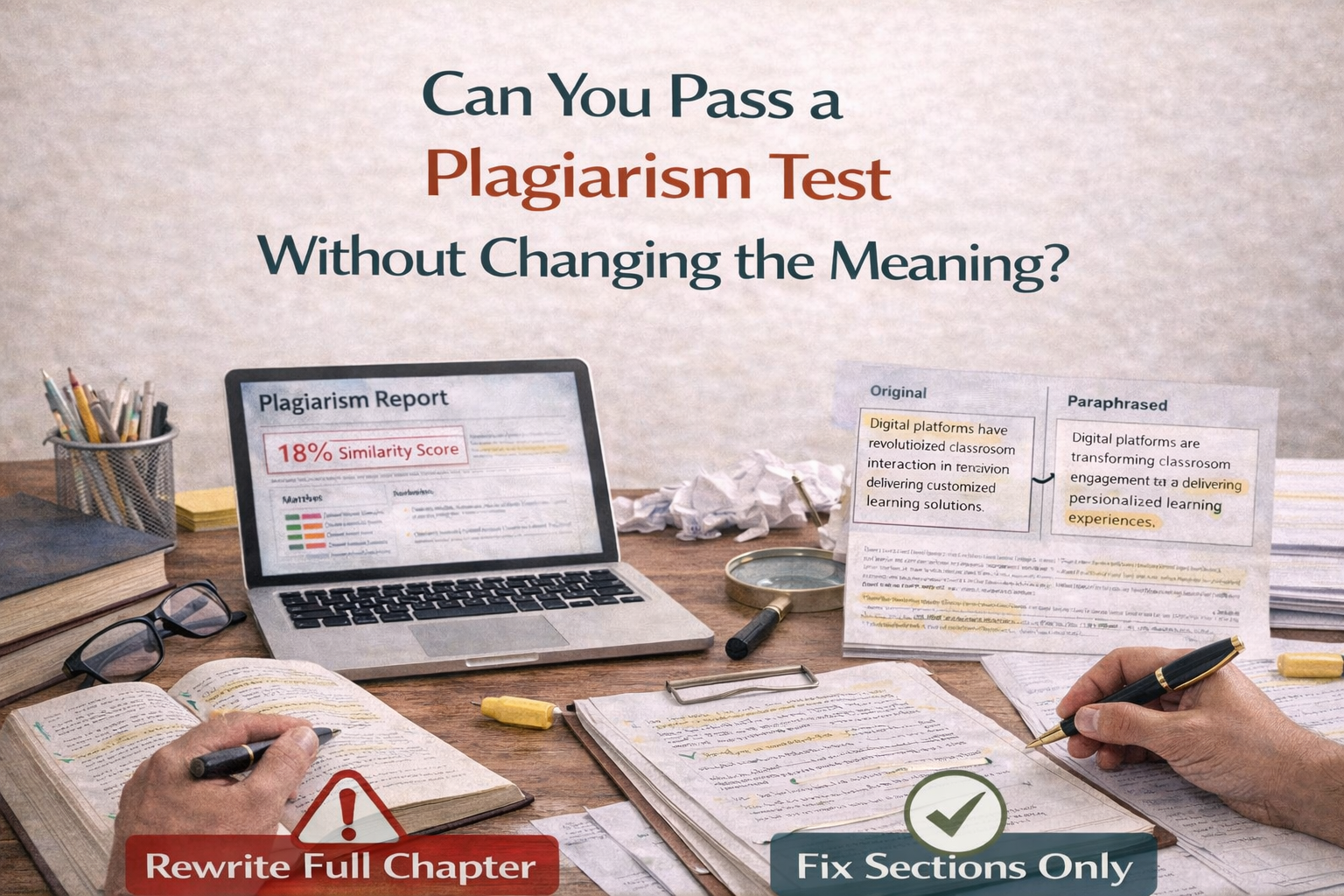
For many Indian PhD candidates, one of the most common concerns during thesis preparation is whether they can clear the plagiarism check while keeping the original meaning of their content intact. Research work often contains complex ideas, technical explanations, and precise terminology that cannot be altered without losing accuracy. The challenge lies in ensuring that the writing reflects the scholar’s own voice and structure, even when discussing established concepts. In universities across India — whether public institutions or private universities catering to working professionals — plagiarism screening has become an unavoidable part of the submission process.
The question is not simply about avoiding similarity detection software; it is about balancing originality with fidelity to the source material. A scholar may need to discuss a theory, method, or dataset exactly as it appears in the literature, yet still ensure that the work does not breach the institution’s acceptable similarity threshold. This balance requires more than technical rewriting — it calls for deeper engagement with the subject matter and careful attention to how ideas are presented.
Preserving Accuracy While Achieving Originality
Passing a plagiarism test without changing the meaning begins with understanding what actually counts as plagiarism. Similarity detection tools are not designed to penalise accurate representation of facts; they flag text that is identical or too close in structure to existing sources. This means that a scholar can keep the meaning intact by rephrasing the content in their own sentence patterns and integrating it into a broader discussion. For example, in an engineering thesis, a formula or equation may remain unchanged, but the explanation around it can be reconstructed in a way that reflects the scholar’s interpretation of its relevance.
Rewriting Through Comprehension, Not Substitution
One common mistake is relying on direct synonym replacement — a method that often fails to lower similarity significantly and can distort meaning in technical or specialised contexts. Instead, the most reliable approach is to read the source carefully, understand it fully, and then explain it from memory in one’s own words. This ensures that the structure of the sentence, not just the vocabulary, is original. For instance, a researcher in education might read about a learning theory, reflect on how it applies to their study, and then write their explanation, supported by examples from their own fieldwork. This preserves meaning but results in unique expression.
Integrating Sources into the Researcher’s Voice
Even when the content is accurate and paraphrased, over-reliance on a single source can make a section appear too similar to the original. To address this, scholars can integrate multiple references into the same discussion, linking them through their own analytical commentary. This not only lowers similarity but also strengthens the academic quality of the work. In a doctoral study on climate policy, for example, the candidate could combine findings from several reports, highlight points of agreement and difference, and present their interpretation of the trends. The underlying meaning remains true to the literature, but the presentation is distinctly the researcher’s own.
Citing Without Overquoting
Direct quotations are sometimes necessary to preserve exact wording, especially in fields such as law or literature. However, overusing quotations can raise the similarity score and reduce the originality of the thesis. A more balanced approach is to reserve direct quotes for definitions, legislative texts, or particularly significant phrasings, while paraphrasing the rest in the scholar’s own words. Proper citation remains essential in both cases — even a well-paraphrased section is plagiarism if the source is not acknowledged.
When Meaning Cannot Be Changed
Certain disciplines present unique challenges in passing a plagiarism check without altering meaning. In scientific writing, for example, descriptions of experimental procedures often follow standard formats that cannot be modified much. Similarly, in the humanities, established theoretical frameworks may require precise wording to maintain academic accuracy. In such cases, scholars should focus on originality in interpretation, analysis, and application rather than in the standardised elements. This can involve connecting the theory or method to unique research data, offering alternative viewpoints, or highlighting its implications in a new context.
Using Plagiarism Reports as a Writing Tool
Instead of treating plagiarism checks as a final hurdle, scholars can use them as a guide during the drafting process. Running similarity reports at intermediate stages allows them to identify sections that are too close to the sources and rewrite them without losing meaning. Private universities in India often provide candidates with access to plagiarism detection software throughout their research journey, encouraging this iterative approach. This not only helps meet the required similarity threshold but also improves the overall clarity and originality of the writing.
The Role of Academic Discipline and Time
Passing a plagiarism test without losing meaning is rarely a quick fix. It requires disciplined writing habits, consistent engagement with the subject, and enough time to rewrite and refine sections thoughtfully. For working professionals pursuing a PhD part-time, this can be a balancing act between job responsibilities and research obligations. Yet, scholars who take the time to understand their material deeply often find that paraphrasing without distortion becomes second nature, and plagiarism concerns diminish as a result.
Conclusion
It is entirely possible to pass a plagiarism test without changing the meaning of the content, but doing so depends on more than mechanical rewording. It involves rewriting from comprehension, integrating sources with original commentary, and ensuring proper citation at every stage. By approaching the process as an opportunity to engage more deeply with their subject, PhD candidates in India can produce work that is both accurate and authentically their own. In this way, the thesis remains true to its sources while standing as a distinct scholarly contribution.