
Introduction
For many students in India, postgraduate education is not just an academic milestone but also a stepping stone toward research and doctoral study. However, the rise of distance education has brought new questions to the surface, especially for those aiming to pursue a PhD. A common concern is whether a postgraduate degree earned through distance mode holds the same eligibility for doctoral admissions as a regular degree. Since pursuing a PhD involves years of dedication and significant career planning, clarity on this issue is essential. Understanding where distance postgraduate degrees stand in doctoral admissions can help aspirants avoid confusion and make informed academic choices.
The Legal and Academic Standing of Distance PG Degrees
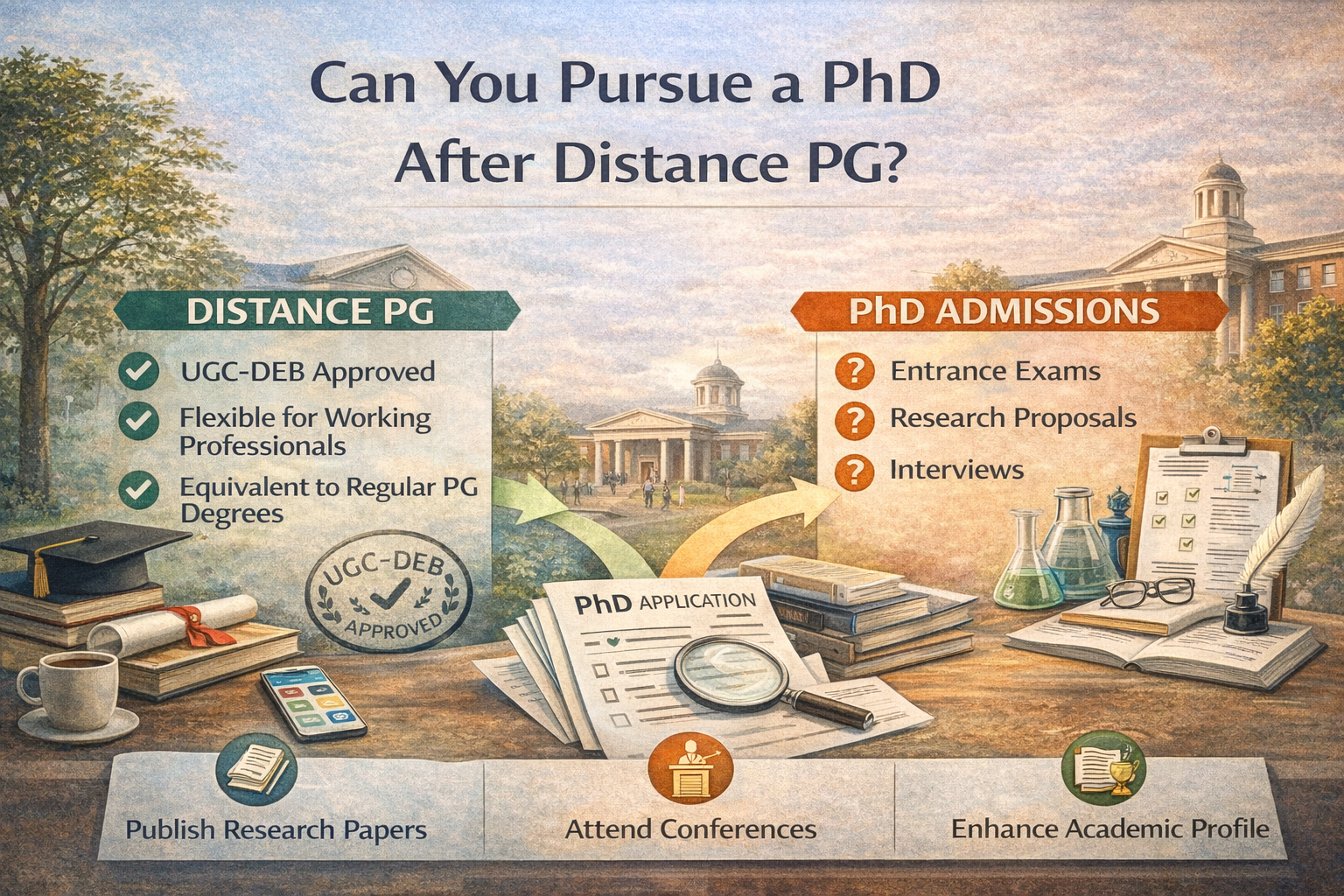
From a regulatory perspective, the University Grants Commission (UGC) has consistently clarified that postgraduate degrees earned through UGC-DEB approved distance programs are valid and equivalent to regular degrees, provided the program is recognised. This means that if a student has completed a master’s degree in Arts, Commerce, Management, or Science through an approved distance mode, they are legally eligible to apply for PhD programs in India.
However, it is important to note that eligibility does not mean automatic acceptance. PhD admissions in Indian universities depend on multiple criteria, including entrance examinations, interviews, and research proposals. A distance PG degree meets the basic requirement, but candidates still have to compete academically.
The Institutional Perspective
Universities in India vary in how they treat distance qualifications during the admission process. Public universities, such as central and state institutions, generally accept recognised distance PG degrees without hesitation. Private universities, which often emphasize flexibility and inclusivity, are also open to distance graduates, provided the degree comes from an accredited source.
That said, some institutions may prefer applicants with regular postgraduate degrees when competition is high, especially for research-heavy subjects. For example, a candidate with a distance M.Sc. may face additional scrutiny compared to one with a regular M.Sc., particularly in fields that involve laboratory work. This does not mean exclusion but highlights the importance of demonstrating research readiness and strong academic preparation.
Perception in the Research Community
Beyond policy, perception plays a role. Distance education in India has long carried a stigma of being less rigorous than regular education. Although this view is changing with digital advancements and private university initiatives, some faculty members and admission panels may still hold reservations. In such cases, the onus is on the candidate to demonstrate their competence through entrance scores, publications, or prior research experience.
For working professionals, this is often an advantage. Many who pursue distance PG degrees already have industry or teaching experience, which can strengthen their PhD applications. When combined with clear research interests and professional achievements, a distance degree can be positioned as part of a broader academic journey rather than a limitation.
The Role of Private Universities in PhD Admissions
Private universities offering PhD programs have become a significant gateway for distance graduates. They often value diversity in academic backgrounds and recognize the practical challenges faced by mid-career professionals who pursue postgraduate studies in distance mode. By adopting flexible yet rigorous admission policies, these institutions have made it possible for distance PG holders to transition into doctoral research.
In fact, many private universities highlight distance graduates as part of their inclusive research culture. For students balancing family, work, and study, this flexibility provides a realistic path toward fulfilling their doctoral ambitions.
Challenges to Be Aware Of
Despite recognition, candidates should be aware of certain limitations. Professional courses such as engineering, medicine, or law cannot be pursued in distance mode at the postgraduate level. Therefore, a distance PG in these fields does not exist, and students from such backgrounds must pursue regular degrees.
Additionally, some foreign universities may not fully accept Indian distance PG degrees for PhD admission. For those planning to study abroad, it is wise to verify eligibility with the institution in advance. Even within India, the competition for limited PhD seats means that distance graduates may need to work harder to prove their readiness through strong proposals and prior work.
Strategies for Distance PG Graduates Applying for PhDs
Students with distance PG degrees can enhance their PhD applications by strengthening other parts of their profile. Publishing research papers, attending conferences, or engaging in academic writing can significantly improve credibility. Similarly, showcasing professional achievements or teaching experience adds depth to their application.
Many distance graduates also benefit from taking additional certifications, short-term research courses, or online workshops in their field. These efforts reflect seriousness toward research and can counter any doubts about academic preparation.
Conclusion
The pathway from a distance postgraduate degree to a PhD is not only possible but also increasingly common in India’s evolving academic landscape. As long as the degree is UGC-DEB approved, it meets the eligibility criteria for doctoral study. While some perceptions and challenges remain, especially in research-intensive fields, determined candidates can bridge the gap by showcasing competence and commitment.
For many working professionals and mid-career educators, a distance PG followed by a PhD is not just an alternative—it is a practical and achievable route. The real key lies in choosing recognised programs, building a strong research profile, and approaching doctoral studies with clarity of purpose. In today’s higher education environment, dedication often matters more than the mode of learning.