
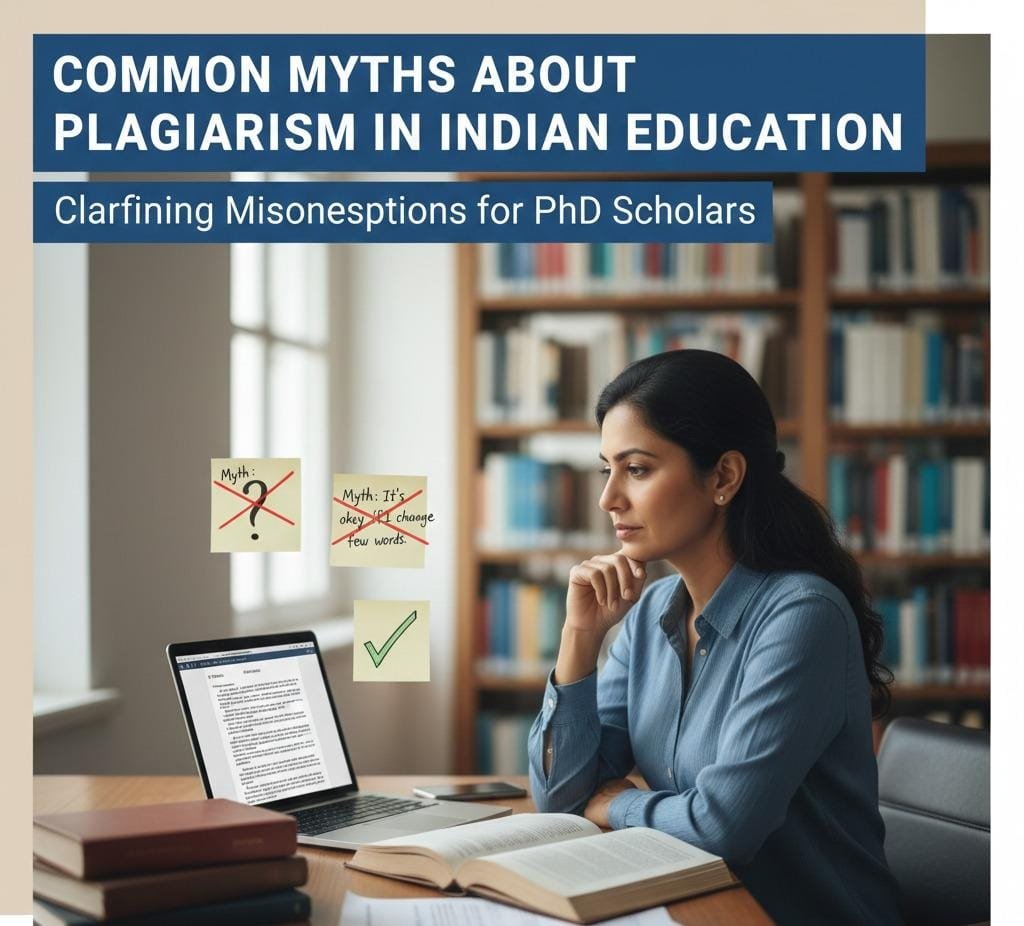
In Indian academia, especially at the doctoral level, plagiarism has become a widely discussed issue. With institutions introducing software checks and UGC mandating similarity thresholds, awareness has increased. However, what hasn’t improved at the same pace is clarity. Many students and even faculty still operate based on misconceptions—partly due to lack of structured training, partly due to inherited academic habits. For Indian PhD students, particularly those in private universities, these myths can cause unnecessary fear, confusion, or, in some cases, unintentional violations. Understanding what plagiarism truly is—and what it is not—is essential for writing ethically and confidently.
“If I Don’t Copy-Paste, It’s Not Plagiarism”
One of the most common myths is that plagiarism only occurs when someone copies text directly without attribution. While this is certainly one form, it is only a small part of what plagiarism includes. Even if you don’t copy-paste but rephrase someone else’s idea or structure too closely without citing them, it still counts as plagiarism. In fact, paraphrasing plagiarism is often harder to detect but equally serious.
In many Indian classrooms, especially before students reach the postgraduate or PhD level, paraphrasing and summarising are rarely taught with proper citation practices. As a result, students often assume that changing a few words makes the material their own. This assumption becomes risky in a doctoral thesis, where originality and attribution are expected at every stage. Plagiarism is not defined by intent alone—it is judged by outcome. If a reader cannot distinguish your voice from your source, it becomes an ethical concern.
“Self-Plagiarism Doesn’t Count Because I Wrote It”
Many PhD scholars are surprised to hear that they can plagiarise their own work. Reusing previously published content—such as an article, conference paper, or even a seminar assignment—without citation in your thesis is considered self-plagiarism. This is especially relevant in Indian private universities, where students are encouraged to publish before thesis submission. While incorporating published material is allowed, it must be cited just like any other source.
Self-plagiarism becomes problematic when it creates the impression that the content is newly written for the thesis. Even if you were the original author, academic integrity requires that readers know where and when the material first appeared. Universities now ask for declaration forms where students list their prior publications and clearly indicate which sections of the thesis are drawn from them. Ignoring this step, whether out of oversight or misunderstanding, can delay evaluation or lead to revision requests.
“Only English Text Is Checked for Plagiarism”
Another widespread myth is that plagiarism detection applies only to English-language content. With many Indian scholars writing in regional languages, especially in fields like Hindi literature, philosophy, or regional history, there is an assumption that such theses are not scrutinised as rigorously. While it’s true that many detection tools are optimised for English, universities are increasingly adopting software that supports multiple languages or conducting manual checks when required.
Furthermore, plagiarism is not just about language—it’s about the originality of thought and acknowledgment of sources. Regardless of the language in which a thesis is written, the expectation is that ideas borrowed from other scholars are cited properly. As multilingual research expands in Indian universities, language is no longer a shield from academic standards.
“Software Reports Are the Final Word”
In Indian institutions, plagiarism detection tools like Turnitin and Ouriginal are now standard. This has created a new myth: that if your similarity report is below a certain percentage—say 10% or 20%—your work is automatically considered clean. In reality, these tools only measure textual similarity, not plagiarism. They do not assess whether citations are correct or whether the matching text was used ethically.
For example, a student may have a low similarity score but still commit plagiarism by copying a structure or idea without crediting it. Conversely, a high similarity score may be due to properly quoted and cited material, which is acceptable. The interpretation of the report depends on context, and that judgment lies with the supervisor or thesis committee—not the software alone. Reducing the process to a number leads to confusion and anxiety, and it often misses the point of why academic integrity matters in the first place.
“Indian Universities Don’t Really Enforce These Rules”
Some scholars believe that rules around plagiarism are flexible or rarely enforced—especially in private universities where student pressure and administrative expectations run high. This is no longer true. With the UGC’s 2018 guidelines in place and NAAC rankings tied to academic quality, most institutions are taking plagiarism seriously. Thesis evaluations can now be delayed, rejected, or sent back for major revision if plagiarism is detected, regardless of intent.
Moreover, universities increasingly require students to submit plagiarism declarations and originality reports. In some cases, PhD degrees are withheld until all similarity concerns are addressed. Rather than viewing these rules as obstacles, scholars benefit more from understanding them as part of academic professionalism. A thesis free from plagiarism is not just a formality—it is a mark of credibility in a competitive academic field.
Conclusion
Plagiarism in Indian education is surrounded by myths that often do more harm than good. Whether it’s believing that paraphrasing doesn’t need citation, that self-written content can be reused freely, or that low similarity scores guarantee safety—these misunderstandings can lead to ethical issues and academic setbacks. For Indian PhD students, especially those in private universities where the research culture is still evolving, clarity matters as much as compliance. By addressing these myths early and embracing honest writing practices, scholars can build work that is not only acceptable but respected. Academic integrity begins with knowing the rules—and choosing to follow them with awareness and intent.