Introduction
For Indian faculty, particularly in universities and colleges governed by academic performance frameworks, the API (Academic Performance Indicator) score plays a crucial role in career progression. While publications and teaching are often highlighted, participation in conferences and seminars is a significant yet sometimes overlooked contributor to this score. Engaging regularly in these academic events not only enhances research visibility but also strengthens the overall evaluation profile, making it an essential component of professional development for faculty and PhD scholars alike.
Contribution to API Score
API scoring systems in India typically allocate points for presenting papers, organizing conferences, attending workshops, and participating in seminars. Each of these activities reflects scholarly engagement beyond classroom teaching and research writing. For faculty, attending conferences is a practical way to accumulate API points while staying current with developments in their field. Indian universities, including private institutions, increasingly value such participation during appraisals, promotions, and faculty evaluations, recognizing the link between active engagement and academic quality.
Presenting at a conference can carry more weight than attendance alone. Faculty who submit papers, present findings, or chair sessions demonstrate initiative and scholarly contribution, translating into higher API points. For early-career researchers or PhD students aspiring to faculty roles, this can be a strategic way to build a strong professional profile that aligns with institutional expectations.
Skill Development and Professional Visibility
Beyond API points, conferences and seminars enhance professional skills and visibility. Indian faculty gain opportunities to present research to diverse audiences, receive constructive feedback, and refine communication abilities. These experiences contribute indirectly to teaching quality, mentoring, and research supervision. By participating in multiple events annually, faculty build a visible presence in their field, enhancing credibility and recognition. Such visibility often attracts invitations to collaborate, review papers, or engage in interdisciplinary projects, all of which reinforce a scholar’s professional standing.
Networking and Collaboration
Active participation in conferences and seminars also facilitates networking, which can indirectly boost API-relevant outcomes. Engaging with peers and senior academics enables collaboration on research projects, joint publications, and grant proposals. In the Indian academic context, such collaborations are highly valued during faculty evaluations and appraisals. The relationships forged through these events often lead to sustained scholarly engagement, increasing the likelihood of high-quality research output that further strengthens API scores over time.
Strategic Participation
Not all conferences are equally valuable for API scoring. Indian faculty should strategically select events recognized by academic bodies or aligned with their research domain. National and international conferences accredited or endorsed by professional associations often carry higher weight in evaluations. Combining both offline and online events ensures broader engagement while managing time and resources efficiently. Preparing presentations that contribute meaningfully to academic discourse maximizes the benefit of each event, ensuring that participation translates into tangible professional growth.
Long-Term Impact
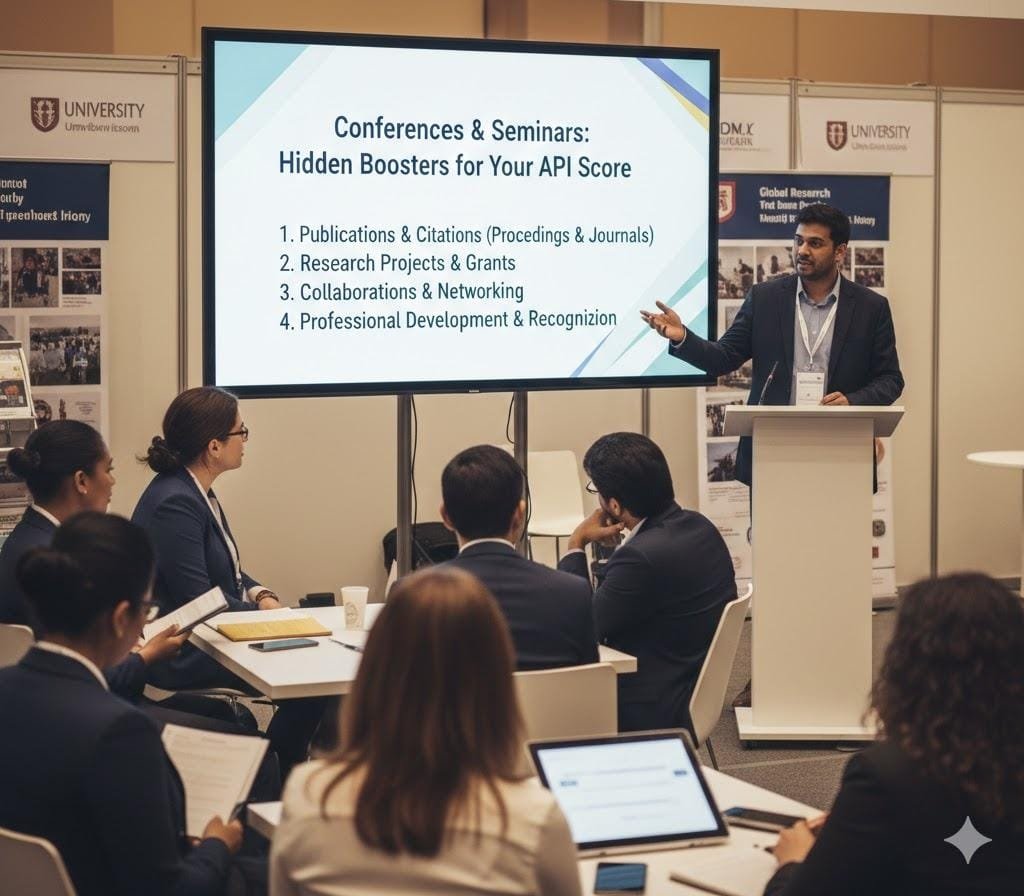
Consistent involvement in conferences and seminars has a cumulative effect on career development. Faculty who actively engage in such events gain higher API scores, broader recognition, and enhanced research networks. For PhD scholars aspiring to academic roles, early exposure to these events establishes habits of professional participation, strengthens research portfolios, and fosters connections that support future career milestones. In this sense, conferences and seminars function as hidden boosters, providing both immediate and long-term benefits for academic performance.
Conclusion
Conferences and seminars are more than venues for presenting research—they are essential tools for professional growth and API score enhancement in India. Regular participation helps faculty and PhD scholars accumulate points, develop skills, expand networks, and gain visibility in their field. By approaching these events strategically, researchers can maximize both the quantitative benefits for evaluations and the qualitative advantages for career development. In doing so, conferences and seminars become key instruments for sustaining scholarly excellence and advancing professionally within the Indian academic ecosystem.