
Introduction
For many Indian doctoral scholars, the terms “guide” and “co-guide” are familiar yet not always fully understood. At first glance, they seem interchangeable, but in practice, the distinction is important and affects the way research unfolds. The difference between guide and co-guide in PhD supervision is not just administrative; it reflects how universities structure responsibility and support for a scholar’s thesis. In India, where doctoral admission in both public and private universities has expanded significantly, understanding this difference helps students choose wisely and set realistic expectations about academic mentorship.
Role of the Primary Guide
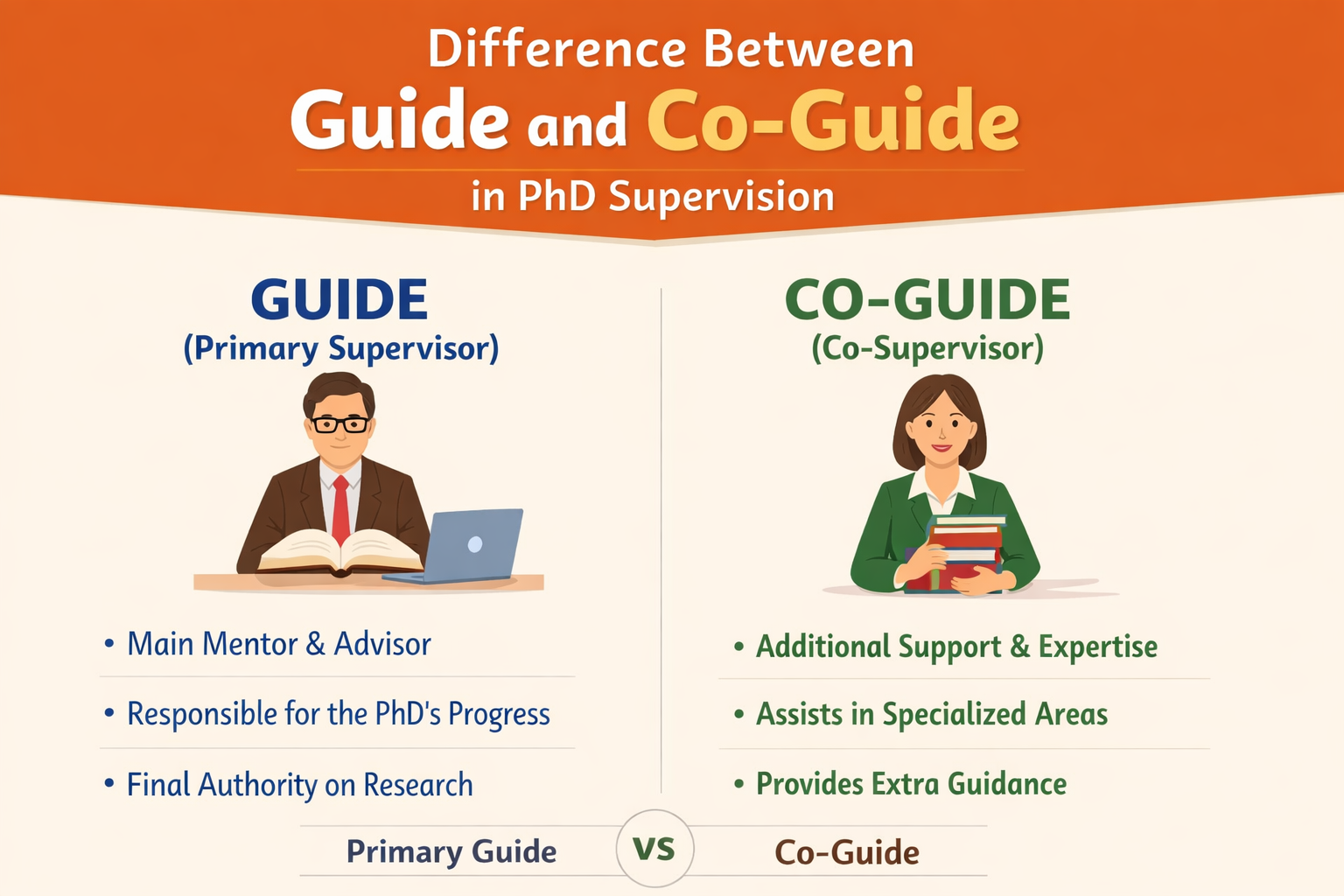
The guide, often referred to as the supervisor, is the principal academic mentor responsible for steering the research project. They are recognised by the university as the official supervisor and bear the primary responsibility for ensuring that the thesis meets academic standards. The guide usually helps in formulating the research problem, refining methodology, and maintaining compliance with institutional regulations. In the Indian context, a guide’s role extends beyond technical advice: they are also the point of contact for administrative approvals, progress reviews, and submission processes. Whether in a government university or a private one, the guide is essentially accountable for the doctoral scholar’s academic journey from registration to thesis defense.
The Supporting Role of the Co-Guide
The co-guide, sometimes called a co-supervisor, serves as an additional mentor who complements the expertise of the main guide. In interdisciplinary research, which is increasingly common in India, a co-guide becomes essential. For example, a PhD in environmental engineering might require a primary guide from civil engineering and a co-guide from environmental sciences. Private universities often encourage such arrangements because they bring in multiple perspectives, sometimes including faculty with industry or international experience. While the co-guide does not carry the same administrative responsibility as the main guide, their intellectual input can significantly shape the quality and scope of the research. For students, this dual support system can reduce dependency on a single mentor and provide a broader academic network.
Practical Differences in Academic Life
In practice, the difference between guide and co-guide becomes visible in how decisions are made. The main guide usually has the final word on research direction, submission timelines, and institutional requirements. The co-guide may suggest methods, contribute to refining analysis, or provide insights from a different discipline, but they generally play a supportive rather than authoritative role. Universities also reflect this distinction in formal documentation, where the guide’s name appears as the primary supervisor, while the co-guide is listed as a secondary mentor. For scholars, this distinction matters when presenting work at seminars, applying for fellowships, or listing supervisors in publications.
Why the Distinction Matters
Many doctoral students in India mistakenly assume that having a co-guide is optional or simply ceremonial. In reality, the co-guide system is designed to acknowledge the complexity of modern research, where a single faculty member may not have the full range of expertise required. In private universities especially, co-guides often come from allied disciplines, helping scholars bridge gaps that a single supervisor cannot cover. This structure also protects students from delays that can occur if one guide is unavailable, ensuring continuity in supervision. Understanding these differences enables students to appreciate how institutional arrangements are meant to support, rather than complicate, their research journey.
Conclusion
The difference between guide and co-guide in PhD supervision lies in responsibility, authority, and contribution. While the guide is the formal academic supervisor who ensures that research aligns with university standards, the co-guide enriches the project with additional expertise and perspectives. For Indian doctoral scholars, recognising this distinction allows them to navigate their research relationships more effectively and to draw the best possible support from both mentors. In a higher education system that is increasingly interdisciplinary and diverse, the guide–co-guide model reflects the need for collaborative scholarship that benefits both students and institutions.