Introduction
In the fast-evolving academic environment of India, especially among private universities and research institutions, plagiarism has become a serious concern. As more PhD students, mid-career professionals, and independent scholars engage in research writing, terms like “plagiarism checking” and “plagiarism removal” are commonly heard — yet often misunderstood. Many researchers assume the two are the same, while others treat them as technical formalities. This confusion can affect the quality of academic submissions, delay doctoral progress, and even lead to rejections. This blog explores the difference between plagiarism checking and removal, and why understanding this distinction matters deeply for Indian researchers.
A PhD scholar submitting a synopsis, a professor writing for UGC CARE journals, or a postgraduate student preparing a dissertation — all will likely go through plagiarism protocols. But while checking is a diagnostic step, removal is a remedial one. Mixing them up often leads to incomplete academic work or misuse of rewriting tools. Recognising the difference can help Indian students and professionals approach research writing more responsibly and with better outcomes.
Understanding the Two Processes in Practice
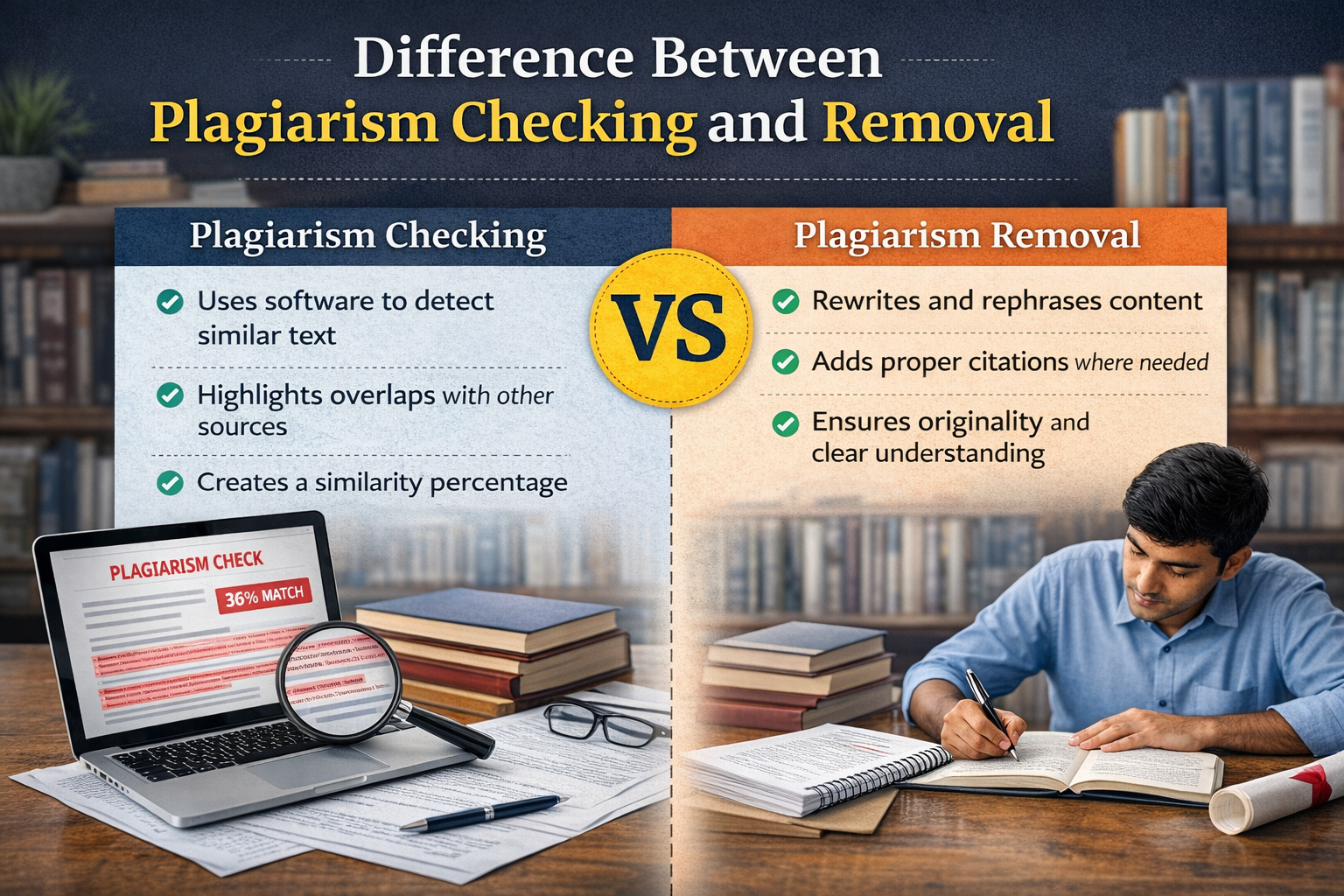
Plagiarism checking refers to the process of scanning a document using software to detect any unoriginal content — that is, content which matches existing published material. In India, most universities rely on tools like Turnitin, Urkund (now Ouriginal), and other similarity detection platforms. These tools generate a similarity report, highlighting the sections that appear similar to content from books, journals, online sources, or previous student work. Importantly, this process does not make any changes to the content — it merely identifies where the issues lie.
In contrast, plagiarism removal is the next step — the actual process of addressing the identified overlaps. This involves rewriting, rephrasing, restructuring, and properly referencing the borrowed ideas. While plagiarism checking is automated, removal is human-intensive and often nuanced. It requires understanding the meaning of the content, deciding what to quote directly, what to paraphrase, and how to blend the idea into one’s own argument. Many Indian researchers mistakenly believe that running a check and reducing the percentage with synonyms is enough. However, experienced guides and university evaluators can often spot superficial changes that fail to reflect true understanding.
Let’s consider a scenario common in Indian private universities. A PhD student uses several sources to explain a theory in their literature review. They run a plagiarism check and find a 28% similarity. They replace a few words, change sentence order, and bring it down to 15%. However, the guide returns the draft, saying it still reads like copied material. This is because what was done was only cosmetic — the student checked and changed words, but did not remove or ethically rewrite the content. The difference here lies in depth: checking is surface-level detection; removal demands re-engagement with the content.
The misunderstanding also stems from the way plagiarism is taught — or not taught — in many Indian institutions. Students are often trained on how to upload to a plagiarism checker but are rarely taught how to ethically incorporate sources, paraphrase effectively, or distinguish between common knowledge and cited work. As a result, checking is overvalued and removal is underdeveloped as a skill. This gap can be problematic, especially for scholars in interdisciplinary research or those writing in English as a second language. A high similarity score may discourage them, while lack of removal knowledge may put their submission at risk.
Also, in the context of doctoral admission in India, particularly in private universities, some candidates submit proposals that pass plagiarism checks but still reflect poor academic ethics. Admission panels increasingly look beyond percentage scores — they assess whether the content shows original thought, critical engagement, and proper scholarly behaviour. This makes plagiarism removal not just a requirement before submission, but a habit that needs to be developed throughout the research journey. Understanding that checking is just the start — and removal is the real work — can help scholars avoid many academic setbacks.
Why the Distinction Matters for Indian Researchers
This difference has practical and cultural significance. In Indian academia, where hierarchical guidance is strong and time for mentorship is limited, many students rely on third-party services to “handle” plagiarism. These services often promise low similarity but do not guarantee conceptual integrity. If a student doesn’t know the difference between a good plagiarism report and a meaningful plagiarism-free thesis, they risk submitting work that may pass software but fail academic scrutiny. This is especially relevant as private universities in India are improving their research protocols to gain NAAC or NIRF recognition, where publication and originality matter more than ever.
Moreover, Indian students coming from regional language backgrounds or professional courses may face more difficulty in expressing complex ideas in original English. For them, plagiarism removal must be more than just rewriting — it must be part of learning how to write academically. Institutions too must recognise this distinction, offering not just access to checkers, but workshops on source integration and academic ethics. PhD supervisors, research committees, and academic counsellors can play a vital role in making this distinction clearer, so that scholars move from mechanical fixes to meaningful rewriting.
In a time when research visibility is increasing — with institutional repositories, UGC guidelines, and journal databases — Indian scholars must be more cautious. Plagiarism checking without removal is like a medical test without treatment. It alerts, but does not cure. Universities may still accept submissions based on similarity percentage alone, but serious academic recognition — whether national or international — comes only when the work shows clear originality and ethical writing.
Conclusion
Plagiarism checking and plagiarism removal may sound similar, but they serve entirely different purposes in the research process. One detects the problem; the other solves it. For Indian PhD aspirants and academic professionals, especially those navigating the growing demands of private universities, understanding this distinction can make all the difference. It can ensure that research is not just cleared for submission, but stands the test of time, scrutiny, and scholarly value.