Introduction
Balancing education with work responsibilities is never easy, yet thousands of Indian professionals take up this challenge every year. Whether it is a teacher seeking promotion, an IT employee aiming for a management role, or a government worker aspiring for higher pay scales, the common thread is the desire to grow academically without stepping away from employment. Distance education has emerged as the most practical pathway for such learners. But while the advantages are clear, working professionals also need realistic expectations about the demands and limitations of studying through this mode. Understanding what distance education offers—and what it requires in return—helps professionals make informed choices that align with their career goals.
Flexibility Without Leaving Employment
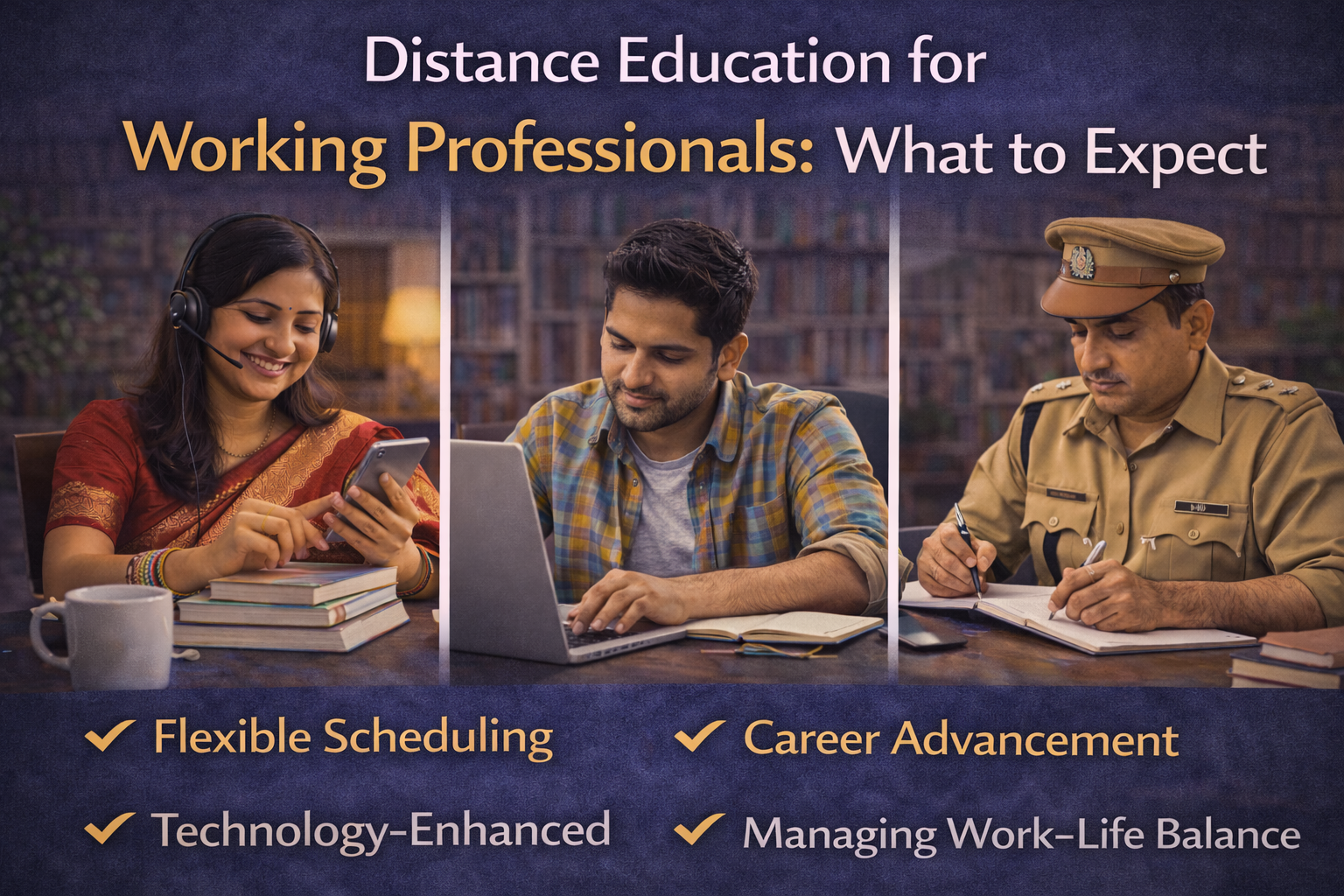
The most attractive feature of distance education for working professionals is flexibility. Unlike regular programs that demand full-time attendance, distance courses allow learners to continue working while studying at their own pace. This is particularly important in India, where financial and family responsibilities often prevent mid-career employees from leaving their jobs for further studies.
However, flexibility should not be mistaken for ease. Professionals must still meet assignment deadlines, prepare for examinations, and engage with study material. The absence of a fixed classroom schedule means learners need strong self-discipline to manage time effectively. A working professional who underestimates this requirement may struggle despite the flexibility.
Recognition and Career Relevance
One common concern among working professionals is whether distance degrees carry weight in their industry. The University Grants Commission’s Distance Education Bureau (UGC-DEB) has clarified that degrees from approved institutions are legally equivalent to regular ones. For government employees, this ensures eligibility for departmental promotions and competitive examinations.
In the private sector, recognition depends not only on the degree itself but also on how professionals apply their learning at work. For example, an MBA earned through distance mode gains credibility when the learner demonstrates improved managerial skills or applies theoretical knowledge in their job. Employers increasingly appreciate employees who upgrade qualifications without leaving the workforce, seeing it as a sign of dedication and commitment.
The Role of Technology in Distance Learning
Distance education today is very different from the correspondence courses of the past. Many universities now use digital platforms, recorded lectures, discussion forums, and e-resources to engage students. For working professionals, this means that learning can be integrated into daily routines—watching a lecture on the commute, joining an online discussion after work hours, or submitting assignments digitally.
Yet, technology also brings its own challenges. Internet access, digital literacy, and the discipline to engage with online platforms are essential. Professionals in smaller towns or those less comfortable with technology may initially find it demanding. Universities offering strong technical support and user-friendly platforms make the transition easier for such learners.
Managing Work–Study–Life Balance
Perhaps the greatest challenge for working professionals is balancing multiple roles. Distance learners often juggle office responsibilities, household duties, and academic commitments simultaneously. Unlike full-time students, they rarely have uninterrupted hours for study. This means success depends on micro-scheduling—using weekends, late evenings, or early mornings for coursework.
Support from family and workplace also makes a difference. Professionals whose employers recognise and encourage further study often find the journey smoother. Some organisations even offer study leave or financial assistance for employees pursuing distance degrees, making the balancing act more manageable.
Realistic Expectations About Outcomes
While distance education opens doors, it is not a magic solution. Working professionals must be realistic about what to expect. A distance MBA may help in securing managerial responsibilities, but it will not automatically guarantee a senior leadership role. Similarly, a distance postgraduate degree may make one eligible for promotion, but the competition within government or private sectors remains tough.
The true value of distance education lies in combining academic credentials with professional experience. Employers tend to view distance degrees most positively when they complement the learner’s existing career trajectory. A working teacher with a distance M.Ed., for instance, is seen as well-prepared for leadership roles in education, while an engineer with a distance MBA may be valued for technical expertise combined with managerial training.
Myths About Distance Learning for Professionals
Several myths continue to surround distance education for working professionals. One misconception is that distance degrees are “easier” to earn. In reality, balancing work and study often makes the journey harder than full-time education. Another myth is that employers dismiss distance degrees. While some bias exists, recognition is strong when the program is UGC-DEB approved and the learner applies knowledge effectively.
A third misconception is that distance education lacks interaction or peer learning. Many modern programs encourage networking through online forums, virtual classrooms, and even occasional contact classes, ensuring professionals do not feel isolated in their academic journey.
Conclusion
Distance education for working professionals in India is not just an alternative—it is a necessity for those who wish to grow without pausing their careers. With regulatory recognition, technological advancement, and increasing acceptance in both government and private sectors, it provides a credible route for upskilling.
Yet, success in this mode requires discipline, time management, and realistic expectations. Professionals who approach distance learning with clarity about its demands and confidence in its value often find that it enhances both their career prospects and personal growth. For India’s vast workforce, distance education stands as a bridge between present responsibilities and future aspirations.