
Introduction
For many years, distance education in India was associated mainly with printed study material and periodic assignments submitted by post. Students depended on self-study and occasional contact classes at regional centers. But with technological advances, particularly after the pandemic, distance education has transformed into a more interactive model. One of the most impactful innovations has been the integration of recorded lectures into distance learning programs. These recordings bridge the gap between classroom instruction and independent study, offering learners the chance to hear concepts explained directly by faculty without being confined to specific schedules.
Understanding how recorded lectures fit into the larger framework of distance education is crucial, especially for students weighing their options in 2025. This blog explains how recorded lectures work in practice, their advantages, limitations, and why they are becoming a cornerstone of India’s open and distance learning landscape.
The Role of Recorded Lectures in Distance Learning
Recorded lectures bring the classroom experience into the homes of distance learners. Instead of relying only on printed material, students can access pre-recorded videos where professors explain concepts, use examples, and sometimes include slides or demonstrations. These lectures are often structured to follow the curriculum module by module, ensuring alignment with the prescribed syllabus.
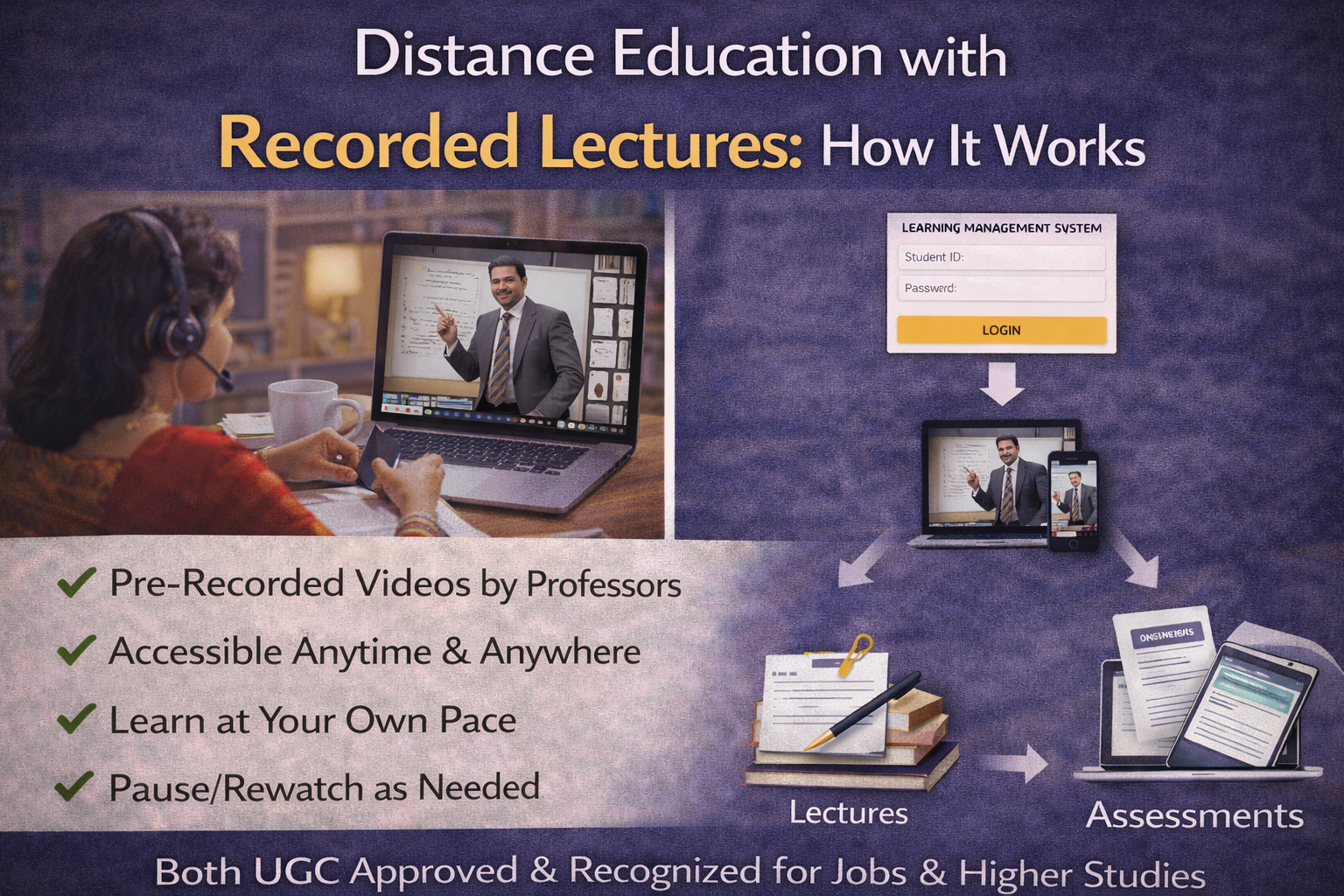
Most universities offering distance programs now maintain digital platforms or portals where these recordings are uploaded. Students can log in anytime, stream the lecture, or download it for offline viewing. Some institutions also provide DVDs or pen drives for learners who lack reliable internet access, keeping the inclusivity of distance education intact.
How the System Works in Practice
When a student enrolls in a distance program, they typically receive login credentials for the university’s learning management system (LMS). This portal acts as a central hub, where recorded lectures are uploaded alongside e-books, assignments, and announcements. Lectures are often broken into short, manageable segments—20 to 40 minutes—making them easier to absorb compared to long, continuous sessions.
Students can revisit a lecture as many times as needed. For example, if a concept in economics or statistics feels complex, the learner can pause, replay, and take notes until they grasp it fully. In some cases, universities supplement recorded content with occasional live sessions or Q&A forums, creating a blended model that combines flexibility with support.
Advantages of Recorded Lectures for Learners
- Flexibility of Time and Place: Perhaps the biggest strength is that students are not bound to attend at a fixed schedule. Working professionals or homemakers can watch lectures at their convenience.
- Self-Paced Learning: Every learner has a different rhythm. Recorded lectures allow individuals to progress at their own pace without the fear of missing important points.
- Reinforcement of Complex Topics: Subjects like mathematics, law, or management often involve layered concepts. Students can re-watch specific sections until clarity is achieved.
- Accessibility for Rural Learners: Even in areas with poor connectivity, recorded content can be downloaded once and revisited multiple times without consuming continuous data.
- Consistency of Quality: Unlike live sessions where distractions or technical issues may arise, recorded lectures are carefully prepared, ensuring clarity and consistency.
Challenges and Limitations
While recorded lectures improve the distance learning experience, they are not without limitations. The biggest drawback is the lack of real-time interaction. Unlike a classroom or a live online session, students cannot immediately ask questions or clarify doubts. Universities attempt to address this by creating discussion forums, email support, or scheduled doubt-clearing sessions, but the gap remains noticeable.
Another issue is digital access. Although recorded lectures reduce dependency on continuous internet, students still require devices such as smartphones, tablets, or laptops. For learners from economically weaker sections, this remains a barrier. Additionally, some recorded lectures may feel one-directional and monotonous if not designed with engaging visuals or examples.
Impact on Academic Outcomes
Studies and feedback from students show that recorded lectures improve comprehension and retention. They serve as a valuable supplement to reading material, especially for learners who struggle with purely text-based study. For instance, a student preparing for distance MBA exams may find case study explanations far clearer when delivered through a recorded video compared to reading dense text alone.
Moreover, recorded lectures help in exam preparation. Students can selectively revisit topics close to exams, focusing on the areas they find most challenging. This adds a layer of personalization that traditional distance education often lacked.
The Institutional Perspective
From the university’s point of view, recorded lectures enhance credibility and appeal. Distance programs in India were often criticized for being impersonal and lacking academic depth. By integrating recorded content, institutions project themselves as modern, student-friendly, and technologically up-to-date. It also allows them to standardize teaching quality across a large number of students, ensuring uniform delivery regardless of location.
Looking Ahead: The Future of Recorded Lectures in Distance Education
As India moves towards hybrid education, recorded lectures will remain central but will also evolve. Future trends point towards interactive recorded sessions, where embedded quizzes, annotations, or case simulations make learning more engaging. Artificial intelligence tools may soon allow students to “ask” the video questions and get instant clarifications from AI-powered systems.
Universities are also exploring multilingual recorded lectures to reach learners in regional languages, ensuring inclusivity. This is especially important in a country where distance education serves students from diverse linguistic and cultural backgrounds.
Conclusion
Recorded lectures have reshaped distance education in India, making it more accessible, flexible, and learner-friendly. They combine the best aspects of traditional self-study with the convenience of modern technology, giving students the confidence that they are not missing out on classroom-style teaching. While challenges like limited interaction and digital access remain, the benefits far outweigh the drawbacks.
For students considering distance education in 2025, recorded lectures represent not just an add-on but a core part of the learning journey. They democratize access to faculty expertise, empower self-paced study, and prepare learners for exams and careers with greater confidence. In many ways, recorded lectures symbolize the future-ready spirit of India’s distance education system.