
Introduction
For Indian PhD scholars, especially those studying in private universities or pursuing doctoral work part-time while working, citations and references are often one of the most confusing aspects of academic writing. The formatting rules are dense, citation styles vary, and many scholars face pressure to cite enough sources while also avoiding plagiarism. In this context, AI tools like ChatGPT, Quillbot, and other citation generators have become increasingly popular. They promise fast reference creation, instant bibliography lists, and even in-text citations.
But there’s a problem scholars rarely anticipate: AI can introduce serious inaccuracies in your citations — and you may not even realise it. These errors aren’t just technical. They can misrepresent sources, cite work that doesn’t exist, or mix up authors and titles. In the Indian PhD ecosystem, where thesis evaluation includes close scrutiny of references, such mistakes can harm your credibility, delay approval, or worse, invite allegations of negligence.
Understanding how AI creates these errors — and how to avoid them — is essential for maintaining academic integrity while still benefiting from digital support.
Where AI Citation Tools Often Go Wrong
Unlike reference managers like Zotero or Mendeley, which are designed specifically for academic citation management, many AI tools function as text generators — not bibliographic databases. This means that when you ask an AI tool to “add references to this paragraph” or “give me 5 citations for this topic,” it doesn’t pull data from verified journal databases. Instead, it guesses.
This guessing process is where the problems begin.
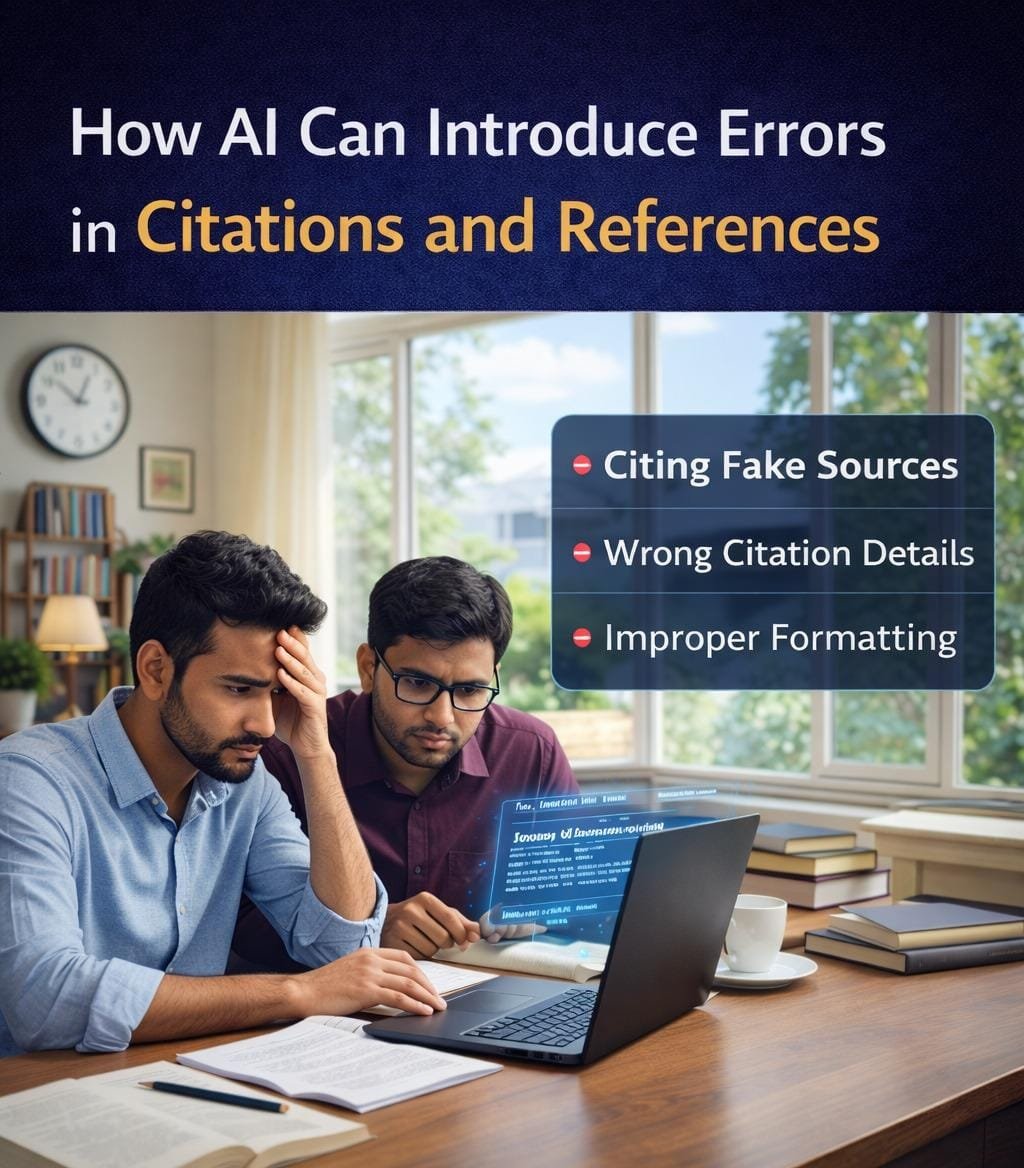
- Hallucinated Sources: AI tools often invent article titles, author names, or journal names that sound plausible but do not actually exist. These “hallucinated” references are especially common in niche Indian topics — like caste-based labour practices, local governance models, or region-specific education interventions — where data is less globally available. A scholar in Jharkhand reported including a reference to a 2016 article on tribal land rights in a respected journal — only to find out during viva preparation that the article was entirely fictional.
- Incorrect Details: Even when referencing real sources, AI can confuse the title and the author, mix publication years, or cite the wrong journal. This often happens when similar-sounding papers exist. In fields like management, education, or environmental policy — which have overlapping terminologies — such mix-ups are common with AI assistance.
- Wrong Citation Style: Indian universities often follow APA, MLA, or specific institutional styles. AI-generated references may not match these exactly. They may miss italics, capitalization, DOI numbers, or formatting rules. A thesis that appears sloppy in citations can give examiners the impression that the scholar lacks attention to detail — even if the research itself is strong.
- Bias Towards Global Sources: AI tools tend to suggest Western authors and journals, even for topics that are India-specific. This may result in your thesis lacking regional grounding, or worse, overlooking important Indian scholarship. Over time, this creates an imbalance — your research may look polished, but it will feel disconnected from the Indian academic ecosystem.
Why This Matters in the Indian PhD Context
Citation issues aren’t just about presentation. In Indian universities — especially private ones with UGC affiliation — plagiarism and citation accuracy are taken seriously. Before final submission, most institutions now require a plagiarism report. But what many scholars don’t realise is that citation inaccuracies can also lead to questions of integrity, especially when fabricated sources are detected.
External reviewers, especially those assigned by the university or UGC-recognised panels, often scan the bibliography carefully. They check whether sources are real, relevant, and properly cited. A few questionable entries can lead to comments like “lack of scholarly rigour” or “inconsistent citation practice” — both of which can delay your thesis approval and force multiple rounds of revision.
A PhD scholar from a private university in Punjab shared how his thesis was returned with major comments on references. He had used AI to generate citations and didn’t verify them. Two of the journals didn’t exist. The examiner flagged this as careless scholarship. Even though it wasn’t intentional, the damage was done. He had to manually rework the entire reference list and provide evidence of each source.
How to Avoid AI-Driven Citation Errors
The solution is not to abandon AI completely, but to use it wisely — and always verify. If you’re using AI for citation generation, treat its output as a starting point, not the final list. Cross-check every citation using Google Scholar, JSTOR, or your university’s academic database. If you’re unsure, tools like Zotero or EndNote — which are built for academic citation — offer more reliable formatting and integration with MS Word or Google Docs.
Equally important is understanding what you’re citing. Don’t add references just to fill a bibliography.
Read the abstracts at least, understand the relevance, and ensure you’re not misrepresenting the work. If you’re referencing Indian government reports, policy documents, or newspaper articles, cite them as per your institution’s guidelines — AI rarely gets this right.
For scholars writing in English as a second language, consider working with a human academic editor during the final stages. They can help align your references with your writing, ensure proper formatting, and flag any inconsistencies before submission.
Conclusion
AI tools offer speed and convenience — and for busy Indian PhD scholars managing research with limited time and support, they seem like a lifesaver. But when it comes to citations and references, that convenience can come at a high cost. Fabricated sources, incorrect details, and style mismatches can weaken the very foundation of your academic credibility.
In doctoral work, your reference list is not just a formality. It’s a reflection of your reading, your awareness, and your responsibility as a scholar. Trust AI to assist — but never to decide. Your thesis deserves more than auto-generated footnotes. It deserves accuracy, integrity, and your careful attention.