
Introduction
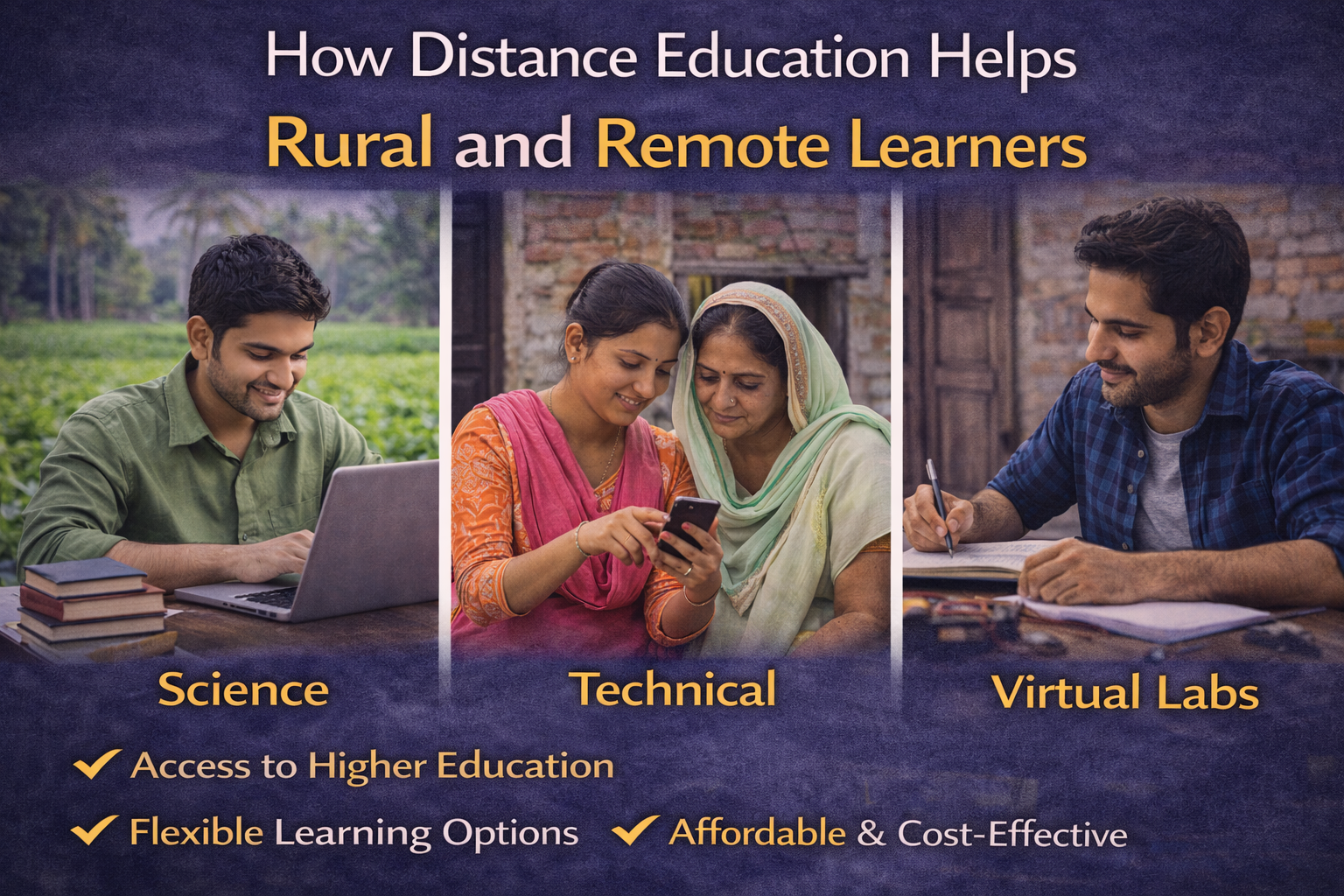
For many students in rural and remote parts of India, pursuing higher education has always been challenging. Traditional universities and colleges are often concentrated in urban centers, leaving large parts of the population without easy access to quality education. Travelling long distances, relocating to cities, and bearing the financial burden of hostel and living expenses make regular education unattainable for many families. Distance education has emerged as a lifeline in this context, creating pathways for learners who would otherwise be left behind. By leveraging technology, flexibility, and inclusive policies, distance learning has redefined the accessibility of higher education for rural India.
Bridging the Geographical Divide
The most obvious advantage of distance education for rural learners is that it breaks the barrier of location. A student living in a small village in Bihar or a remote town in the Northeast no longer needs to move to Delhi, Mumbai, or Bengaluru to earn a recognized degree. Through distance education, universities reach students rather than expecting students to travel to them. With printed study materials, digital lectures, and occasional contact programs held at regional centers, higher education becomes accessible without displacing learners from their communities.
This accessibility also reduces the dropout rates that are common among rural students, who often abandon studies due to financial or geographical hurdles. By staying within their families and communities, they can continue education alongside daily responsibilities.
Cost-Effective Learning
Financial limitations remain one of the biggest obstacles to higher education in rural India. Hostel fees, city living expenses, and travel costs often exceed tuition itself. Distance education significantly reduces these costs by eliminating the need for relocation. Study materials are delivered to students’ homes or made available online, and examinations are conducted at centers close to their residence.
For families dependent on agriculture or small-scale work, distance education ensures that education does not become a financial strain. Many programs are priced lower than regular courses, making them accessible to a larger section of society. In this way, distance learning addresses the economic inequalities that restrict educational opportunities.
Balancing Education with Responsibilities
Rural learners often have responsibilities that urban students may not face at the same scale. Many are involved in farming, household work, or supporting family businesses from a young age. Regular programs that require daily attendance are not feasible for them. Distance education allows these students to study at their own pace, balancing education with livelihood.
This flexibility is particularly valuable for women in rural areas. Social and cultural norms may restrict their ability to leave home for studies, but distance learning provides a dignified alternative. Women can pursue higher education, qualify for jobs, or prepare for competitive exams while still fulfilling family expectations. In many villages, women earning degrees through distance mode are not only transforming their own lives but also inspiring younger generations to follow suit.
Digital Tools and New Possibilities
The growth of digital technology has further enhanced the role of distance education. With smartphones and internet penetration reaching rural India, students can now access online lectures, e-books, and discussion forums. Even where connectivity is uneven, recorded lectures and downloadable resources make study possible offline. Universities are increasingly adopting hybrid models that blend printed materials with online engagement, ensuring that rural learners are not left out of the digital wave.
For example, a rural student enrolled in a distance MBA can watch recorded case study discussions, participate in WhatsApp groups for peer learning, and attend occasional workshops at the nearest study center. This combination of low-tech and high-tech solutions ensures inclusivity, regardless of digital divides.
Opening Pathways to Employment
One of the strongest motivators for rural learners is employability. Distance degrees approved by UGC-DEB are recognised for government jobs, competitive exams, and promotions. Many rural students use distance education to qualify for teaching positions, clerical posts, or public sector roles. Others pursue postgraduate courses to prepare for NET or PhD programs, aiming for academic careers.
Distance education also empowers rural learners to acquire skills relevant to local contexts. For example, programs in agriculture, rural development, or public administration align directly with the needs of rural communities. This knowledge not only enhances employability but also enables students to contribute meaningfully to local development.
Overcoming Social Barriers
In rural India, education is not only about logistics but also about social acceptance. Traditional families may resist sending daughters or sons far from home for higher studies. Distance education provides a socially acceptable middle ground—it allows learners to pursue degrees while remaining within the community. This has been particularly important for women, who might otherwise be denied the chance to study further.
By making education compatible with rural lifestyles and cultural expectations, distance learning reduces resistance and expands opportunities. Over time, this also reshapes attitudes toward higher education within communities, making it a norm rather than an exception.
The Role of Private and Open Universities
Institutions like Indira Gandhi National Open University (IGNOU) and several state open universities have been pioneers in making higher education accessible across India. In recent years, private universities have also entered the space with flexible, technology-driven distance programs. These institutions not only offer degrees but also provide academic counseling, online support, and recognition that is critical for career growth.
Such initiatives ensure that rural students are not limited to local institutions but have access to a national and even global educational network. By maintaining UGC-DEB approval, these universities give rural learners the confidence that their degrees will hold value in both government and private sectors.
Conclusion
Distance education has become a powerful equalizer in Indian higher education. For rural and remote learners, it provides access, affordability, and acceptance—all without uprooting them from their homes and communities. By bridging the gap between aspiration and opportunity, distance learning ensures that geography no longer determines destiny.
For students who once saw higher education as out of reach, distance programs offer a legitimate and practical path forward. In doing so, they not only transform individual lives but also contribute to the larger project of rural empowerment and national development. Distance education, therefore, is not just a mode of study; it is a bridge to inclusion and progress.