
Introduction
For many Indian PhD scholars, discovering a high similarity score in a plagiarism report can feel like an unplanned detour on an already demanding academic journey. Whether the research is being pursued in a private university with flexible schedules or a traditional public institution, plagiarism removal has become a crucial checkpoint before submission. While some imagine it to be a simple matter of rewording a few sentences, the actual time it takes is influenced by a combination of academic, institutional, and personal factors.
In doctoral admission and thesis evaluation processes, similarity checks are now standard practice. Universities across India, especially those offering PhD programmes to working professionals, have set strict originality thresholds. When a report crosses those limits, even slightly, the process of making revisions begins. Understanding how long plagiarism removal takes on average is important for scholars who must coordinate academic deadlines with professional responsibilities, supervisor availability, and institutional review timelines.
Extent and Nature of Overlap
The duration of plagiarism removal largely depends on the extent and nature of the overlap. If a report shows only a minor excess over the permissible percentage, revisions can sometimes be completed in a few days. In such cases, the scholar might only need to rephrase certain parts or replace direct matches with original expression while maintaining the intended meaning. However, when significant portions of a chapter — often the literature review or methodology — are flagged, the process becomes more time-intensive. Rewriting these sections requires careful attention to academic accuracy and originality, which cannot be rushed without risking content quality.
Type of Similarity Detected
The kind of similarity flagged is another important factor. In some cases, the material consists of common technical phrases or standard definitions that are unavoidable in a specialised field. These may be easier to address or justify. In other situations, the overlap results from heavy dependence on a single source, which calls for substantial restructuring of the text and integration of ideas from multiple references. This deeper rewriting demands not just linguistic skill but also renewed engagement with the source material, naturally adding to the time required.
Institutional Review Timelines
Institutional processes also shape the timeline. Even after revisions are made, the updated document must be resubmitted for another similarity check. Private universities often process these rechecks quickly, sometimes within two working days. On the other hand, larger public universities or research bodies may take longer, especially when the plagiarism check is conducted in batches or routed through multiple administrative levels. If the supervisor’s feedback is part of the process, the scholar may also have to wait for their review, which can be delayed by teaching schedules, examination duties, or research commitments.
Scholar’s Workload and Availability
The scholar’s own circumstances are equally important. Many doctoral candidates in India are employed full time, meaning that their rewriting work is often limited to evenings and weekends. Those who can dedicate long, uninterrupted hours to revisions may complete the process in a shorter time frame, while others with heavy workloads or personal commitments might find the same task extending over several weeks.
Beyond Removal: Strengthening the Work
In some cases, plagiarism removal is not just about replacing similar text but also about enhancing the scholarly foundation of the work. Supervisors may recommend expanding citations, incorporating additional references, or reworking arguments for clarity. This means the process becomes part of a broader academic refinement, rather than a purely corrective task. Gathering new literature, aligning it with existing arguments, and ensuring correct citation formatting can easily add extra days to the revision period.
Challenges in Interdisciplinary Research
Interdisciplinary theses present another layer of complexity. When a research project spans two or more fields, the originality expectations can differ between disciplines. A study combining engineering and management principles, for instance, might require separate scrutiny of technical descriptions and theoretical frameworks. Each area may demand different levels of rewriting, lengthening the time before the similarity report falls within acceptable limits.
Typical Timeframes
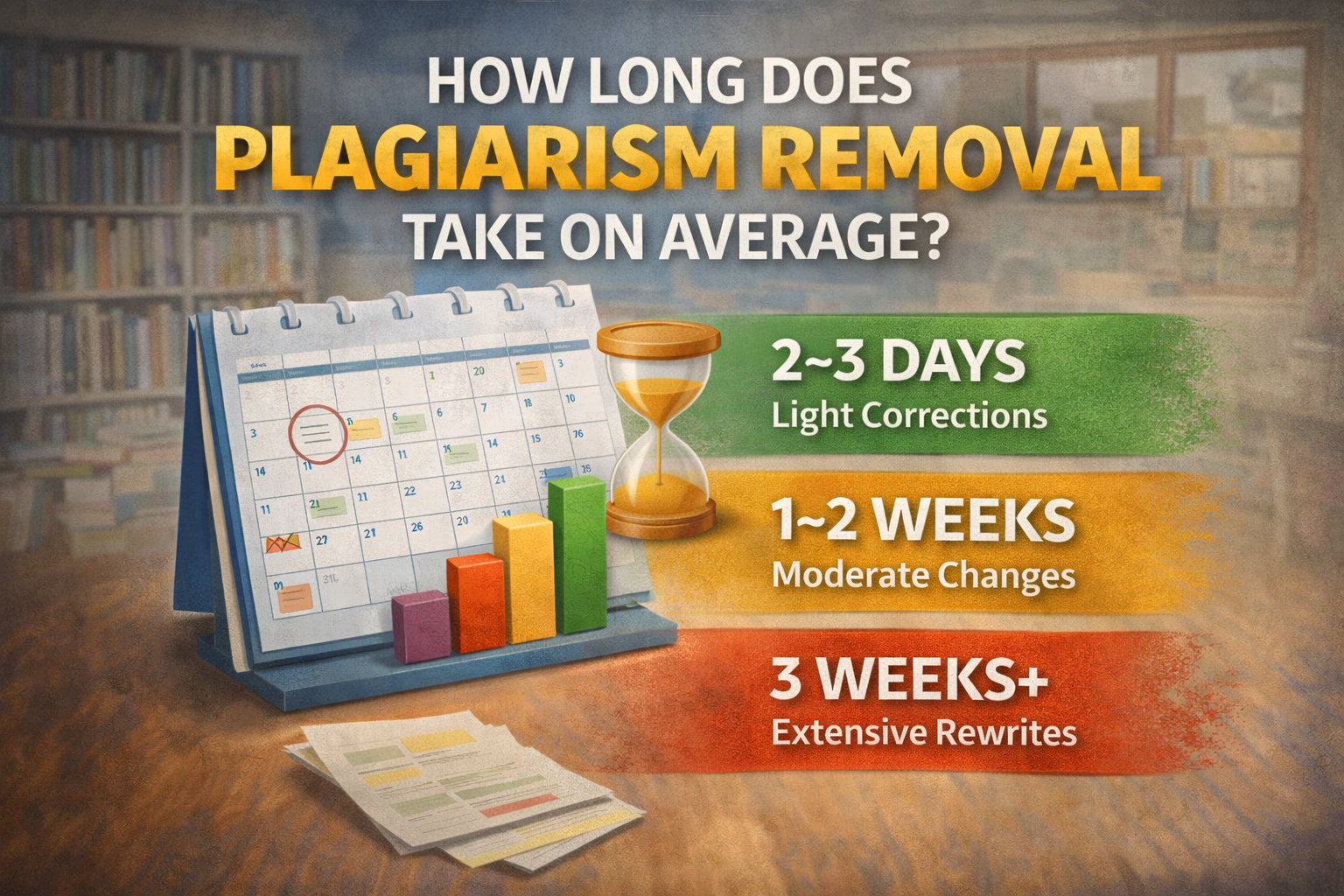
Given these realities, there is no single universal answer to how long plagiarism removal takes. For light corrections, where only a few percentage points need to be reduced, the process might be completed within two to three days, provided the scholar can work consistently and the university processes rechecks quickly. For more moderate revisions involving substantial paraphrasing and reference adjustments, a period of one to two weeks is common. In cases where large sections must be restructured, particularly when multiple feedback rounds are involved, the process can extend to three weeks or more.
Conclusion
Plagiarism removal is not just a technical requirement but a stage in which a scholar re-engages with their own work to ensure it meets the standards of academic originality. The time it takes reflects more than the number of flagged lines — it is shaped by the depth of revisions, the responsiveness of institutional systems, and the scholar’s own pace of work. For PhD candidates in India, especially those balancing research with employment, building realistic timelines for this process can prevent unnecessary stress at the final stage of submission. Addressing plagiarism is, in the end, an exercise in refining the authenticity and credibility of one’s scholarly contribution.