
Introduction
For anyone beginning a doctoral journey in India, the choice of supervisor is never just about academic compatibility. It also involves understanding how much time and attention a guide can realistically give. Many scholars find themselves wondering: how many PhD students can one guide supervise at a time? The question may sound administrative, but it directly affects the quality of mentorship, the pace of research, and the overall doctoral experience. With private universities expanding their research programmes and public universities facing pressure from rising enrolments, the matter of supervision limits has gained increasing importance. This is not only about numbers but also about balancing access to doctoral opportunities with the need for meaningful academic support.
The UGC Framework and Its Rationale
The University Grants Commission (UGC), as India’s main higher education regulator, has prescribed limits on the number of PhD students a faculty member can supervise. These limits are not arbitrary; they are designed to ensure that every scholar receives sufficient guidance. Supervising a doctoral candidate is far more intensive than teaching a course or guiding a master’s dissertation. It requires sustained involvement in literature review, research design, data collection, and thesis writing. Without such limits, a single faculty member could end up with a dozen or more students, which may dilute attention and compromise quality. By regulating numbers, UGC tries to strike a balance between expanding access and maintaining academic rigour.
Differentiation by Academic Rank
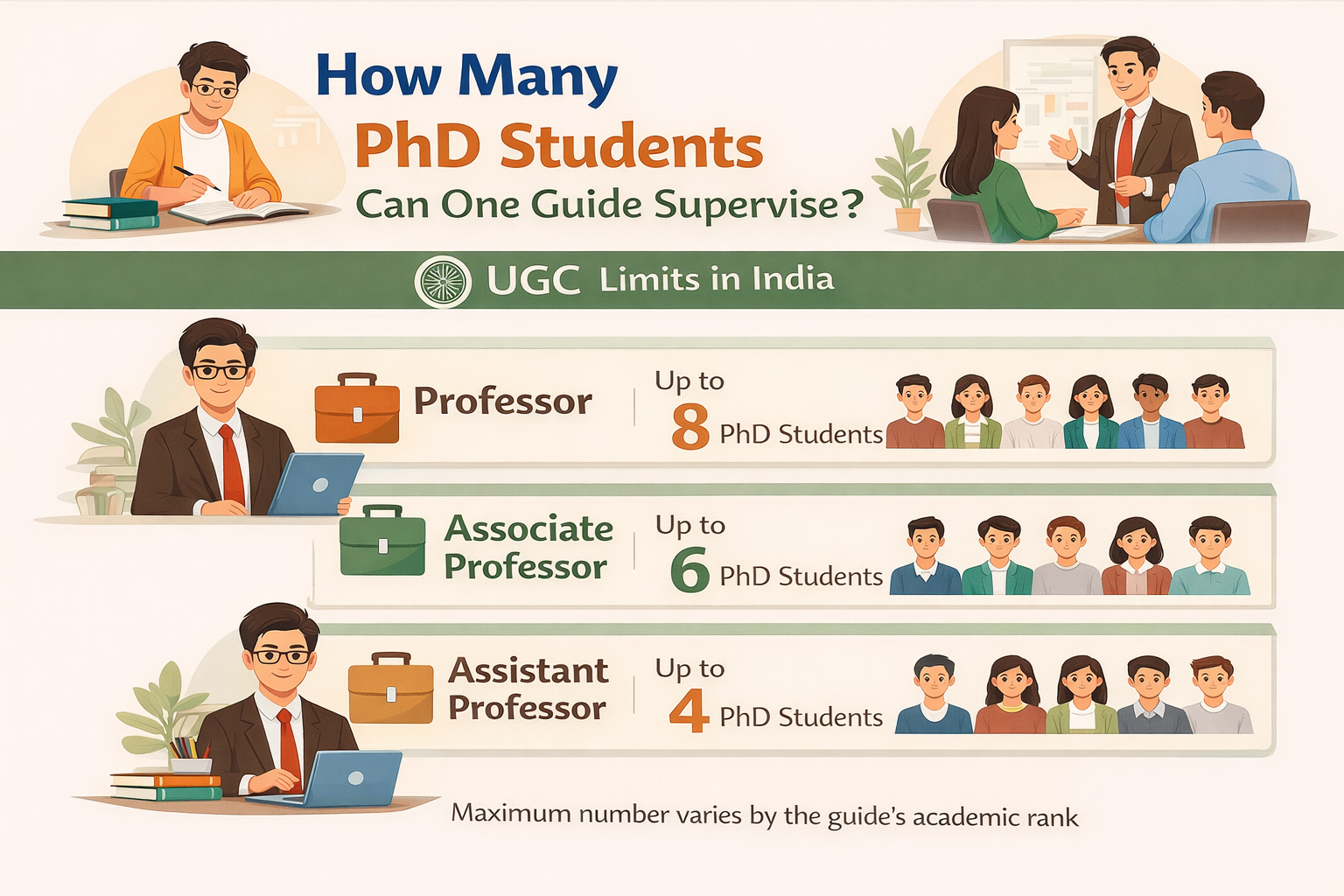
One important aspect of supervision limits is that they are not uniform across all faculty designations. Professors, by virtue of their seniority and experience, are generally allowed to supervise more candidates compared to associate or assistant professors. This hierarchy acknowledges not only years of academic engagement but also the ability to manage complex research portfolios. For example, a professor in a central university may officially be permitted to guide up to eight scholars at a time, while an associate professor might be allowed six, and an assistant professor four. These numbers can vary slightly depending on institutional interpretation, but the principle remains consistent: senior faculty can manage more doctoral scholars, while early-career faculty are given a smaller number to ensure quality supervision.
Variations Across Institutions
While UGC provides a general framework, implementation rests with universities. Public universities usually enforce these limits through doctoral research committees, ensuring that no supervisor exceeds the sanctioned number. Private universities, while bound by UGC norms, may sometimes exercise flexibility, particularly in emerging disciplines where the demand for guides exceeds availability. For instance, in fast-growing fields like data science or biotechnology, a private university may temporarily expand supervisory capacity by allowing joint supervision or by appointing co-guides to share responsibility. This flexibility reflects the realities of a system where research interests are expanding more quickly than the pool of recognised supervisors.
The Student’s Perspective
For students, the guide–student ratio is not merely a regulatory figure but a matter of lived experience. A guide with too many scholars may struggle to provide timely feedback, attend review meetings, or resolve research obstacles. Conversely, a supervisor with fewer students can often give more personalised attention, which can make a significant difference in thesis progress. Many Indian doctoral candidates informally ask potential supervisors how many scholars they are already guiding before making a decision. This practical consideration reflects the importance of ensuring that mentorship is not only formally valid but also effectively delivered.
Challenges in Maintaining Ratios
Despite regulations, maintaining the ideal ratio is not always easy. In large public universities, some senior professors may already be supervising near the maximum number allowed, leading to long waiting periods for new admissions. On the other hand, in smaller private universities, limited faculty strength sometimes results in pressure to admit more scholars under a single guide than is ideal. While this may address enrolment needs, it risks stretching supervisors too thin. Another challenge arises when scholars drop out, shift disciplines, or delay completion, complicating the counting of active supervision slots. These realities demonstrate that supervision ratios, while clear on paper, are complex in practice.
The Role of Co-Guides and Joint Supervision
One way universities manage these challenges is by appointing co-guides or encouraging joint supervision. In such cases, the main guide shares responsibility with another faculty member, often from a different department or institution. This not only distributes the workload but also enriches the research with multiple perspectives. For example, in interdisciplinary research on climate policy, a student might have a primary guide from environmental science and a co-guide from economics. While the main guide remains formally responsible, the co-guide’s contribution ensures that supervision is not overly dependent on a single individual. This arrangement also helps maintain effective mentorship even when the number of students per guide approaches the official limit.
Impact on Research Quality
Ultimately, the number of students a guide supervises is directly tied to research quality. When limits are respected, scholars are more likely to receive detailed feedback, timely suggestions, and stronger academic mentoring. Overcrowded supervision, on the other hand, often results in generic advice, slower progress, and weaker research outputs. In India’s competitive academic environment—where timely completion is a persistent challenge—supervision limits can mean the difference between a scholar finishing within the minimum period or struggling for years without adequate guidance. This makes it important for both universities and students to treat ratios not just as regulations but as safeguards for academic success.
Why Students Should Pay Attention
Many doctoral aspirants focus heavily on choosing a university or a research topic, often overlooking the importance of supervision capacity. However, knowing how many PhD students a guide already supervises can provide a realistic picture of the mentorship experience. A faculty member with eight active students may not have the same availability as one with three. While enthusiasm for a particular research area is important, scholars benefit when they balance this with practical considerations about supervision. For Indian students, who often juggle academic commitments with family or professional responsibilities, choosing a guide with adequate time can make the doctoral journey smoother.
Conclusion
The question of how many PhD students one guide can supervise goes beyond regulatory detail; it is central to the quality of doctoral education in India. UGC guidelines set clear limits, but universities interpret them in ways that reflect their faculty strength and research priorities. For scholars, understanding these numbers is not about bureaucracy but about ensuring that their work receives the focused mentorship it deserves. As doctoral education in India continues to grow, both public and private universities must keep the balance between quantity and quality in supervision. In the end, the effectiveness of a PhD guide is measured not by how many students they supervise but by how well they support each one.