
Introduction
Distance education in India has often been associated with government universities and open learning institutions. For many years, private universities were seen as focusing mainly on regular classroom programs, while distance education was dominated by public providers like IGNOU or state open universities. In recent times, however, private universities have begun to reshape this space. With the rise of digital platforms, increased demand for flexible learning, and stricter UGC-DEB guidelines, private universities are now using innovation to make distance education more engaging, credible, and career-oriented.
This shift is significant because private universities bring with them resources, technological agility, and industry linkages that can transform how distance learning is perceived and delivered.
Technology-Driven Classrooms
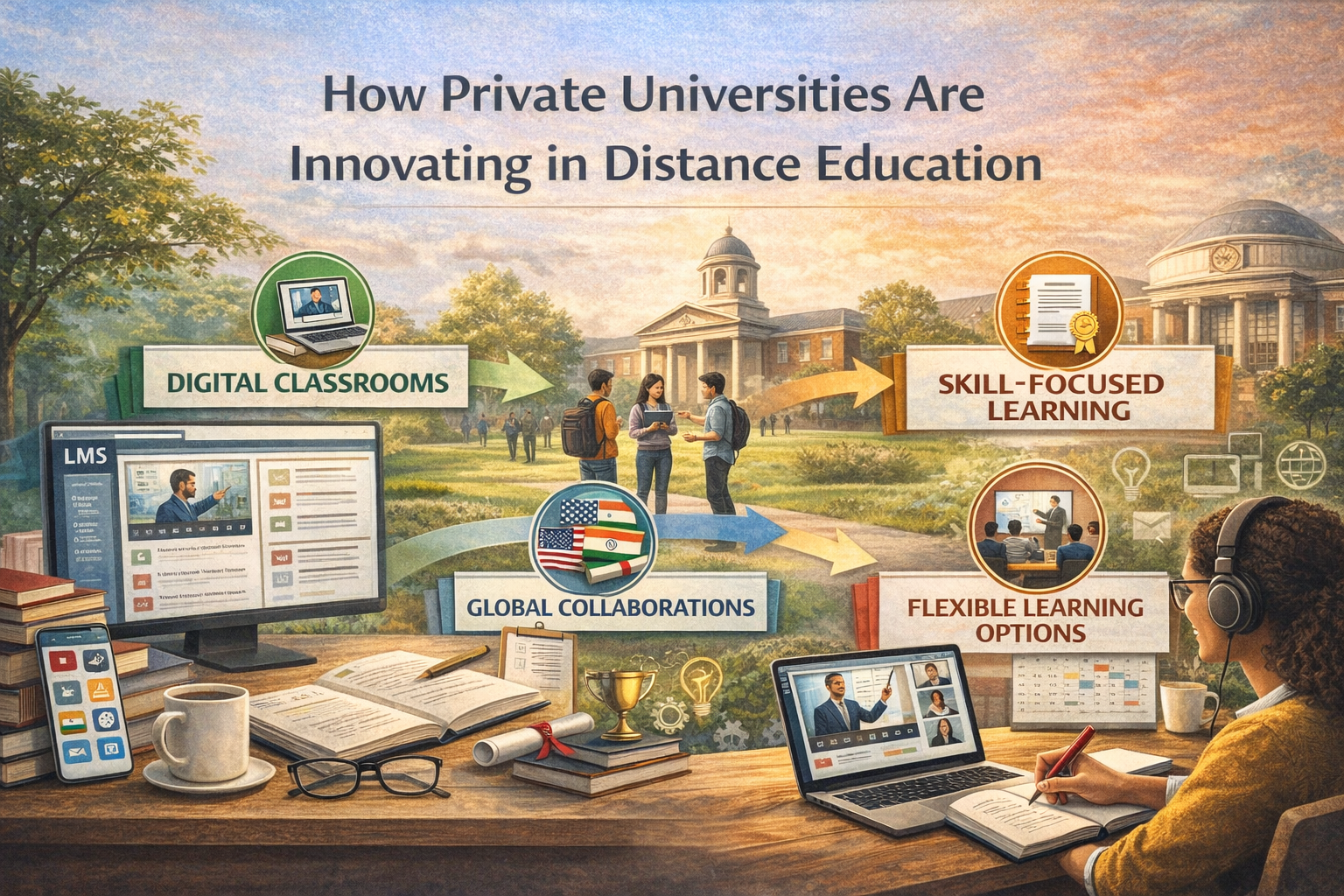
One of the biggest contributions of private universities is the adoption of digital tools to enhance distance learning. Instead of relying solely on printed study material, many institutions now offer access to Learning Management Systems (LMS) with recorded lectures, interactive sessions, and e-libraries. Students can download resources, attend live classes, and revisit recorded lectures at their convenience.
Some private universities have gone a step further by integrating artificial intelligence (AI) and analytics into their platforms. These systems track student progress, provide personalised feedback, and help identify areas where learners may need additional support. Such features bridge the gap between distance and regular learning, making the experience richer and more interactive.
Focus on Employability
Unlike traditional distance programs that were often theory-heavy, private universities are aligning their courses with industry needs. Distance learners today can access skill-based modules, workshops, and even virtual internships as part of their programs. For instance, a student pursuing a distance MBA might get access to case study competitions, online simulations, or industry webinars, all of which prepare them for real-world challenges.
By embedding employability into their curriculum, private universities are addressing one of the long-standing criticisms of distance education—that it does not adequately prepare students for jobs. This approach also makes their graduates more competitive in the private sector.
Blended and Flexible Models
Private universities are also experimenting with blended learning, where distance students can opt for occasional on-campus sessions or attend regional workshops. This hybrid approach provides the flexibility of remote study while still offering opportunities for face-to-face networking and mentorship.
Flexibility is another area of innovation. Many universities now allow rolling admissions, modular programs, and credit transfer systems that make it easier for students to pace their studies according to personal and professional commitments. This is particularly beneficial for working professionals who cannot commit to rigid academic schedules.
Global and Institutional Collaborations
Another unique contribution of private universities is their ability to form collaborations with international institutions and industry partners. Some offer joint certification programs, while others provide access to online lectures from global experts. This kind of exposure was rarely available in traditional distance education.
Additionally, private universities often involve their own faculty in online teaching rather than outsourcing it, ensuring consistency and accountability. When students interact with the same professors who teach on campus, the credibility of the program improves significantly.
Building a Sense of Community
One of the criticisms of distance education in the past was that students felt isolated. Private universities are addressing this challenge by building virtual communities where students can participate in discussion forums, peer learning groups, and online cultural events. These interactions foster a sense of belonging and engagement, making distance learning less lonely and more motivating.
Some institutions even provide dedicated mentorship programs, where experienced faculty guide small groups of students throughout their academic journey. This personal touch adds value to the overall experience.
Conclusion
Private universities in India are redefining distance education by blending technology, flexibility, employability, and global exposure. Their innovations are helping to shift perceptions, showing that distance learning can be both rigorous and rewarding.
For students, these changes mean that choosing a distance program from a reputed private university no longer feels like a compromise but rather an opportunity. For the education sector, it reflects a broader trend where the boundaries between regular and distance modes are becoming increasingly blurred. In 2025 and beyond, private universities are set to play a central role in making distance education not just a second option, but a first choice for many learners.