
Introduction
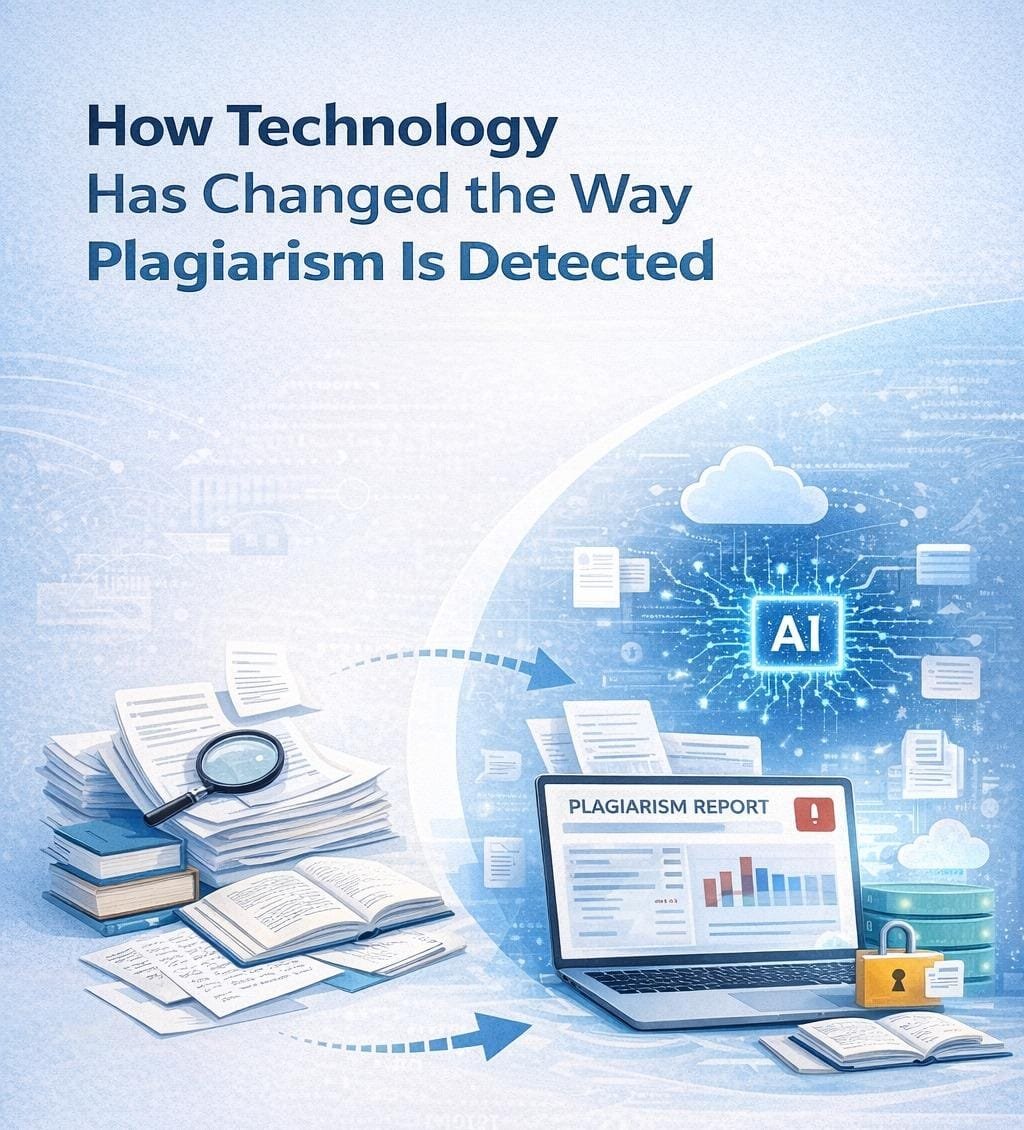
Plagiarism detection in Indian higher education has transformed dramatically over the past two decades. Earlier, identifying copied content relied heavily on manual checks, faculty intuition, and simple keyword searches. However, with the advancement of digital tools and artificial intelligence, detecting plagiarism has become faster, more accurate, and more sophisticated. For PhD students in private universities, understanding this shift is crucial—not only to maintain academic integrity but also to navigate the modern research environment with awareness.
From Manual Checks to Automated Systems
In the past, detecting plagiarism meant comparing physical documents, highlighting suspicious sections, and running them through basic internet searches. This process was time-consuming and often missed cleverly rephrased content. Today, universities use automated plagiarism detection software that can scan thousands of documents in seconds, compare them with vast databases, and flag even subtle similarities.
Database Expansion and Accessibility
Modern tools like Turnitin, Urkund, and Grammarly Premium have access to billions of web pages, academic journals, e-books, and student thesis repositories. This massive database coverage means that content copied from obscure sources is now more likely to be detected. For Indian private universities, the integration of such tools has become a standard practice, especially after UGC’s mandatory plagiarism regulations.
Artificial Intelligence and Pattern Recognition
One of the biggest technological leaps has been the use of AI. These systems do not just look for exact matches; they analyse sentence structure, vocabulary patterns, and contextual meaning to detect paraphrased plagiarism. This is particularly important because many students believe changing a few words is enough to avoid detection—AI now proves otherwise.
Multilingual Capabilities
India’s academic landscape often involves research in multiple languages. Modern plagiarism detection tools are increasingly capable of scanning content in Hindi, regional languages, and English, making it harder to bypass detection by translating text. This is a crucial development for diverse linguistic settings in Indian private universities.
Cloud-Based and Real-Time Analysis
Plagiarism detection is no longer limited to offline reports. Cloud-based tools allow students and faculty to check documents from anywhere, and some provide instant feedback while writing. This enables proactive corrections rather than last-minute panic before submission.
Data Security Concerns
With these technological advancements, there is also a rising concern about data privacy. Many scholars worry about their thesis being stored in tool databases. This has led to the introduction of private repository checks, where documents are scanned without being permanently uploaded, a feature increasingly offered by private universities in India.
Impact on Academic Culture
Technology has not just changed detection—it has also changed behaviour. Knowing that plagiarism can be caught easily has encouraged more students to write original work, seek guidance on citation, and take plagiarism prevention seriously. This cultural shift is one of the most significant impacts of technology in this space.
Conclusion
Technology has revolutionised plagiarism detection from a manual, time-consuming process into an efficient, AI-powered system that leaves little room for dishonesty. For PhD students in private universities, these advancements are both a safeguard and a challenge—they protect academic integrity while demanding higher standards of originality. As tools continue to evolve, scholars must adapt, not just to avoid detection, but to produce genuinely valuable and authentic research.