
Introduction
Examinations are often the most important part of a student’s academic journey because they decide whether the effort invested in study translates into a valid degree. For distance learners in India, exams are not just about testing knowledge but also about ensuring their qualifications are recognised and respected. Since distance education is meant to provide flexibility, many students worry about how exams are conducted, where they need to appear, and what processes they must follow. Appearing for distance education exams in India involves preparation not just in academics but also in logistics, compliance with rules, and understanding the unique formats universities now use.
Exam Formats in Distance Education
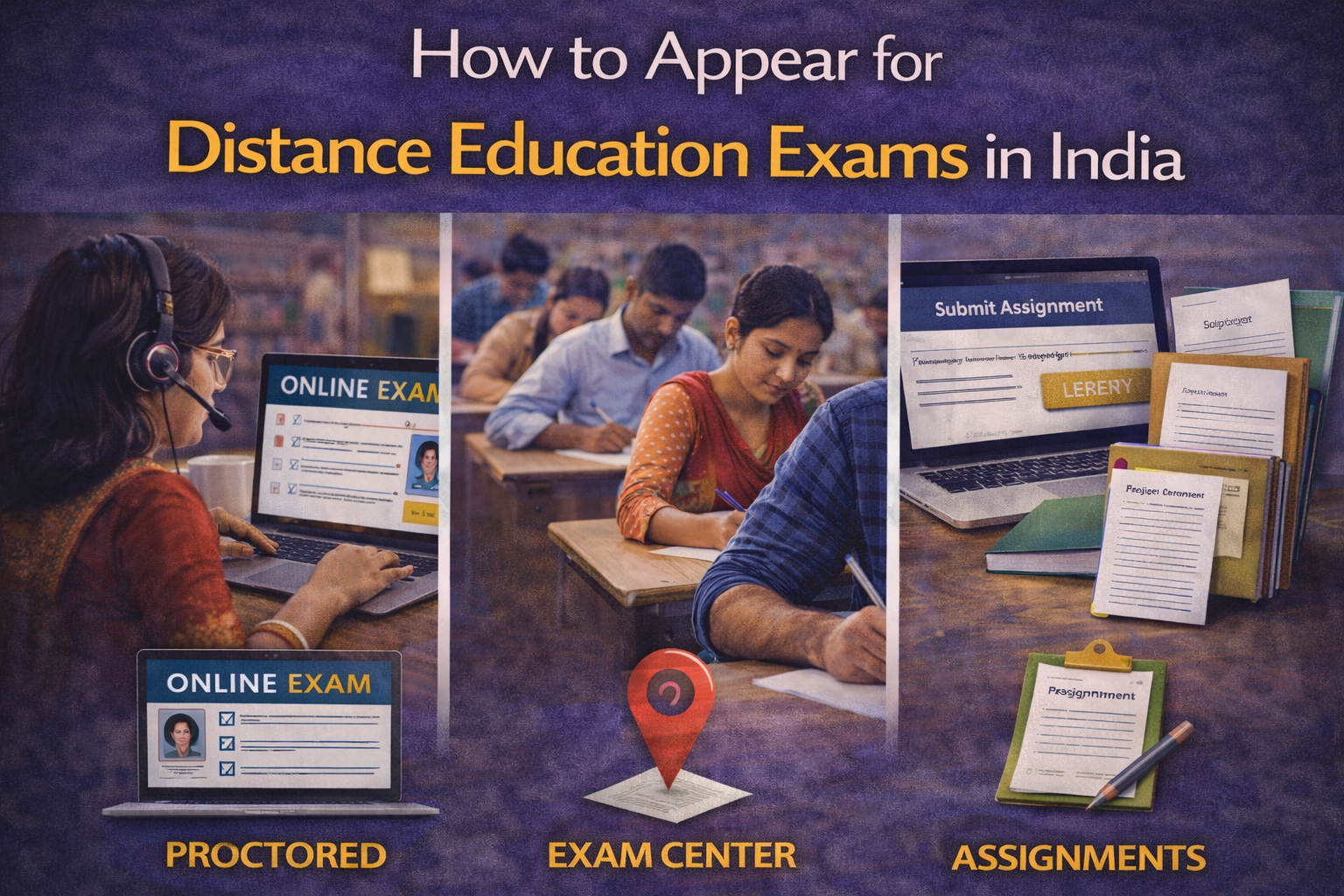
Distance education in India does not follow a single examination model. Universities and institutions choose formats depending on their infrastructure, accreditation, and regulatory guidelines. Traditionally, exams were conducted offline at regional centres, but with the rise of digital education, online exams have become more common.
Today, three broad formats exist:
- Offline exams at designated centres, where students write in pen-and-paper mode under supervision.
- Online proctored exams, where students take tests remotely using cameras, identification checks, and monitoring software.
- Hybrid formats, where internal assessments and mid-term tests are conducted online, but final semester exams remain offline.
Understanding the exam format before enrolling is crucial, as it directly affects the student’s convenience, travel needs, and preparation strategy.
Registration and Admit Card Process
Appearing for a distance education exam usually begins with online registration. Students are required to fill out an exam form, pay the necessary fees, and choose their preferred exam centre (for offline exams) or slot (for online exams). Universities then issue admit cards, either in digital format or through student portals, containing details such as roll number, exam venue, and schedule.
For online exams, admit cards also include technical requirements like internet speed, permitted devices, and system login instructions. Students are expected to test these systems before the actual exam day to avoid last-minute disruptions.
Preparing for Offline Exams
For offline exams, students must report to their allotted centre with valid identification, admit card, and sometimes a university-issued hall ticket. Centres are usually set up in regional hubs, district headquarters, or affiliated colleges.
Security checks, invigilator verification, and strict adherence to time schedules make these exams similar to traditional classroom assessments. Many learners, especially in rural areas, find this format more familiar and reassuring, though it often involves additional travel and expense.
Preparing for Online Exams
Online exams demand a different kind of preparation. Students must have a reliable internet connection, a functioning webcam, and a quiet space free from disturbance. Universities often require a 360-degree view of the room before the exam begins to ensure fairness. During the test, live proctors or AI systems monitor the student’s activity, and even minor violations—like looking away from the screen repeatedly—may trigger warnings.
While online exams are convenient for those unable to travel, they can be stressful for learners unfamiliar with technology. Universities often provide mock tests to help students practice the process, which reduces anxiety and increases confidence.
Assignments and Internal Assessments
Apart from end-semester exams, many distance education programs also include assignments, project work, and case studies. These components may be submitted online through Learning Management Systems (LMS) or offline by post. Completion of these tasks is often mandatory for eligibility to sit in final exams.
Assignments also serve as a way to balance exam pressure, as they carry weightage in the final grade. For distance learners managing jobs and family responsibilities, this system provides multiple chances to demonstrate learning beyond a single exam performance.
Challenges Faced by Students
Appearing for distance education exams is not without challenges. Offline exams can be difficult for working professionals who need to take leave or travel long distances to centres. Online exams, on the other hand, bring issues like unstable internet connections, technical glitches, or digital unfamiliarity.
For rural students, access to reliable infrastructure remains a concern. Even though universities attempt to set up centres close to student clusters, some learners must still travel hundreds of kilometres. These realities highlight the importance of planning and early preparation.
Institutional Support
To make the process smoother, many universities now provide student helplines, FAQs, and technical assistance before and during exams. Some even partner with local colleges or cybercafés to provide facilities for students who cannot arrange their own. Private universities, in particular, are innovating with 24/7 chat support, recorded demo sessions, and dedicated exam coordinators.
Such measures not only reduce stress but also increase the credibility of distance programs, showing that institutions are committed to maintaining fairness and accessibility.
The Role of UGC and DEB
The University Grants Commission (UGC), through the Distance Education Bureau (DEB), monitors exam practices to ensure academic integrity. Institutions must follow UGC guidelines, whether they are conducting online or offline assessments. For students, this means that as long as their program is UGC-DEB recognised, their degree will be considered valid, irrespective of exam format.
Conclusion
Appearing for distance education exams in India is a process shaped by regulation, technology, and the practical needs of learners. While offline exams remain the most common format, online and hybrid systems are becoming increasingly popular. Success in these exams requires not just subject knowledge but also familiarity with the processes, whether that means travelling to a centre or setting up a home testing environment.
For students, the most important step is to check the exam format before admission, plan ahead for logistics, and use the support provided by universities. Ultimately, exams in distance education are designed to ensure credibility and fairness, so that the degrees earned by learners hold the same respect and recognition as those from traditional programs.