
Introduction
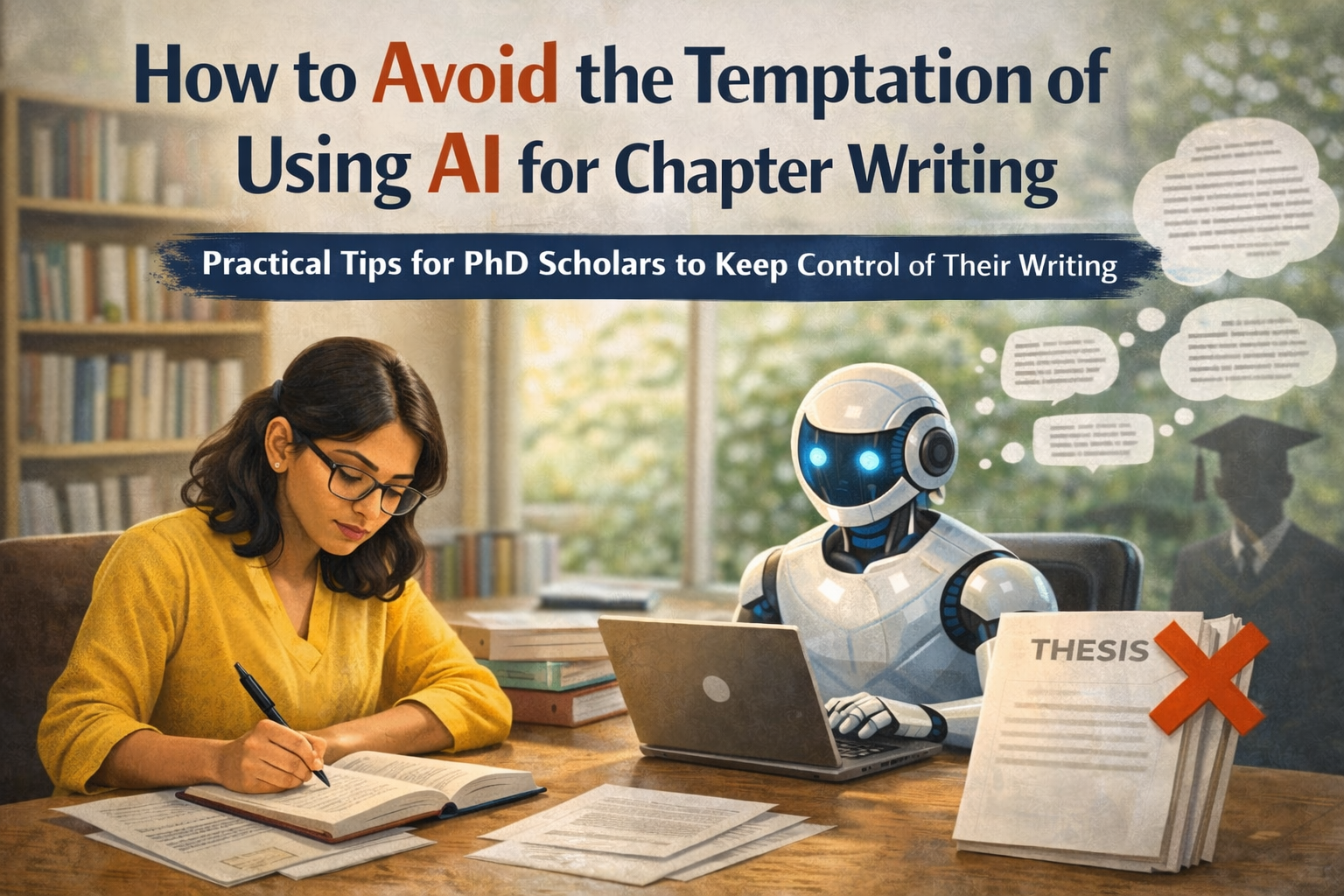
PhD scholars in India, particularly those in private universities or balancing academic work with jobs and family life, often face overwhelming pressure during the thesis writing phase. Deadlines are tight, supervisors may be distant, and writing in English can be daunting. In such moments, tools like ChatGPT or AI-based paraphrasers seem like a practical solution. With just a few prompts, you can generate pages of text that sound academic, well-structured, and ready to submit.
But what begins as a time-saving experiment can quickly become a habit — or worse, a dependency. Many scholars don’t start out intending to misuse AI. The temptation grows gradually, often from a place of stress and uncertainty. That’s why it’s important to understand not just the risks of using AI for chapter writing, but also how to avoid falling into that pattern in the first place. For Indian researchers committed to honest scholarship, learning to resist this temptation is part of becoming a confident academic writer.
Why Scholars Turn to AI — And What Makes It Hard to Resist
The pressure to deliver clean, formal, academic writing is intense — especially for scholars whose primary language isn’t English. Many private universities in India expect thesis chapters to be formatted like published journal articles. Yet, they often don’t provide training in academic writing, critical analysis, or methodology structure. This gap pushes students to look elsewhere for help.
Add to that the emotional load: juggling a teaching job, managing home responsibilities, feeling isolated in research — it’s no wonder AI tools feel like a lifeline. Unlike a human consultant, AI doesn’t judge, delay, or charge a fee. It gives instant results and even sounds polished.
A mid-career scholar from a university in Jaipur shared that she used ChatGPT to draft a paragraph for her literature review. It felt like relief at first, but she later realised she couldn’t explain the sources or the framing. She then spent more time rewriting than if she had written it herself from the beginning. Her experience reflects what many go through — the short-term gain quickly becomes a long-term confusion.
Practical Ways to Stay in Control of Your Writing
Avoiding AI misuse isn’t about rejecting all technology. It’s about using tools wisely, while staying at the centre of your research process. Here are some grounded strategies to maintain control over your thesis chapters without falling into AI dependency.
1. Create rough drafts in your own words, even if they are imperfect.
Don’t wait for the perfect sentence. Start by putting your ideas down as you understand them. Even if the grammar is weak or the structure feels messy, a rough draft written by you carries your voice. You can always revise later — but your core thinking remains intact.
2. Use AI only for support tasks — not for generation.
Let AI help you summarise a journal article, rephrase a confusing sentence, or check spelling. Avoid using it to generate full paragraphs, introductions, or conclusions. The more you use AI to write your arguments, the more disconnected you become from your own logic.
3. Work with a trusted human mentor or consultant.
A good thesis coach won’t write for you, but they can guide your process. In the Indian context, where university guides may be too busy to provide line-by-line feedback, external academic support (if used ethically) can help you improve your drafts without replacing your effort.
4. Build a simple writing habit — 300 words a day.
You don’t need to finish a chapter in one sitting. Aim to write a small portion daily — maybe a paragraph or two. Over weeks, this builds both confidence and continuity. This reduces panic — and that panic is what often drives scholars to AI tools.
5. Remind yourself of the viva.
One of the clearest reasons not to let AI write your chapters is the oral defence. If you don’t understand or remember how a point was made, you’ll struggle to explain it. Viva examiners in Indian universities are sharp — and often informal in their questioning. They’ll quickly sense when a scholar isn’t the true author of their own words.
What You Gain by Writing Yourself — Even When It’s Hard
When you write your thesis chapters with your own hands, you don’t just create a document — you develop academic stamina. You learn how to find gaps in literature, frame arguments, use citations, and handle feedback. These are not skills that come from automation — they come from struggle and practice.
A doctoral candidate in education from Nagpur shared that she found writing her methodology chapter “painful but empowering.” It took her three weeks to finish the first draft, but once she did, she could talk about it confidently during her pre-submission seminar. That confidence, she said, mattered more than the grammar. She later worked with an editor to polish her language — but the structure remained her own.
By resisting the shortcut, she ended up owning her research — and it showed.
Conclusion
In a digital world full of quick fixes, using AI to write your thesis chapters can feel like the easy way out. But that ease comes at a cost — a loss of ownership, depth, and clarity. Thesis writing is difficult by design. It’s where you confront complexity, learn how to express your ideas, and grow as a scholar.
For Indian PhD students — especially those navigating flexible but under-supported university systems — the temptation to outsource to AI is real. But so is the reward of writing with your own voice, however slowly. You don’t need to be perfect. You just need to stay present. That, more than anything, is what makes your thesis truly yours.