
Introduction
In India, the role of a recognised research guide (PhD supervisor) is a prestigious academic responsibility. Beyond teaching and publishing, it enables faculty to mentor future scholars, contribute to research culture, and enhance their institution’s academic standing. Recognition as a research guide, however, requires meeting specific eligibility norms laid down by the University Grants Commission (UGC) and being approved through one’s university procedures. This blog explains the process of becoming a recognised PhD guide in your university, especially from the perspective of Indian academia.
Understanding the Role of a Research Guide
A research guide is expected to mentor PhD scholars throughout their doctoral journey—beginning with proposal development, coursework guidance, and ethics approvals, to thesis writing and viva preparation. Universities entrust only qualified and experienced faculty with this role because the supervisor’s expertise directly impacts research quality.
Being a recognised guide is not just about personal career growth; it also reflects institutional credibility in research. That is why strict regulations exist to determine who can officially supervise PhD candidates.
UGC Regulations on Eligibility
According to the UGC (Minimum Standards and Procedure for Award of PhD Degree) Regulations, 2022, the following eligibility norms apply:
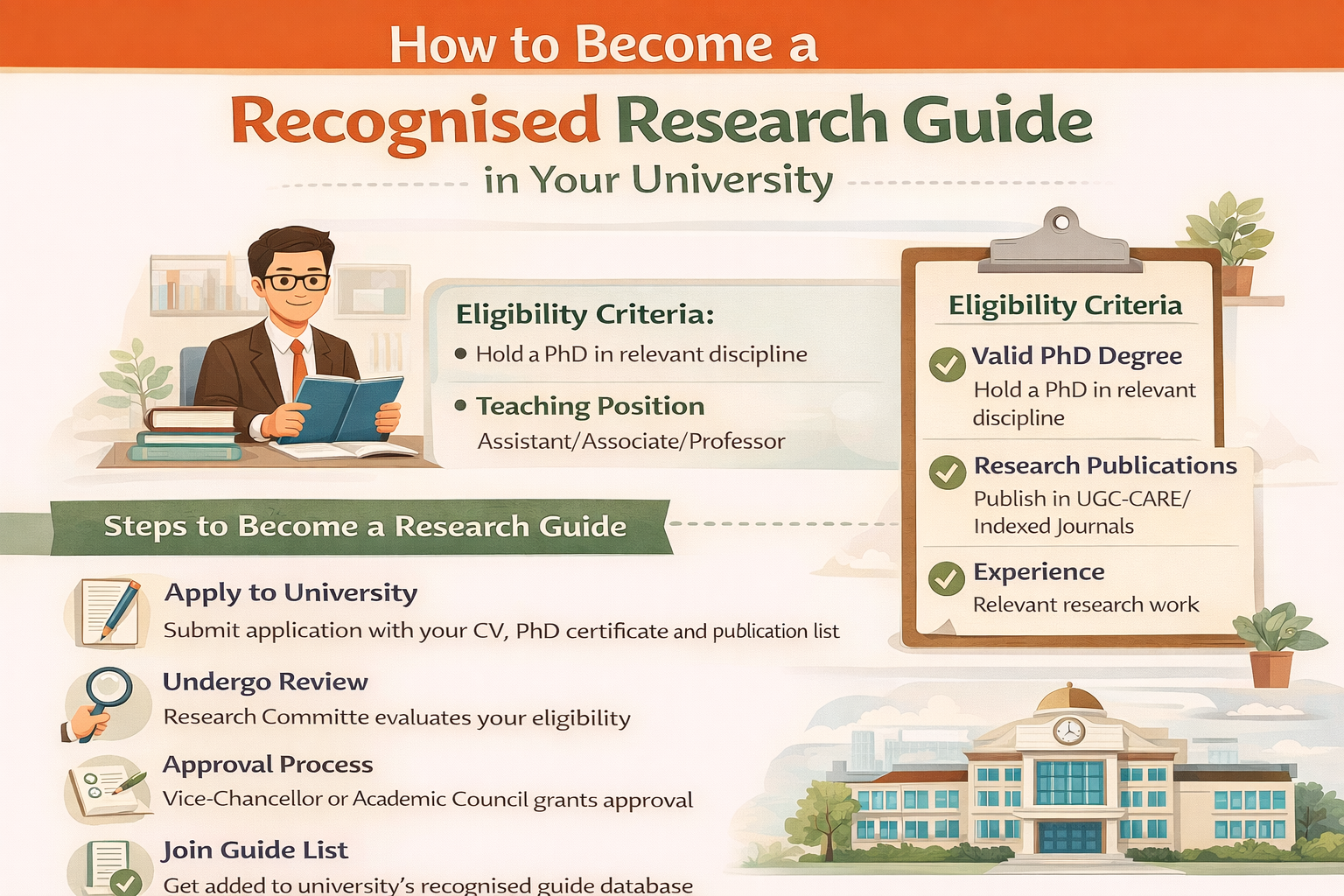
- Educational Qualification – The faculty member must hold a PhD in a relevant discipline.
- Position in Service – Typically, only those in the cadre of Professor, Associate Professor, or Assistant Professor (meeting experience requirements) can apply.
- Research Output – The individual should have a strong academic record with publications in peer-reviewed or UGC-CARE listed journals.
- Experience – For Assistant Professors, prior research experience (such as post-doctoral work, funded projects, or significant publications) strengthens eligibility.
These conditions ensure that only academically accomplished faculty can mentor doctoral research.
University-Specific Recognition Process
While UGC lays down the minimum framework, each university follows its own procedure to recognise research guides. Common steps include:
- Application by Faculty Member – Interested faculty submit a formal application with supporting documents such as PhD certificate, list of publications, teaching experience, and research projects.
- Scrutiny by Research Committee – The university’s Research Board or Doctoral Committee evaluates the application to ensure compliance with UGC rules.
- Approval from Academic Council – Final recognition is generally granted after approval by the Vice-Chancellor or Academic Council.
- Inclusion in Approved Guide List – Once approved, the faculty’s name is added to the university’s official list of recognised research supervisors.
Institutional Variations
Different types of institutions may have variations in procedure:
- Central and State Universities – Often stricter, with emphasis on research publications and experience.
- Deemed Universities – Usually follow UGC norms closely but may add their own benchmarks, such as minimum Scopus-indexed papers.
- Private Universities – Require formal recognition by their Research Council, though oversight by state legislation ensures they align with UGC guidelines.
Thus, while UGC sets the baseline, institutional regulations determine final approval.
Responsibilities After Recognition
Becoming a recognised guide comes with ongoing responsibilities:
- Maintaining Research Output – Continued publications and conference participation are expected.
- Adhering to Guide–Scholar Ratio – UGC allows a maximum number of scholars per guide (usually 8 for Professors, 6 for Associate Professors, and 4 for Assistant Professors).
- Compliance with Ethics and Quality Standards – Guides are accountable for plagiarism checks, originality of work, and overall research integrity.
- Periodic Reporting – Universities may require annual progress reports on supervised scholars.
Failure to meet these standards can even lead to withdrawal of recognition.
Tips for Faculty Aspiring to Become Research Guides
For those aiming to be recognised supervisors, the following steps can help:
- Build a Strong Publication Record – Publish in UGC-CARE, Scopus, or Web of Science indexed journals.
- Undertake Research Projects – Apply for government or private research grants to demonstrate capability.
- Guide at Master’s Level – Start by supervising M.Phil. or postgraduate dissertations to gain experience.
- Network within Academic Bodies – Actively participate in conferences, associations, and collaborations to establish credibility.
- Stay Updated with UGC Guidelines – Regulations may evolve; being aware ensures compliance.
Challenges in the Recognition Process
Aspiring guides often face hurdles, such as:
- Delay in Approval due to multiple levels of scrutiny.
- High Publication Requirements which can be difficult for younger faculty.
- Variations Across Universities leading to confusion about eligibility.
- Workload Balance since recognition adds significant mentoring duties alongside teaching.
Despite these challenges, faculty view recognition as an important career milestone.
Conclusion
Becoming a recognised research guide in your university is a structured yet rewarding journey. It requires a strong academic foundation, compliance with UGC norms, and approval through institutional procedures. For Indian faculty, this recognition not only enhances personal academic stature but also strengthens the overall research ecosystem of their university.
By preparing early—through publications, projects, and academic networking—faculty can position themselves as credible mentors ready to guide the next generation of PhD scholars.