
Introduction
In India, choosing a distance education program is not just about flexibility or affordability—it is about ensuring that the degree will actually hold value for jobs, promotions, and higher studies. Every year, thousands of students enroll in programs that are either not recognised or offered by institutions without approval from the University Grants Commission (UGC) and its Distance Education Bureau (DEB). The result is heartbreaking: graduates realise too late that their degree is invalid for government jobs, competitive exams, or even postgraduate admissions. With so many private and online institutions now advertising aggressively, students must know how to verify whether a distance program is genuinely UGC-recognized.
The Role of UGC and DEB
The University Grants Commission is the apex regulatory body for higher education in India. Within it, the Distance Education Bureau (DEB) specifically regulates distance and online education programs. When UGC-DEB grants approval, it means the institution has met essential requirements related to faculty, infrastructure, learning resources, and academic quality. Without this approval, a degree is not considered valid in the eyes of the law, no matter how attractive the program may look.
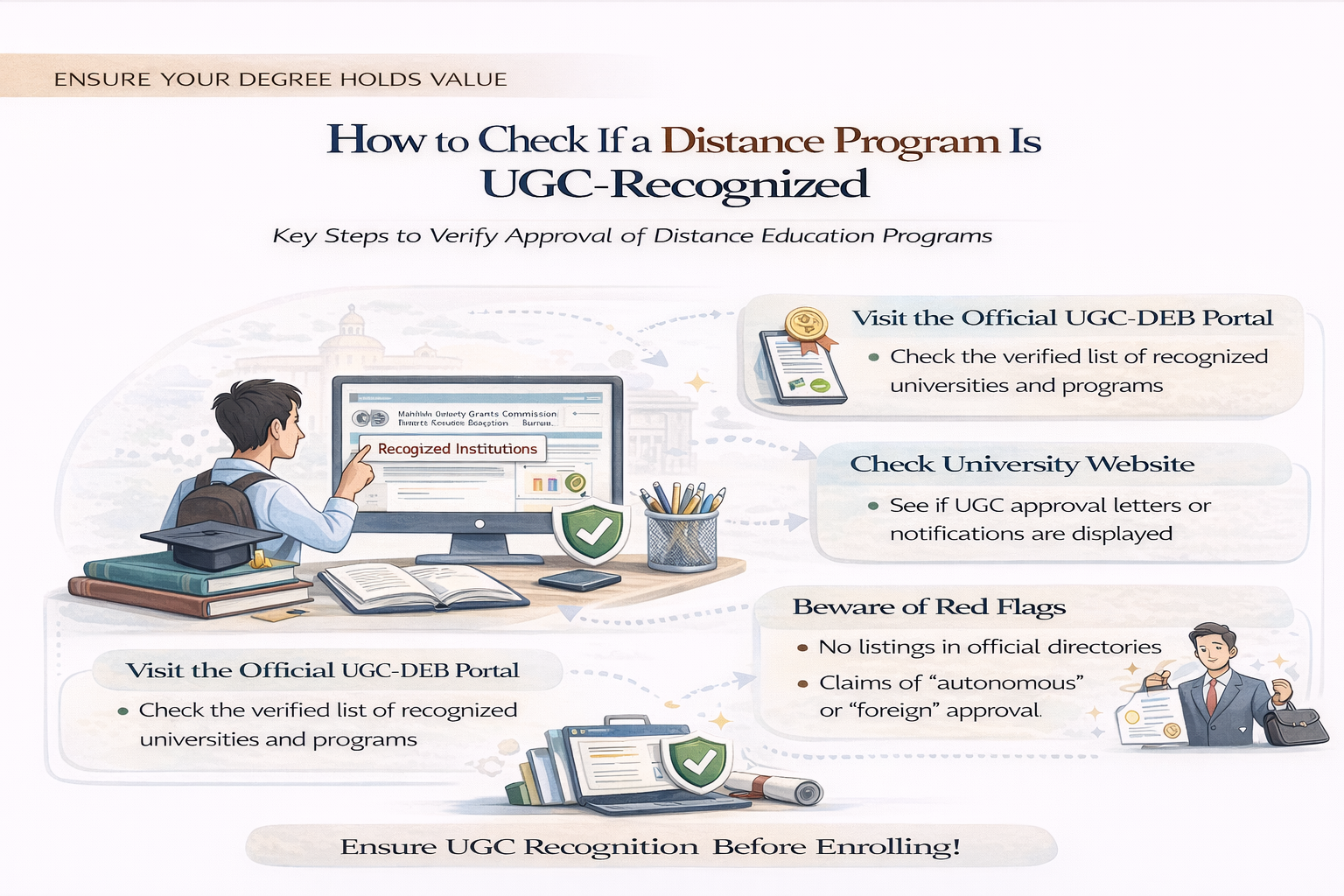
For students, the first rule is simple: if the program is not listed on the official UGC-DEB portal, it should not be trusted. This is particularly important because some universities advertise programs that were once recognised but have since lost their approval.
Where to Verify Recognition
The most reliable source is the UGC-DEB official website, which publishes updated lists of recognised universities and the specific programs they are permitted to offer. Students should carefully note that recognition applies not just to the institution but also to the program and the academic session. For example, a university may be approved to run a distance MBA in 2024 but not in 2025 if renewal is not granted.
Another reliable channel is the university’s own website. Legitimate institutions usually display their UGC-DEB approval letters, notifications, and circulars. Students should cross-check these with UGC records rather than accepting them at face value.
In addition, the Ministry of Education and state higher education councils often release notices clarifying valid institutions. Consulting these resources before admission can prevent costly mistakes.
Common Red Flags to Watch Out For
Unfortunately, many unrecognised institutions continue to lure students with attractive promises. Some claim “international recognition” or use terms like “autonomous certification” to confuse applicants. Others may advertise foreign collaborations without having UGC approval.
A common red flag is when an institution offers professional degrees like B.Tech, MBBS, or LLB through distance mode. UGC does not permit such courses to be taught through distance education due to their practical requirements. Another warning sign is when universities claim “permanent approval” or avoid sharing clear documentation. Recognition is always granted for specific periods and must be renewed regularly.
The Importance of Choosing Recognised Programs
The consequences of choosing an unrecognised program can be severe. Students may find that their degree is rejected during government job verification or when applying for further studies in India and abroad. Even in private sector jobs, HR departments often check UGC-DEB approval before accepting qualifications.
Beyond employability, recognised programs ensure quality. Approved universities are required to provide study material, faculty support, evaluation systems, and grievance mechanisms. Enrolling in an unrecognised program often means poor academic support and a lack of accountability.
Distance Education in Private Universities
Many private universities now offer distance education in India. While some have excellent programs with strong digital infrastructure, others operate without proper approval. Students should be extra cautious when dealing with private institutions, verifying both their UGC status and NAAC accreditation. Choosing universities that consistently appear on the UGC-DEB approved list ensures that the degree will stand up to scrutiny.
Private universities that are properly recognised often go beyond compliance by offering blended learning, online libraries, and industry tie-ups. Such initiatives make their distance programs competitive with regular ones, but recognition remains the foundation of their value.
Student Responsibility in the Selection Process
While UGC and DEB publish lists and monitor institutions, the responsibility ultimately lies with students to check before enrolling. Many fall into the trap of assuming that because a university is well-known in regular education, all its programs must be recognised. This is not always the case. Recognition is program-specific, and approvals can vary from year to year.
Students should take the time to check official notifications, speak directly with university admission offices, and request documentation. Even a simple step like emailing UGC-DEB for clarification can save years of regret.
Conclusion
In India’s expanding education landscape, distance learning offers valuable opportunities—but only when pursued through recognised channels. A degree from a UGC-DEB approved program is legally valid, professionally respected, and academically secure. On the other hand, enrolling in unrecognised programs risks wasted time, money, and effort.
For students, the message is clear: do not rely solely on advertisements or word of mouth. Verification is not just a formality; it is the single most important step in choosing a distance program. With the right checks in place, distance education can open doors to growth and opportunity. Without them, it can close those very doors permanently.