
Introduction
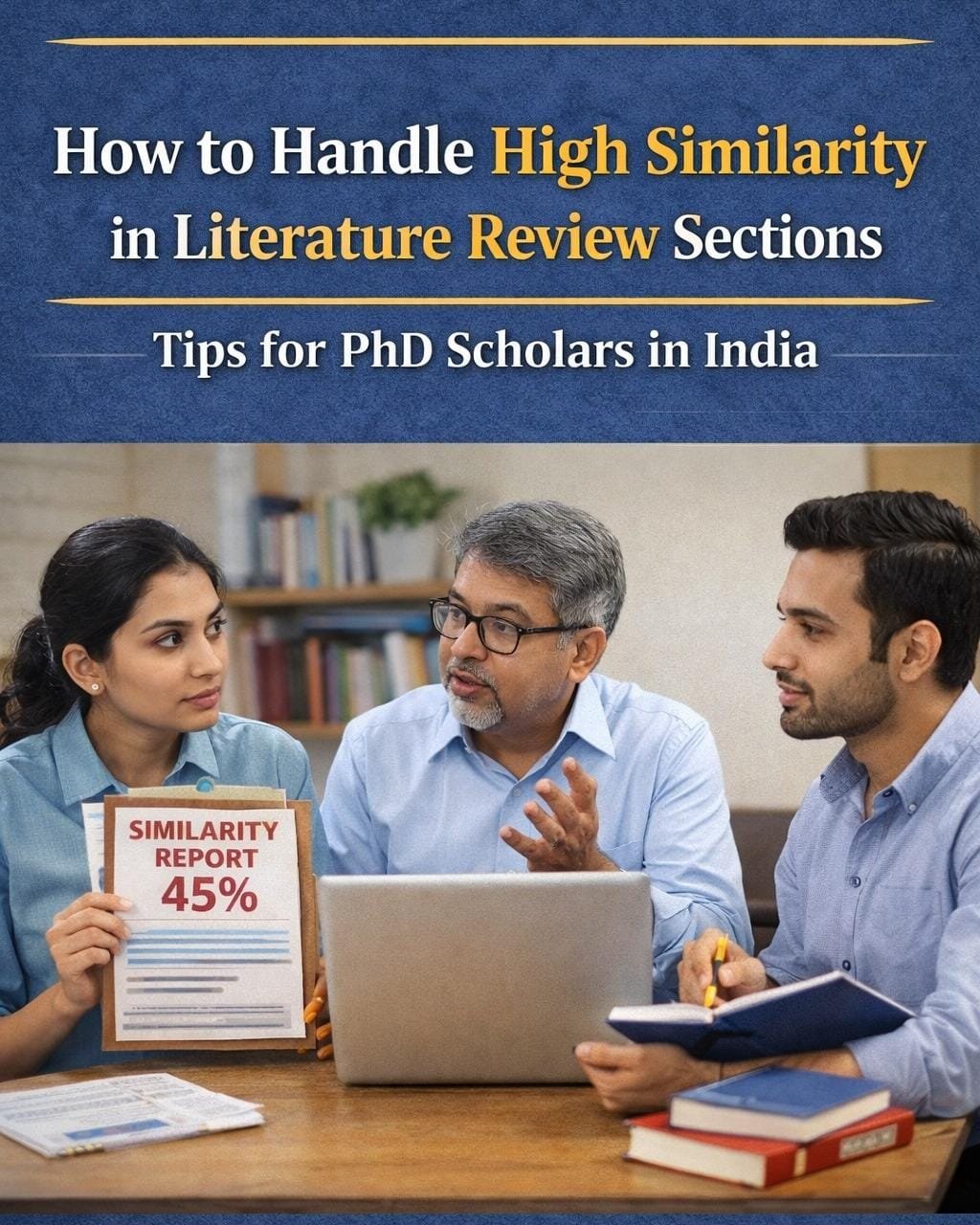
For most PhD scholars in India, the literature review is one of the most challenging chapters to write. It requires summarising existing research while linking it to your own work. However, because it involves referencing other authors’ ideas, it often shows higher similarity percentages in plagiarism reports. Many scholars panic when they see this, fearing rejection from their university or journal. In reality, a certain level of similarity in literature reviews is expected—but managing it smartly is key. Understanding how to handle high similarity in this section can help you avoid unnecessary trouble and ensure your thesis passes the plagiarism test.
Why Literature Reviews Naturally Show Higher Similarity
A literature review is based on summarising and discussing the work of others. You are dealing with technical terms, established definitions, and widely accepted facts, many of which cannot be changed without losing meaning. In addition, proper academic writing requires citing these works accurately, which may include using certain phrases directly from the source. This makes the literature review prone to higher similarity scores even when plagiarism is not present.
UGC and University Tolerance for Literature Review Similarity
In India, most private universities and even UGC guidelines acknowledge that the literature review section will show higher similarity than other parts of a thesis. Some institutions even exclude references, bibliography, and quotes from similarity calculations. However, the problem arises when large chunks of text are copied without enough paraphrasing or analysis. Universities still expect originality in how you present the information, even if the facts are taken from other sources.
Effective Paraphrasing Strategies
If your plagiarism report shows high similarity in the literature review, the first step is to review your paraphrasing. Instead of just replacing words with synonyms, restructure the sentence completely. For example, rather than “Research by Sharma (2019) found that rural students face limited access to higher education due to infrastructure issues,” you could write, “According to Sharma (2019), inadequate infrastructure continues to limit higher education access for rural students.” This changes the structure without altering the meaning.
Balancing Direct Quotes and Paraphrasing
Direct quotes should be used sparingly in a literature review. If you rely too heavily on them, your similarity percentage will rise quickly. Reserve direct quotations for definitions, unique expressions, or critical statements that cannot be paraphrased without losing meaning. For the rest, summarise in your own words while giving proper credit to the author.
Adding Critical Analysis
One way to reduce similarity is to move beyond summarising existing work and add your own critical analysis. After discussing a study, provide your perspective: point out its strengths, weaknesses, or relevance to your research. This not only reduces similarity but also demonstrates your understanding of the topic. For instance, after summarising a paper, you could write, “While the study provides useful insights into policy gaps, it overlooks regional variations that may affect implementation.”
Rewriting Overlapping Sections
If your plagiarism tool highlights a large chunk from one source, break it down into smaller points and rewrite them individually. This ensures that no continuous block of text matches the original. Even if the facts remain the same, the sentence structure, tone, and flow will be different, lowering the similarity score.
Excluding References and Standard Phrases
Many plagiarism tools include references in their similarity calculations. If your software allows it, exclude these sections, as they are standard and cannot be rewritten. Similarly, standard academic phrases such as “The study aims to explore…” or “According to the findings…” are common in research writing and may be flagged even though they are not plagiarism.
Working Closely with Your Guide
When dealing with high similarity in the literature review, involve your research guide early. Experienced supervisors can help identify which similarities are acceptable and which need revision. They can also suggest credible rewording techniques and sources to consult for paraphrasing without distorting meaning.
Conclusion
High similarity in a literature review section is not unusual, especially in Indian PhD theses, where technical and subject-specific terminology is unavoidable. The key lies in knowing how to present existing research in your own voice while giving due credit to original authors. By paraphrasing effectively, balancing quotes with analysis, and working closely with your guide, you can ensure your literature review passes the plagiarism check without compromising academic quality. A carefully handled literature review not only clears technical checks but also strengthens the intellectual backbone of your thesis.