
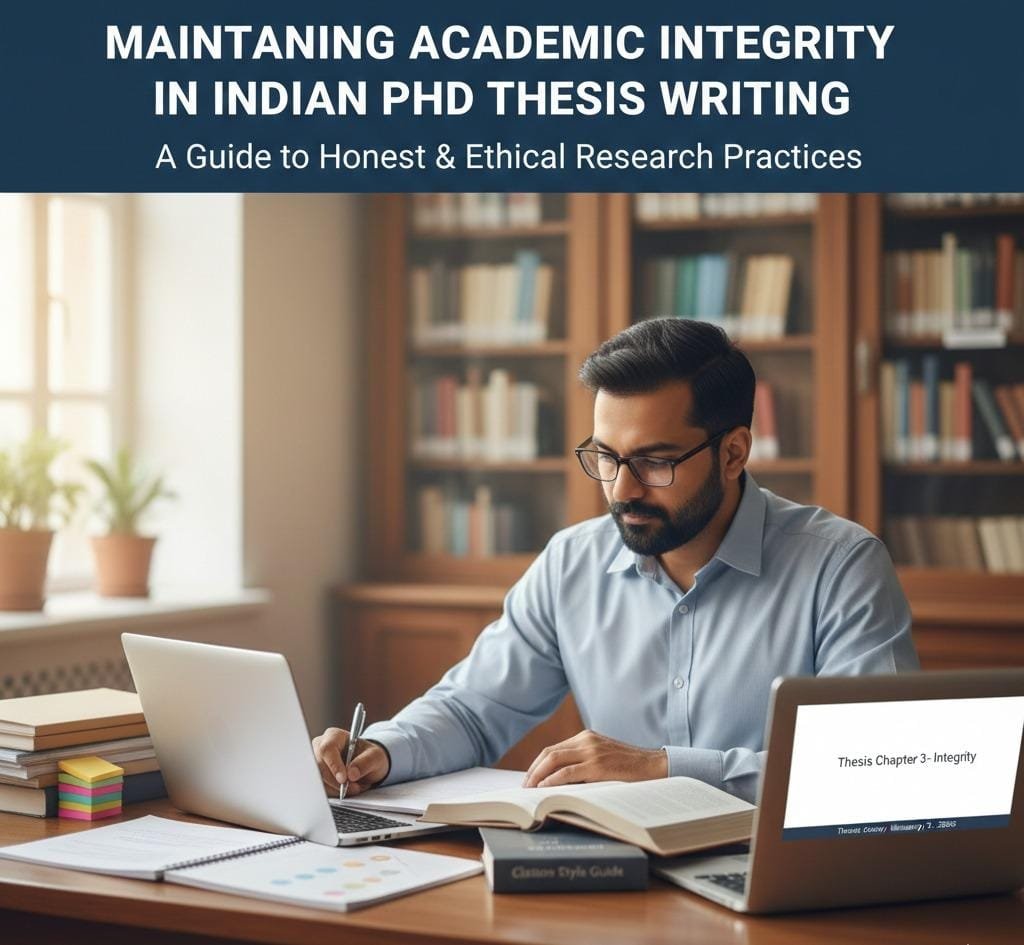
Thesis writing is a defining part of the PhD journey, and with it comes the responsibility to uphold academic integrity. In the Indian context—where doctoral education is expanding across private and public universities—students are expected to contribute original research while navigating unclear rules, tight timelines, and limited writing support. This makes it easy to unintentionally compromise on academic honesty. Whether it’s paraphrasing without citation, overusing a secondary source, or submitting a thesis chapter that borrows from earlier assignments, lapses in integrity often stem from a lack of clarity rather than deliberate misconduct. Understanding what academic integrity looks like in practice is essential to completing a thesis that stands on solid ground.
Academic Integrity Is Not Just About Avoiding Plagiarism
Academic integrity in thesis writing involves more than avoiding copy-paste or keeping the similarity index below a threshold. It includes giving credit for others’ ideas, being transparent about your methodology, reporting data honestly, and ensuring that every part of your writing reflects your independent effort. In Indian private universities, where part-time scholars, mid-career professionals, and first-generation researchers form a significant portion of the PhD population, the understanding of these principles varies widely.
For instance, a scholar may assume that using previously published work in a thesis is acceptable without citation because they authored it themselves. However, this falls under self-plagiarism and can be flagged during thesis evaluation. Another may rely heavily on secondary sources, summarising without citing the original study—unintentionally misrepresenting the origin of the ideas. These examples show that breaches of integrity are not always intentional but can still affect the credibility of the research.
Private universities, while offering flexibility and accessibility, often do not have the same structured research ethics training found in central institutions. This leaves it up to the scholar—and sometimes the guide—to define what academic integrity means. Without clear institutional support, students may focus more on completion than on ethical clarity. But in the long run, this affects both the quality of the thesis and the scholar’s academic reputation.
Building Integrity Through Daily Writing Practices
Maintaining academic integrity is not a one-time decision—it’s a habit built through consistent writing practices. One of the most effective habits is keeping detailed and accurate notes while reading. When students record both the idea and its source during literature review, they are less likely to forget citations later. This reduces the chances of accidental plagiarism during the writing phase.
Another important habit is learning how to paraphrase correctly. Paraphrasing is not just about changing a few words; it involves understanding the source deeply and expressing it in your own academic voice. For Indian scholars who are not native English speakers, this can be challenging—but it is a skill that improves with practice and feedback. Many cases of unintentional plagiarism occur because students try to paraphrase complex material without fully grasping it. Working with a supervisor, mentor, or writing group to improve this skill can have a long-term impact on both integrity and confidence.
Using plagiarism detection tools is helpful, but only when used as a learning aid, not just a final checkpoint. Running drafts through Turnitin or similar tools during the writing process helps identify overlaps early and allows time to correct them. More importantly, it teaches students to pay attention to how closely their writing mirrors the sources they read. Many private universities now provide access to these tools for student use before formal submission—a practice that should be used not out of fear, but as a part of responsible research writing.
Institutional Culture and Supervisor Support Matter
While the responsibility for academic integrity ultimately lies with the student, the institutional culture plays a major role in shaping writing ethics. Universities that provide structured orientation on research ethics, clear thesis guidelines, and opportunities for skill-building are more likely to produce original, honest work. Unfortunately, not all private universities have formal systems in place for such support. The guidance a student receives may depend heavily on the supervisor’s individual interest and availability.
Supervisors can support integrity by encouraging regular submissions of thesis drafts, giving feedback not only on content but also on citation and structure, and discussing ethical concerns openly. When students see academic honesty as a shared value—not just a rule—they are more likely to internalise it in their work. It is also helpful when institutions make space for writing workshops, peer-review forums, or access to sample theses that reflect good ethical practices.
For students returning to academia after years in industry, or those balancing research with full-time jobs, time pressures can often lead to shortcuts. In such cases, having a realistic writing schedule, along with supervisor check-ins, can prevent rushed work that may cross ethical lines. Academic integrity does not require perfection—it requires consistency, reflection, and a willingness to learn from mistakes.
Conclusion
Maintaining academic integrity in thesis writing is not about meeting a checklist—it is about writing with responsibility, clarity, and respect for the research process. For Indian PhD scholars, especially those in private universities, integrity becomes even more important in a system where standards are evolving and credibility is hard-earned. By developing ethical writing habits, seeking proper guidance, and treating the thesis as a contribution rather than just a requirement, scholars can ensure that their work is not only accepted but respected. In the end, integrity is not a hurdle to clear—it is the foundation on which lasting scholarship is built.