
Introduction
For many PhD candidates in India, the literature review is one of the most challenging sections to rewrite during plagiarism removal. This is not because the ideas are overly complex, but because the section is heavily dependent on citations. Every claim, definition, or prior finding in a literature review comes from another scholar’s work, and therefore, even after rephrasing, proper citations must remain. For doctoral admission in India, especially in private universities where supervisors closely monitor similarity reports, the challenge lies in making the review sound like the candidate’s own writing without reducing its academic integrity.
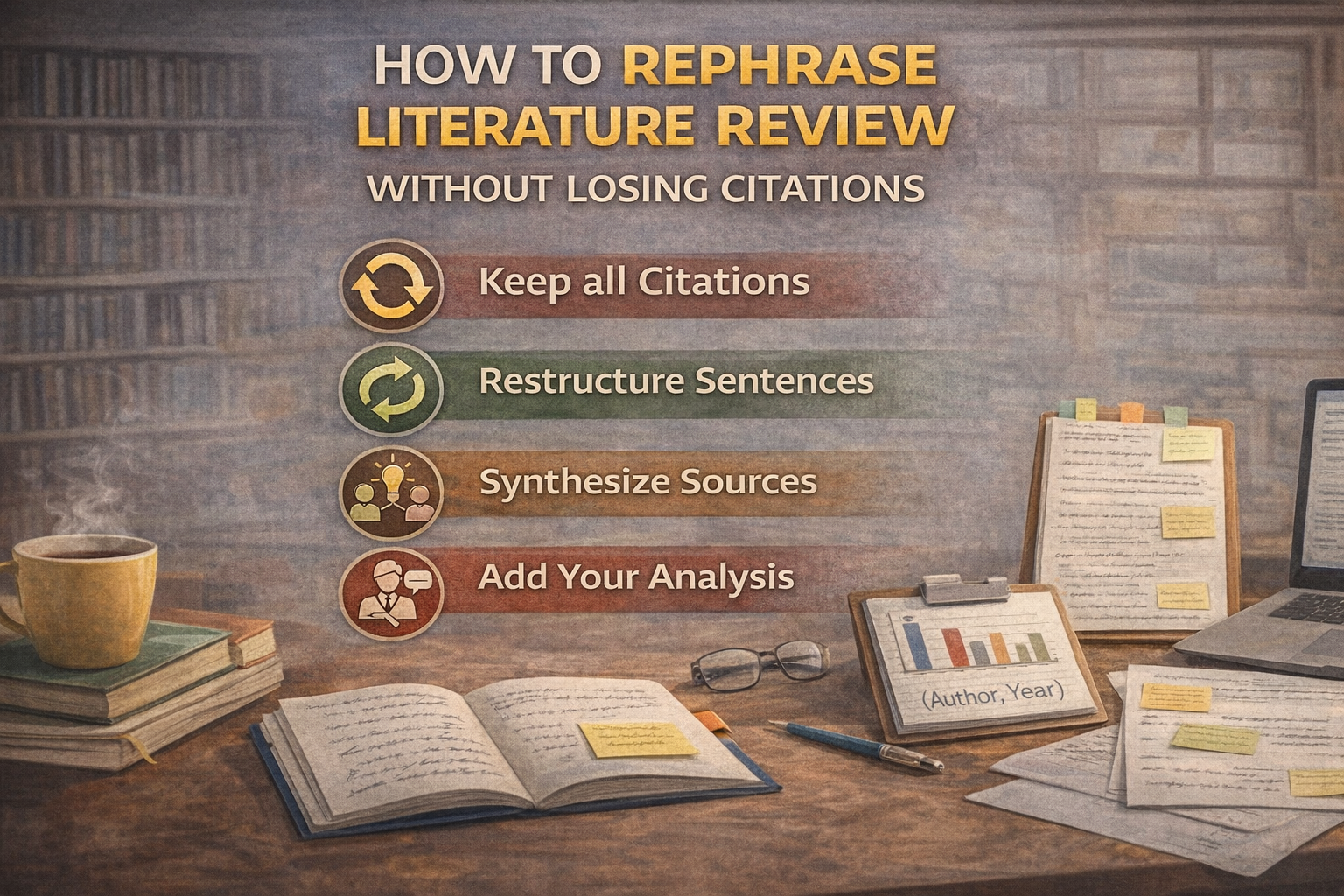
Rephrasing in this context is not a matter of replacing words with synonyms. It involves rethinking the sentence structure, integrating the researcher’s own voice, and maintaining correct attribution. Done correctly, it not only reduces similarity scores but also demonstrates scholarly maturity—a quality examiners expect in a doctoral thesis.
Balancing Paraphrasing and Attribution
A common mistake some scholars make when rephrasing a literature review is accidentally dropping or altering a citation. This often happens when the original sentence is broken into multiple sentences or when two sources are synthesised. In the Indian PhD system, particularly under UGC plagiarism guidelines, missing citations are treated seriously, regardless of whether the omission was intentional.
The key is to decide whether each point being rephrased still belongs entirely to the cited author or whether it has been combined with the candidate’s own observation. If it is purely from the source, the citation remains exactly where it is—sometimes even repeated if the content is spread across multiple sentences. This is especially important in private universities where research supervisors tend to check not only similarity percentages but also citation consistency.
Restructuring Sentences Around Citations
One practical approach to rephrasing without losing citations is to change the placement of the citation within the sentence. For example, an original sentence might read: “According to Kumar (2019), the adoption of digital tools improves student engagement.” This can be rephrased as: “Student engagement improves with the adoption of digital tools, as observed by Kumar (2019).” The meaning remains the same, the structure is altered, and the citation is still present.
Another method is to incorporate the source into a broader statement. For instance, if several authors have discussed a similar idea, the candidate might write: “Several researchers, including Kumar (2019) and Singh (2020), have observed improvements in student engagement when digital tools are introduced.” This technique both reduces repetition and maintains proper attribution.
Synthesising Multiple Sources
In Indian doctoral research, a literature review often involves summarising the work of many scholars in succession. This sequential style, while straightforward, can lead to high similarity if the order and structure closely match existing reviews. A more effective method is synthesis—integrating findings from multiple sources into a single, coherent paragraph.
For example, instead of describing Kumar’s study in one sentence and Singh’s in the next, a candidate might merge their findings: “Digital tools have been linked to improved engagement across several studies, with Kumar (2019) focusing on classroom participation and Singh (2020) examining long-term retention.” This approach makes the paragraph more original while still crediting each author for their specific contribution.
Maintaining Academic Voice
Rephrasing is not just a technical process—it is also a matter of style. A well-written literature review reflects the candidate’s ability to engage with existing scholarship critically. For Indian PhD candidates, this often means going beyond summarising what other authors have said to commenting on how their work relates to the current research.
For example, after paraphrasing a study, the candidate might add: “This finding is particularly relevant in the Indian higher education context, where digital infrastructure is uneven across regions.” Such commentary does not require a citation because it represents the candidate’s own perspective, but it changes the structure enough to make the section more original while still retaining the cited source where appropriate.
Avoiding Citation Clustering
When multiple citations are placed at the end of a long paragraph, plagiarism tools may still flag high similarity because the surrounding text mirrors existing reviews. One way to address this is to distribute citations more evenly throughout the paragraph. This not only lowers similarity but also improves readability, making it clearer which statement belongs to which source.
In private universities, supervisors often advise spreading citations naturally rather than listing them all together. For instance, instead of ending a paragraph with “(Kumar, 2019; Singh, 2020; Patel, 2021),” each author’s work could be integrated into separate sentences or clauses. This ensures both originality in expression and clarity in attribution.
Conclusion
Rephrasing a literature review without losing citations is less about finding clever synonyms and more about restructuring ideas while preserving the scholarly trail. For Indian PhD candidates, it is an exercise in both academic ethics and writing skill—balancing the need to meet plagiarism thresholds with the responsibility to represent sources accurately. When approached with care, the process strengthens the thesis, making it not just compliant with guidelines but also a more authentic reflection of the candidate’s engagement with the field.