
Introduction
For many Indian PhD candidates, especially those in private universities where faculty encourage thorough originality checks, rewording statistical findings can be one of the most delicate stages of thesis writing. Unlike theoretical discussions, statistics carry precise meanings that cannot be altered without changing the outcome of the research. Yet, when aiming to meet plagiarism thresholds under UGC guidelines, it becomes necessary to present numerical results in fresh language.
The challenge lies in ensuring that the meaning, context, and significance of the data remain intact. Whether it is the percentage of respondents supporting a policy, a correlation coefficient between two variables, or the mean value of a measured trait, every detail must be preserved while adjusting the presentation to avoid similarity concerns.
Why Statistical Language Needs Careful Rephrasing
Numbers themselves cannot be “plagiarised” in the traditional sense, but the surrounding descriptive text often overlaps with previously published work, especially if it follows standard academic phrasing. For example, “The mean score of group A was significantly higher than group B” is a common construction found in many research papers. Without thoughtful rewording, such lines can trigger plagiarism detection, even if the data are original.
In Indian doctoral writing, supervisors often advise candidates to describe findings in more than one way—both statistically and interpretively. This not only reduces similarity but also shows deeper engagement with the results. Instead of repeating formulaic patterns, researchers can restate findings in terms of their practical meaning while still including the statistical detail.
Strategies for Rewording Without Changing Meaning
One approach is to vary sentence structure while keeping the statistical values unchanged. For instance, “Group A scored 72.5 on average, compared to 65.4 for Group B” can be rewritten as: “On average, participants in Group A achieved a score of 72.5, whereas Group B recorded 65.4.” The numbers remain exactly the same, but the phrasing is altered.
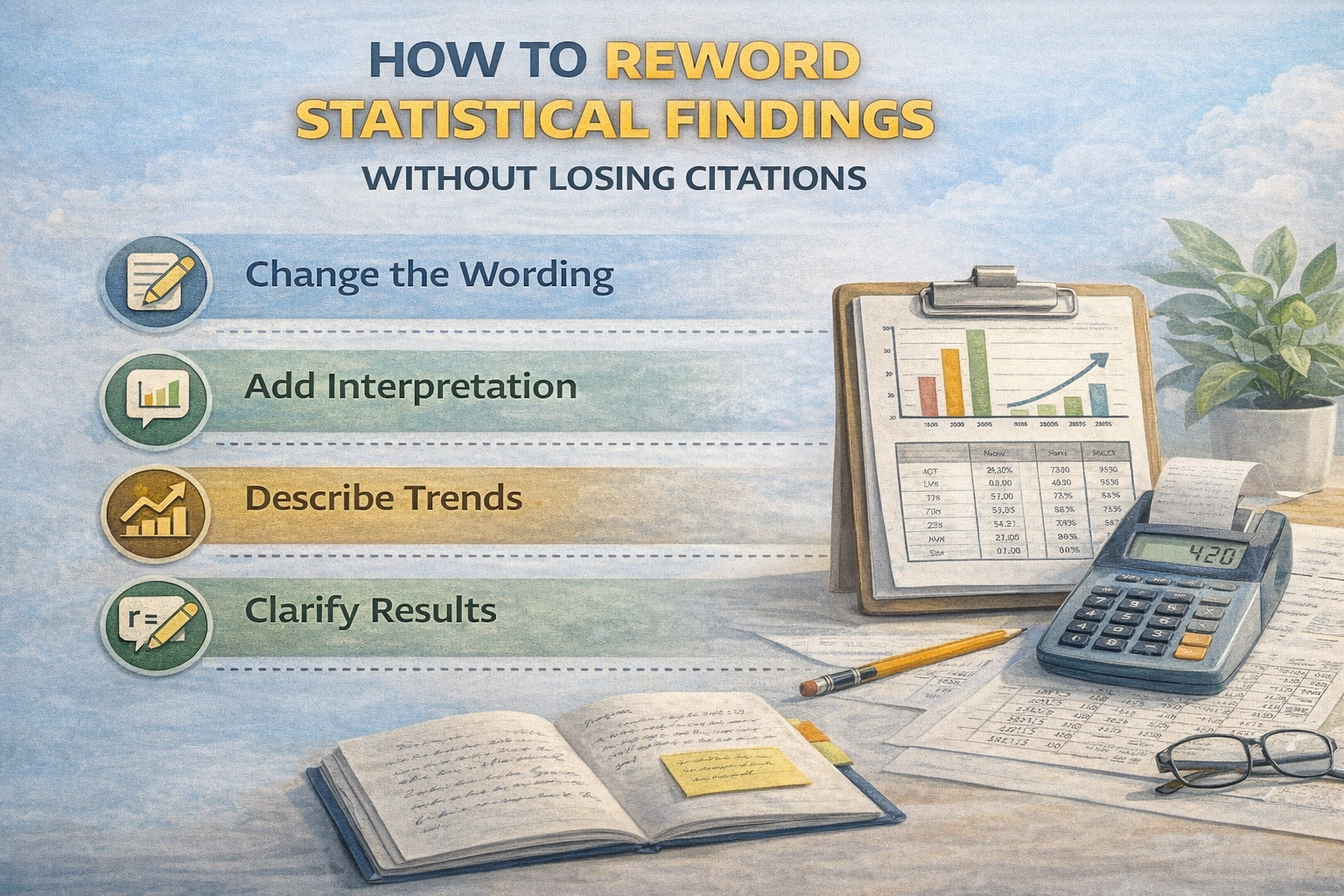
Another useful method is to pair statistical results with contextual commentary. For example: “The survey revealed a higher mean satisfaction score for urban respondents (M = 4.2) compared to rural respondents (M = 3.7), suggesting a possible influence of infrastructure availability.” Here, the statistical reporting is combined with interpretation, reducing the chance of similarity while enhancing clarity.
Where tables and figures are used, the textual description can focus on trends rather than repeating the exact format of the table headings. This shift from purely statistical restatement to analytical explanation aligns with UGC-approved writing practices.
Balancing Precision and Originality
In the Indian academic setting, the integrity of data is paramount. Even a small change in a number, decimal point, or reported p-value can misrepresent results. This is why paraphrasing statistical findings is not about changing the figures but about modifying the narrative around them.
Candidates should also avoid overgeneralising results during rewording. For example, if the original finding specifies “a statistically significant difference at p < 0.05,” rewriting it as “a clear difference” is insufficient because it loses the exact statistical threshold. Academic precision must always be preserved, even while rewriting.
Incorporating Multiple Forms of Expression
One effective way to reword statistical findings is to describe the same result numerically and then conceptually. For example: “The correlation between hours of study and exam performance was r = 0.68, indicating a strong positive relationship.” Here, the statistical value is presented alongside its meaning. This dual expression not only lowers similarity but also helps examiners see the candidate’s analytical interpretation.
In private universities, supervisors sometimes recommend writing a brief comparative statement after presenting numerical data. This could be as simple as, “This level of correlation suggests that increased study time is associated with better performance outcomes in the sampled population.” Such interpretive additions make the paragraph more original while respecting statistical accuracy.
Conclusion
Rewording statistical findings without distortion is a skill that demands both linguistic flexibility and a strong grasp of research ethics. For Indian PhD candidates, especially those navigating UGC plagiarism limits, the safest approach is to keep all numerical details unchanged while restructuring and enriching the surrounding narrative. Done well, this process not only passes similarity checks but also demonstrates the candidate’s ability to communicate results with precision and clarity—qualities that strengthen the thesis as a whole.