
Introduction
Getting external help for your PhD thesis is no longer rare — especially in India, where scholars often juggle full-time jobs, family responsibilities, health concerns, or distant universities with minimal supervision. In private universities particularly, many scholars choose to work with consultants, editors, or subject experts for chapter-wise guidance, language polishing, or structural clarity. But once help is involved, another worry arises: Am I still the owner of this work?
This concern is valid — and deeply cultural. Indian research scholars are under pressure to “do it all,” even when support is clearly needed. There’s fear of being judged, or worse, feeling detached from one’s own thesis. The good news is, getting help doesn’t mean losing control. The key is staying actively involved — not just for academic integrity, but also for your own confidence, especially when it’s time to defend your work.
Why Involvement Matters Even When You’re Not Working Alone
The difference between ethical support and academic fraud often lies in the level of scholar involvement. When you stay present — offering inputs, reviewing drafts, making decisions — the work remains authentically yours, even if someone else is guiding or assisting.
Many Indian scholars, especially first-generation researchers or mid-career professionals, turn to consultants not to avoid the work but to stay on track. But over time, if communication fades or updates are ignored, a quiet disconnect begins. The thesis starts to feel like it’s someone else’s project — and that creates problems during progress reviews, guide discussions, and viva voce.
A scholar from a private university in Gujarat recalled how she received a well-written methodology chapter from her consultant — but couldn’t explain the framework when her guide asked. It wasn’t copied, and it wasn’t wrong — but she hadn’t participated enough in its creation. That gap nearly delayed her submission.
Staying involved doesn’t require doing everything yourself. It means engaging meaningfully with each stage — understanding, questioning, and taking responsibility for what’s being written in your name.
Practical Ways to Stay Involved During the Thesis Process
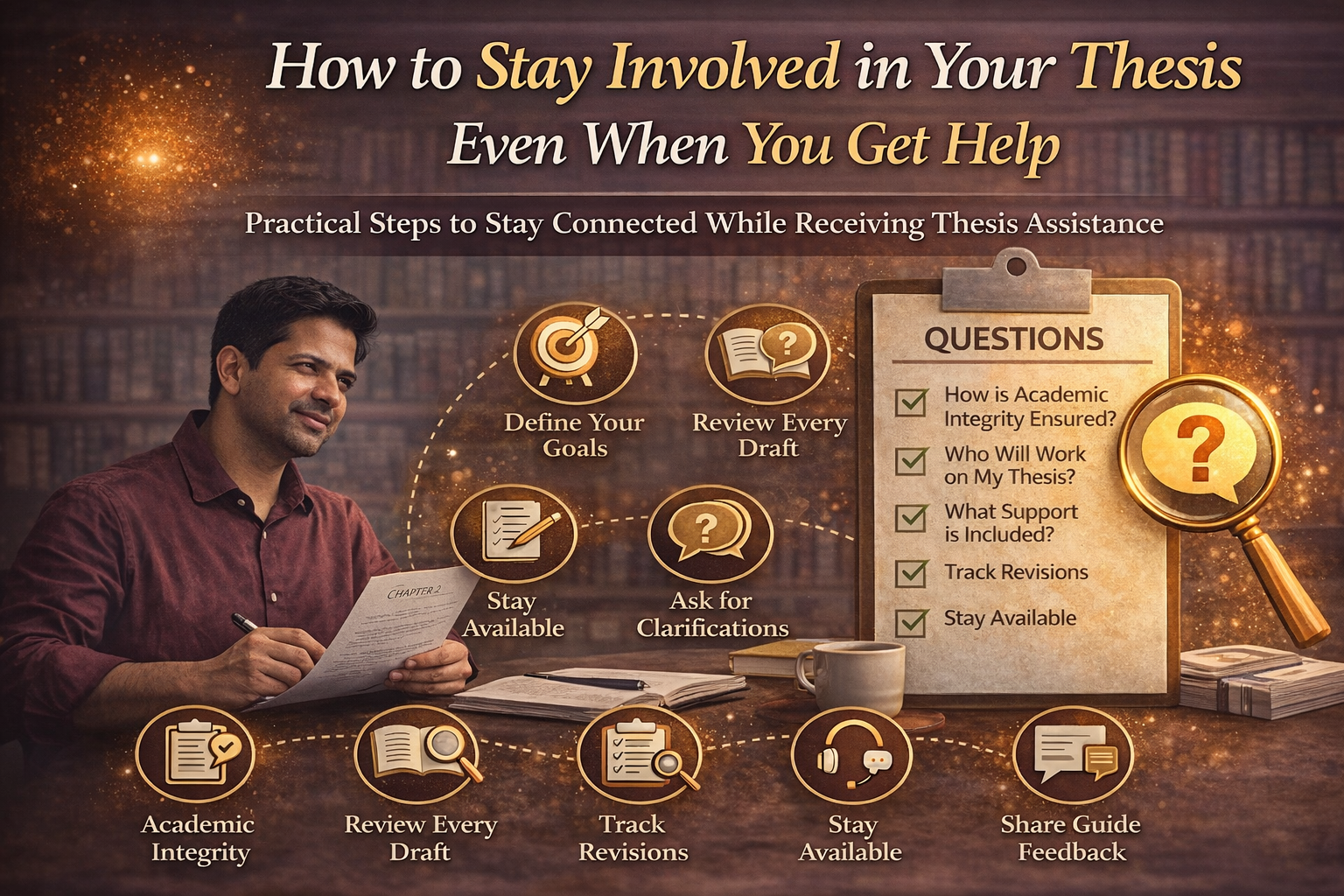
If you’re receiving any form of help — chapter drafting, editing, reviewing, or formatting — here’s how to remain intellectually and ethically involved in your thesis:
1. Begin with clarity about your topic and goals
Before any consultant begins work, take time to write down your research questions, what you’re trying to explore, and why it matters to you. You don’t need perfect academic language — even a simple one-page note helps. When you start from your own thinking, the rest builds around your core ideas.
2. Stay available for inputs and decisions
Whether it’s choosing literature sources, finalising headings, or deciding which data to include, make sure you’re part of those choices. A good consultant may suggest a structure, but you should approve or modify it after understanding why it’s being proposed.
3. Read every draft thoroughly
Don’t just glance at a chapter and say, “Looks good.” Sit with it. Read slowly. Underline terms you don’t understand. Ask why certain references were used or how the argument builds. This practice not only strengthens your thesis but prepares you for viva-style questioning later.
4. Keep a revision notebook or digital file
Each time you receive a draft, note down what changes were made, what feedback you gave, and what parts still feel unclear to you. This becomes a record of your intellectual engagement and makes it easier to explain your work to supervisors or examiners.
5. Ask for summaries or explanations if needed
There’s no shame in saying, “Can you explain this framework again?” or “I didn’t fully understand how this analysis works.” Consultants are there to support, not replace you. A healthy back-and-forth improves both the quality of the thesis and your grasp of it.
6. Participate in formatting and referencing steps
Even if you’re not doing the technical formatting yourself, review your references, check if all citations are listed, and ensure your university’s submission guidelines are being followed. These steps often reveal overlooked errors or missing details.
7. Use feedback from your guide to inform the process
Whenever your supervisor shares comments — even vague or minimal — pass them on to your consultant, but also discuss what they mean. What is the guide really asking for? Is there a mismatch in understanding? Staying involved here shows academic maturity.
The Emotional Payoff of Staying Involved
Apart from ethical concerns, there’s another reason to stay connected with your thesis: confidence. Many Indian scholars report feeling unprepared for their viva, even if their thesis was technically sound. Why? Because they didn’t read deeply or engage critically with the content.
When you stay involved — ask questions, give direction, revise actively — your thesis feels like something you built, not just something you submitted. That confidence shows in your presentations, your writing style, and the way you answer questions.
A working professional in Maharashtra who completed her PhD in management shared how, despite getting help for language editing and structure, she still read every chapter five times, rewrote two herself, and attended every formatting session. She passed her viva with praise — not because her thesis was perfect, but because it was clearly hers.
Conclusion
In India’s evolving academic environment, where thesis support services are becoming more common, staying involved in your own research work is both a responsibility and a safeguard. Getting help isn’t wrong — ignoring your role in the process is.
The best consultants will not write for you — they will work with you. And your job as a scholar is not to micromanage, but to lead. Stay present, stay curious, and keep asking questions. Because at the end of the day, your thesis isn’t just about passing — it’s about owning your research journey with honesty and clarity.