
Introduction
In Indian higher education, plagiarism management goes far beyond generating a similarity percentage. Universities—especially private institutions offering doctoral programmes—follow structured systems to record, store, and monitor plagiarism data over time. These records play a critical role in safeguarding academic integrity, ensuring fair evaluation, and identifying repeated violations.
For PhD scholars, understanding how plagiarism records are maintained is essential. These records can influence thesis approval, publication opportunities, academic evaluations, and even future career prospects. Awareness of this system helps researchers navigate submissions responsibly and avoid long-term academic consequences.
How Plagiarism Records Are Maintained in Indian Universities
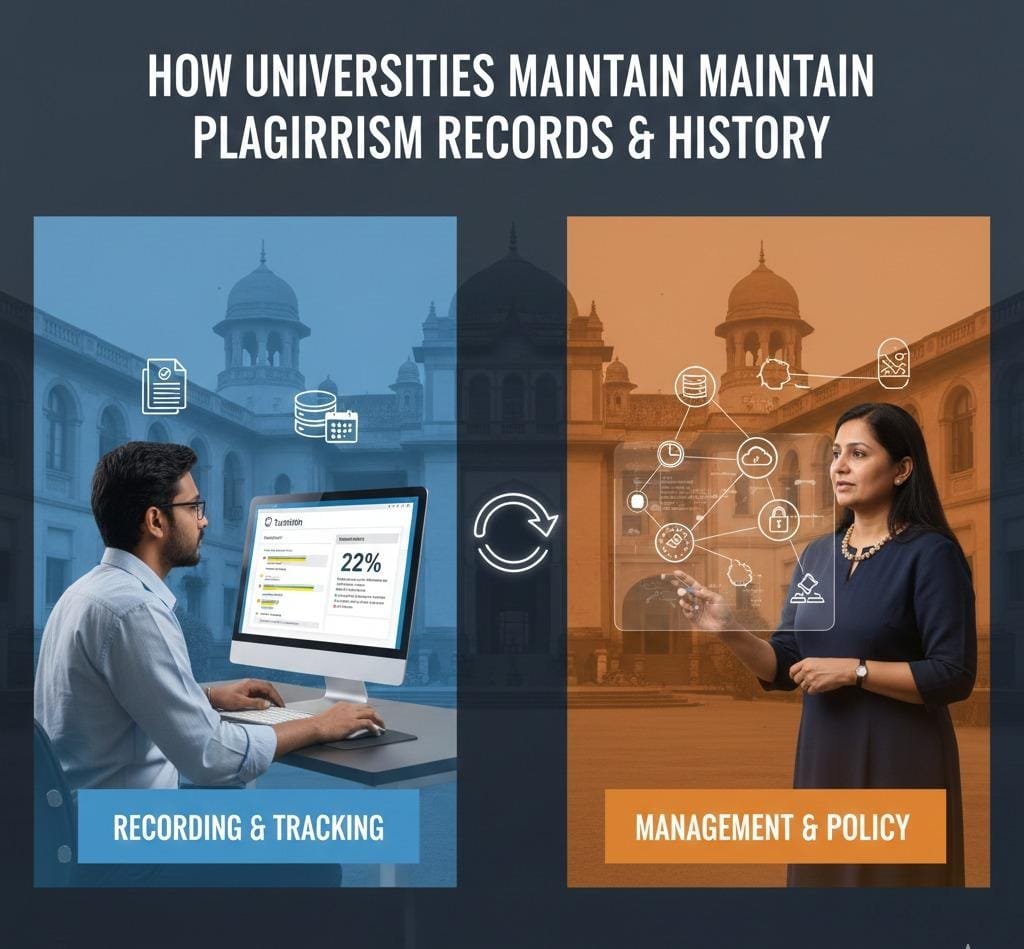
Most Indian universities, guided by UGC plagiarism regulations, maintain digital archives of plagiarism reports for theses, dissertations, and research papers. Each record usually includes key details such as the scholar’s name, date of submission, similarity percentage, plagiarism detection software used, and evaluator remarks.
In many private universities, these records are integrated into internal learning management systems (LMS) or research monitoring portals, allowing access to doctoral committees and academic administrators when required.
Centralised and Department-Level Record Systems
Universities follow either a centralised or decentralised approach to plagiarism record management.
In a centralised system, all plagiarism reports are stored at the university level, ensuring uniform evaluation standards across departments. This approach allows quick retrieval of past reports and helps track a scholar’s academic history consistently.
In contrast, a department-level system allows individual faculties to maintain plagiarism records independently. While this offers flexibility for discipline-specific evaluation, it may lack uniformity if not properly coordinated with central policies.
Role of Plagiarism Software Repositories
Tools such as Turnitin and Urkund play a significant role in maintaining plagiarism history. When a document is submitted with repository storage enabled, it becomes part of an institutional or global database. Future submissions are then checked against this stored content.
For PhD scholars, this has an important implication: reusing sections from earlier submissions without proper citation can result in self-plagiarism flags. Universities often treat self-plagiarism seriously, particularly in thesis chapters and published research.
Record Retention Period and Data Privacy
Most universities retain plagiarism reports for a defined period, typically ranging from three to seven years, depending on institutional policy. This allows academic committees to identify repeated violations or patterns of misconduct.
At the same time, institutions are expected to follow data protection norms. Access to plagiarism records is usually restricted to authorised faculty members, research committees, and examination boards to maintain confidentiality and protect scholars’ academic data.
Why Plagiarism History Matters for PhD Scholars
A scholar’s plagiarism record forms part of their academic identity. A clean history strengthens credibility during thesis evaluation, journal submissions, and academic appointments. Conversely, a major violation recorded in university systems can delay degree completion, affect eligibility for awards, or restrict publication opportunities.
On the positive side, well-maintained records also protect scholars from unjust allegations by providing documented proof of originality and compliance in earlier submissions.
Best Practices to Maintain a Clean Plagiarism Record
PhD scholars can proactively manage their plagiarism history by following a few essential practices:
- Conduct plagiarism self-checks before official submission
- Save copies of all plagiarism reports for future reference
- Clearly cite reused content from previous research work
- Understand institutional repository and exclusion settings
- Consult supervisors when similarity scores appear unclear
These steps reduce unnecessary academic risk and build long-term research integrity.
Conclusion
Plagiarism records are not merely administrative documents—they reflect a scholar’s commitment to ethical research practices. In Indian private universities, these records help uphold academic standards, prevent repeated misconduct, and promote originality in doctoral research.
For PhD candidates, understanding how plagiarism history is maintained is a crucial part of academic awareness. By respecting institutional systems and adopting ethical writing practices, scholars can protect both their current research and their future academic reputation.