Introduction
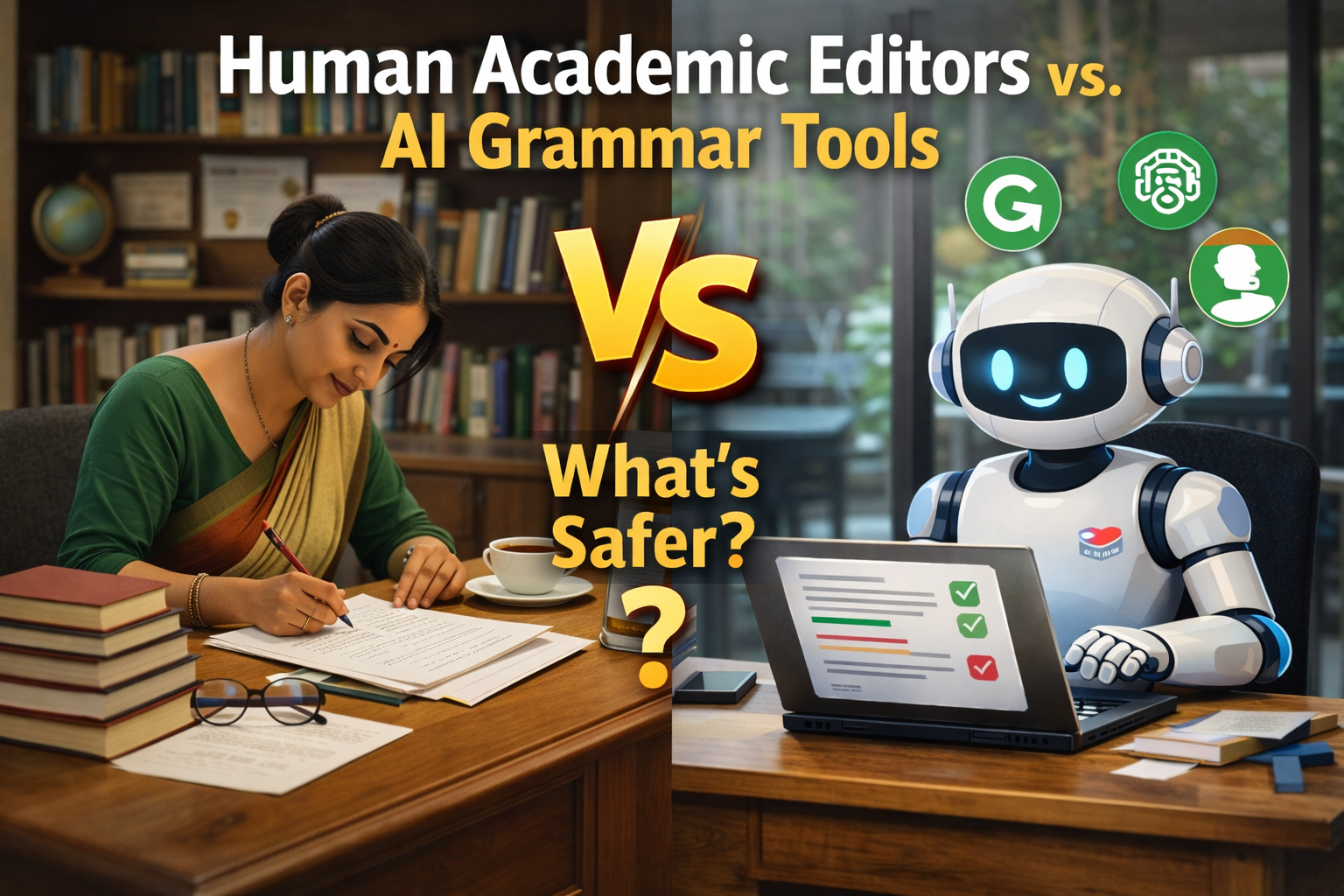
Every Indian PhD scholar, at some point, worries about language. Whether you’re pursuing a doctoral degree in a private university in Hyderabad or a central institute in Delhi, writing clearly and academically in English remains a major challenge — especially for those whose school and college education happened in regional languages. With the rise of AI grammar tools like Grammarly, Quillbot, and ChatGPT, many researchers are now turning to technology to fix their writing. But the question remains: Is it safe to rely on AI tools? Or is working with a human academic editor still the better option?
This debate is not just about grammar. It’s about meaning, nuance, and integrity. In the Indian academic context, where scholars come from diverse linguistic, educational, and socio-economic backgrounds, the need for ethical and effective editing is especially important. And when it comes to preparing a thesis for submission or a research paper for publication, choosing between AI and a human editor is more than a technical decision — it’s a strategic one.
Why AI Grammar Tools Are Useful — But Limited
AI grammar tools have undoubtedly made writing easier. They catch spelling mistakes, flag repetitive phrases, and suggest smoother alternatives. For scholars with limited time or confidence in their English writing, these tools offer a quick way to tidy up paragraphs. They’re accessible, often free, and work instantly — a big help when you’re racing against submission deadlines.
However, these tools are trained on generic patterns. They don’t understand your research topic, the tone expected in academic writing, or the cultural nuances of Indian English. If your thesis includes regional terms, policy references, or technical phrases in your discipline, AI might “correct” them in ways that weaken your argument or change the intended meaning.
A PhD scholar from a private university in Tamil Nadu shared that she ran her entire discussion chapter through an AI tool. While it improved the flow, it also removed certain keywords and softened her arguments. Her guide later pointed out that the revised version lacked clarity and strength. She had to rewrite the section — this time with the help of a human academic editor who understood her field and helped her retain her voice.
What Human Academic Editors Do Differently
A human academic editor doesn’t just check your grammar — they engage with your content. They understand the logic of your argument, the standards of your discipline, and the expectations of Indian PhD supervisors and review committees. They can flag unclear transitions, suggest better ways to present your findings, and ensure consistency in tone across chapters.
More importantly, a professional academic editor respects authorship. They don’t rewrite your work or insert ideas that weren’t originally yours. They guide you to say what you mean more clearly, not say something else entirely. This distinction is crucial — especially in Indian academia, where thesis originality and author involvement are taken seriously during the viva voce.
For scholars whose research spans policy, fieldwork, or regional case studies, human editors also offer cultural sensitivity. They understand that a thesis on caste dynamics in Bihar cannot be edited with the same lens as one on digital marketing in Mumbai. They adapt their edits based on your topic, not just your sentence structure.
Another benefit of human editing is the ability to explain choices. Unlike AI tools, which just highlight errors or offer vague suggestions, human editors can tell you why something isn’t working — and how to improve it. This becomes a learning process, not just a correction service.
Safety, Integrity, and the Indian PhD Process
One concern that often comes up is academic integrity. Scholars fear that using editing services may be seen as unethical. But there’s a difference between someone editing your language and someone writing your content. Ethical editors do the former — they refine your words without touching your core ideas.
In fact, many private universities in India quietly encourage scholars to use language editing services before final submission, especially when English is a second or third language. Some even require a certificate of proofreading or plagiarism check before accepting the final draft.
With AI tools, however, the line is blurrier. Some tools do more than edit — they rephrase, paraphrase, or rewrite entire paragraphs. If you’re not careful, this can lead to unintentional plagiarism or academic fraud. Worse, you may not even understand what’s been changed. During your viva, this could lead to serious embarrassment — especially if you’re asked to explain a sentence that you didn’t actually write.
A scholar in political science from a Delhi-based university shared how his thesis was flagged during review for having “AI-style phrasing.” He had used an AI paraphraser to improve flow, but the result was overly polished and generic. The external examiner noted a lack of voice and questioned the scholar’s authorship. That incident led to weeks of clarification and revision — and could have been avoided with a more human, ethical form of editing.
Conclusion
AI grammar tools are here to stay — and they do have a place in academic life. They can help you catch basic errors, clean up messy drafts, and boost your confidence during early writing stages. But they are not a substitute for deep understanding, contextual editing, or academic awareness.
For Indian PhD scholars working in complex fields, writing in English, and dealing with institutional pressure, human academic editors offer something AI cannot — safety, clarity, and cultural sensitivity. They don’t just fix your sentences. They help you communicate your research more effectively — while keeping your voice intact.
In the end, your thesis is a reflection of your thinking. Use tools where they help — but when it matters most, trust people who understand both your language and your academic journey. That’s not just safer. It’s smarter.