Introduction
Science and technical education in India has traditionally been associated with laboratories, workshops, and hands-on training. Subjects like engineering, medicine, pharmacy, and pure sciences demand practical exposure, making them seem unsuitable for distance learning. Yet, with the growing popularity of online and flexible education, many students and professionals wonder whether science and technical courses can be effectively pursued in distance mode. The answer is layered—while regulations provide clarity, technology and pedagogy are also reshaping the possibilities. To truly understand the suitability of distance education for these fields, one must explore both the opportunities and the limitations in the Indian context.
The Regulatory Standpoint
The University Grants Commission (UGC), through its Distance Education Bureau (DEB), plays the central role in defining what can and cannot be offered in distance mode. As per current guidelines, professional degrees such as medicine, engineering, law, pharmacy, and nursing cannot be pursued through distance education. The reason is simple: these programs require structured laboratory sessions, clinical practice, or industrial training that cannot be substituted by theoretical study alone.
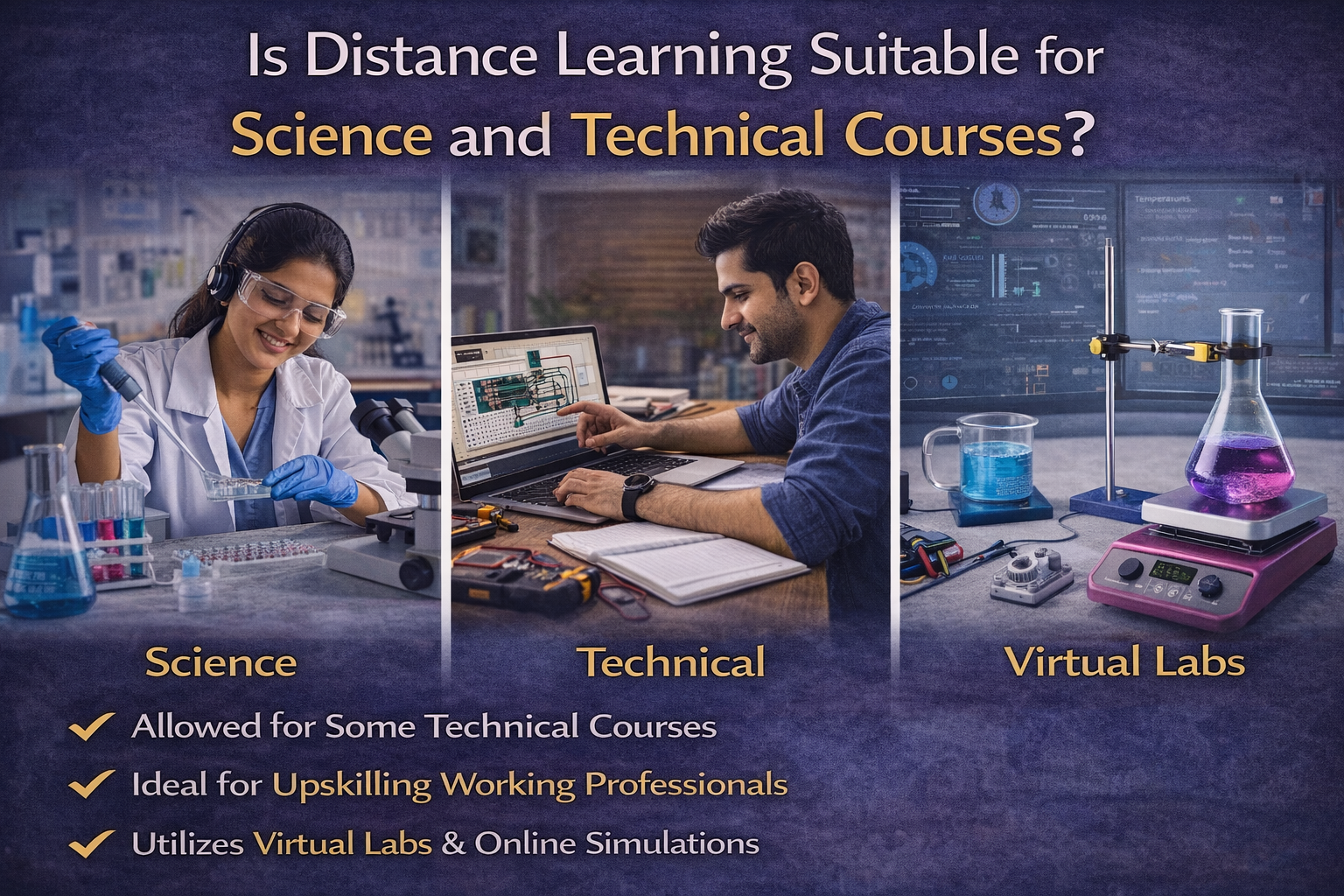
However, this does not mean that all science-related education is barred from distance mode. Several postgraduate programs in pure sciences—such as mathematics, environmental science, and even some applied subjects—are allowed through blended models. Similarly, technical upskilling courses, certificate programs, and postgraduate diplomas related to IT, computer applications, and data science are frequently offered by universities in distance or online mode. Thus, regulatory policy draws a line between professions requiring direct physical training and subjects where theoretical learning and digital simulations can suffice.
The Role of Technology in Bridging Gaps
One of the most significant enablers for science and technical education in distance mode is technology. Virtual labs, 3D simulations, augmented reality tools, and online project-based learning have begun to replicate aspects of laboratory training. For instance, engineering students can run software-based experiments in mechanical design or electrical circuits through online platforms. Similarly, in fields like biotechnology or chemistry, virtual labs allow learners to conduct simulated experiments without being physically present in a laboratory.
Although such tools cannot completely replace real-world practice, they offer a strong supplementary model, particularly for working professionals who already have access to labs at their workplace. This is why many private universities and edtech platforms in India are investing in digital infrastructure to support technical learning in distance mode.
Suitability for Different Learner Groups
Distance learning in science and technical subjects may not be ideal for every student, but it can serve specific groups well. For example:
- Working professionals in technical fields: An engineer employed in the industry may not need basic lab exposure but could benefit from a distance postgraduate diploma in project management, renewable energy, or data analytics.
- Teachers in schools and colleges: Many educators pursue distance science degrees or diplomas to upgrade their qualifications for promotions without leaving their jobs.
- Professionals seeking interdisciplinary skills: A commerce graduate wanting to learn computer applications or a humanities scholar exploring environmental science can pursue these through distance programs, provided the course focuses on conceptual understanding and applications.
For fresh students with no prior exposure to labs, however, purely distance-based technical education may fall short. In such cases, blended models that include contact classes or short-term lab workshops are more suitable.
The Global Perspective
Internationally, several reputed universities offer technical education online. For example, data science, artificial intelligence, and even certain branches of engineering design are available through online or hybrid programs from institutions abroad. These programs rely on advanced digital tools, project-based assessment, and collaboration platforms. India is gradually moving in this direction, though infrastructure and access remain uneven.
It is also important to note that global acceptance of online technical education is higher in industries where skills are demonstrated through projects rather than merely degrees. For example, IT professionals with a distance computer science degree are often judged more by their coding ability than the mode of their qualification. This perspective is slowly gaining ground in India as well.
Common Misconceptions
Many myths surround science and technical education in distance mode. One misconception is that such programs are “fake” or lack credibility. In truth, when offered by UGC-DEB approved universities, they hold legal recognition. Another myth is that distance learners in science cannot perform practical work at all. While true for certain restricted fields, many programs integrate project submissions, industry-based assignments, or hybrid contact classes to ensure practical exposure.
A third misconception is that employers reject distance technical qualifications outright. The reality is more nuanced. In regulated professions like medicine or pharmacy, only regular degrees are valid. But in IT, management, and applied sciences, employers often value skills and experience over the delivery mode of education.
Challenges That Remain
Despite progress, distance education in science and technical fields faces real challenges. Access to reliable internet and devices is still uneven in India, especially in rural areas. Many universities lack the resources to create high-quality virtual labs or interactive platforms. Moreover, the mindset of equating classroom attendance with quality continues to dominate both academic and industry circles. Unless blended models and technological adoption improve, distance education in technical fields will continue to face skepticism.
Conclusion
Distance learning in science and technical fields is neither wholly unsuitable nor universally applicable. It works best for professionals seeking upskilling, interdisciplinary exposure, or conceptual mastery, but it cannot replace full-time laboratory-intensive education in fields like engineering, medicine, or pharmacy. With UGC-DEB providing clear guidelines and technology creating new learning possibilities, distance education in technical areas is gradually finding legitimacy. For Indian students, the key lies in aligning program choice with career goals and verifying regulatory approval. While distance mode may not suit every science learner, it undoubtedly expands opportunities for those who need flexibility without compromising on growth. The future will likely belong to hybrid models where distance education, digital innovation, and occasional physical training come together to make science education more inclusive and adaptable