Introduction
In the Indian research ecosystem, especially for PhD students in private universities, plagiarism detection has become a mandatory step before thesis submission. With paid tools like Turnitin and Urkund often restricted to institutional access, many scholars rely on free plagiarism checkers available online. While these free tools seem convenient, they come with several limitations that can compromise the accuracy, reliability, and even the security of your research work. Understanding these drawbacks is essential for maintaining academic integrity and ensuring that your thesis passes official scrutiny.
Accuracy Issues and Limited Database Coverage
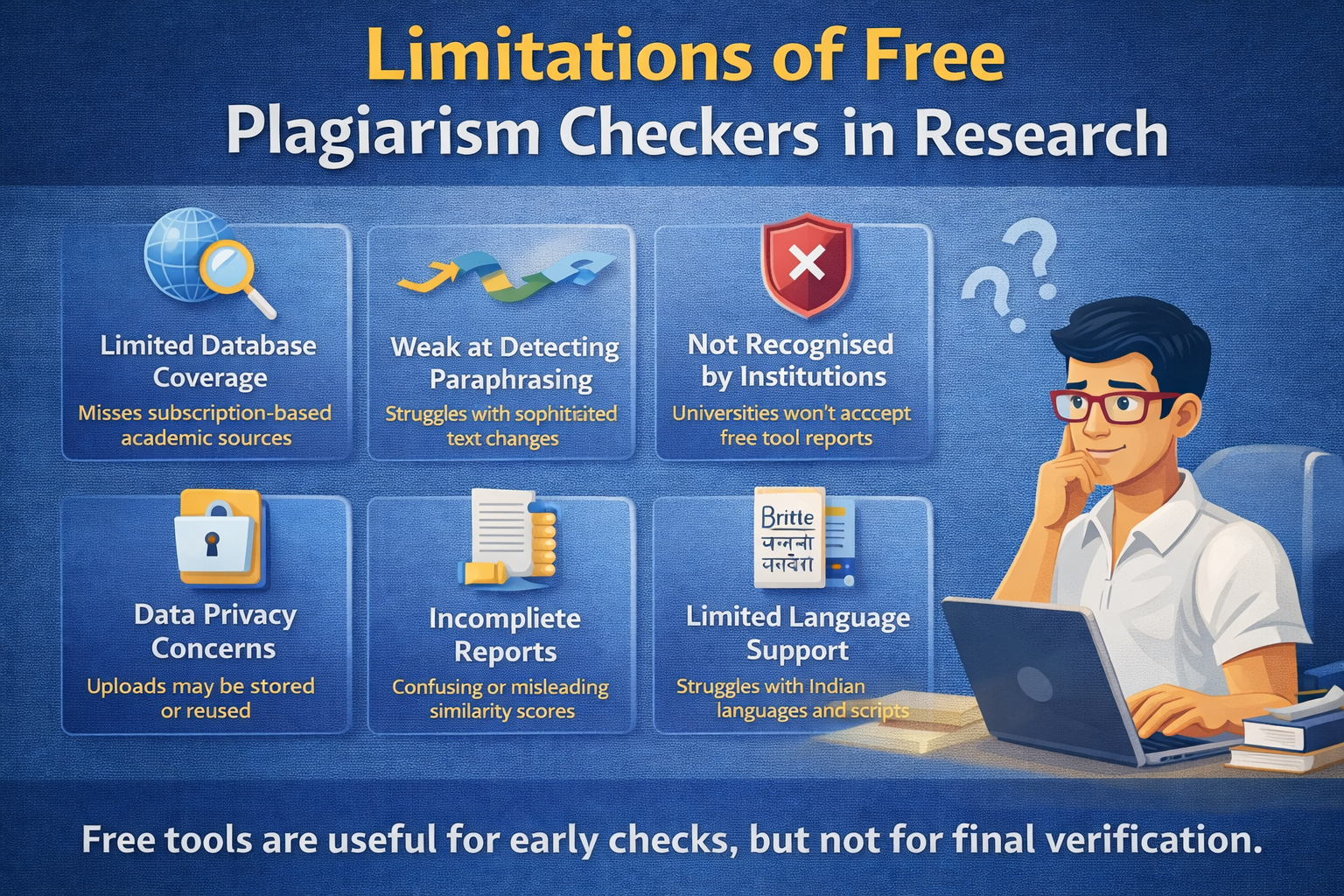
One of the most significant limitations of free plagiarism checkers is their restricted database access. Paid tools like Turnitin scan against vast repositories, including academic journals, university archives, and subscription-based publications. Free tools, on the other hand, often check only publicly available internet sources. This means they might miss similarities with scholarly articles, conference papers, or previously submitted theses that are not openly accessible. For PhD students, this gap can be risky because institutional plagiarism checks will compare your thesis against much more comprehensive databases.
Inability to Detect Advanced Paraphrasing
Many free plagiarism checkers focus on exact word matches or basic synonym replacements. This makes them less effective at identifying sophisticated paraphrasing — a technique often scrutinised in academic work. If you unintentionally paraphrase too closely to a source, a free tool might give you a low similarity percentage, creating a false sense of security. When your thesis is later checked by an advanced paid tool, these undetected similarities may surface, leading to potential academic consequences.
Lack of Institutional Recognition
In India, universities (especially private institutions) usually require plagiarism reports from recognised tools such as Turnitin or Urkund. Reports generated by free checkers are not accepted for official submission because they lack credibility, detailed matching sources, and verifiable report formats. This means that even if you use a free tool for self-checking, you will still have to go through the official institutional process — making free tools only a supplementary option rather than a final solution.
Data Privacy and Security Risks
A less discussed but important limitation of free plagiarism tools is the risk to your research privacy. Many of these platforms store uploaded content on their servers, which may be accessed or reused without your permission. For PhD candidates, where original research ideas are valuable intellectual property, uploading entire chapters to an unknown free service can be risky. Once your work is stored elsewhere, you lose control over how it is used or shared in the future.
Incomplete and Misleading Reports
Free plagiarism tools often present similarity scores without clear source breakdowns. They may also highlight matches that are common phrases or unavoidable academic terms, inflating the percentage unnecessarily. Conversely, they might ignore critical matches in subscription-only sources. This incomplete or misleading feedback can confuse scholars, especially those new to plagiarism checks, making it harder to refine and improve their writing effectively.
Limited Support for Indian Languages and Formatting Styles
Many Indian researchers, particularly in social sciences and regional studies, include references, quotes, or content in Indian languages. Most free plagiarism tools lack the capability to detect similarities in non-English scripts. They also sometimes misinterpret thesis formatting elements such as footnotes, bibliography styles, and tables, leading to inaccurate similarity results. Paid academic tools are better equipped to handle such variations.
When Free Tools Can Still Be Useful
Despite these limitations, free plagiarism checkers can still serve as a preliminary step in the writing process. They can help you identify basic overlaps in the early drafting stage before you run the document through an official institutional tool. Using them for short sections, like a literature review draft or an abstract, can save time. However, scholars must remember that this is only an initial check — not a substitute for official verification.
Conclusion
Free plagiarism checkers may appear attractive for budget-conscious PhD students in India, but their limitations in accuracy, database access, paraphrasing detection, and data security make them unsuitable as a final screening tool. In the competitive and scrutiny-heavy academic environment, relying solely on these tools can jeopardise your research credibility. The best approach is to use free checkers for early-stage self-assessment and then rely on recognised, institution-approved tools like Turnitin or Urkund before submission. This combination ensures both convenience and compliance, protecting your work and your academic reputation.