
Introduction
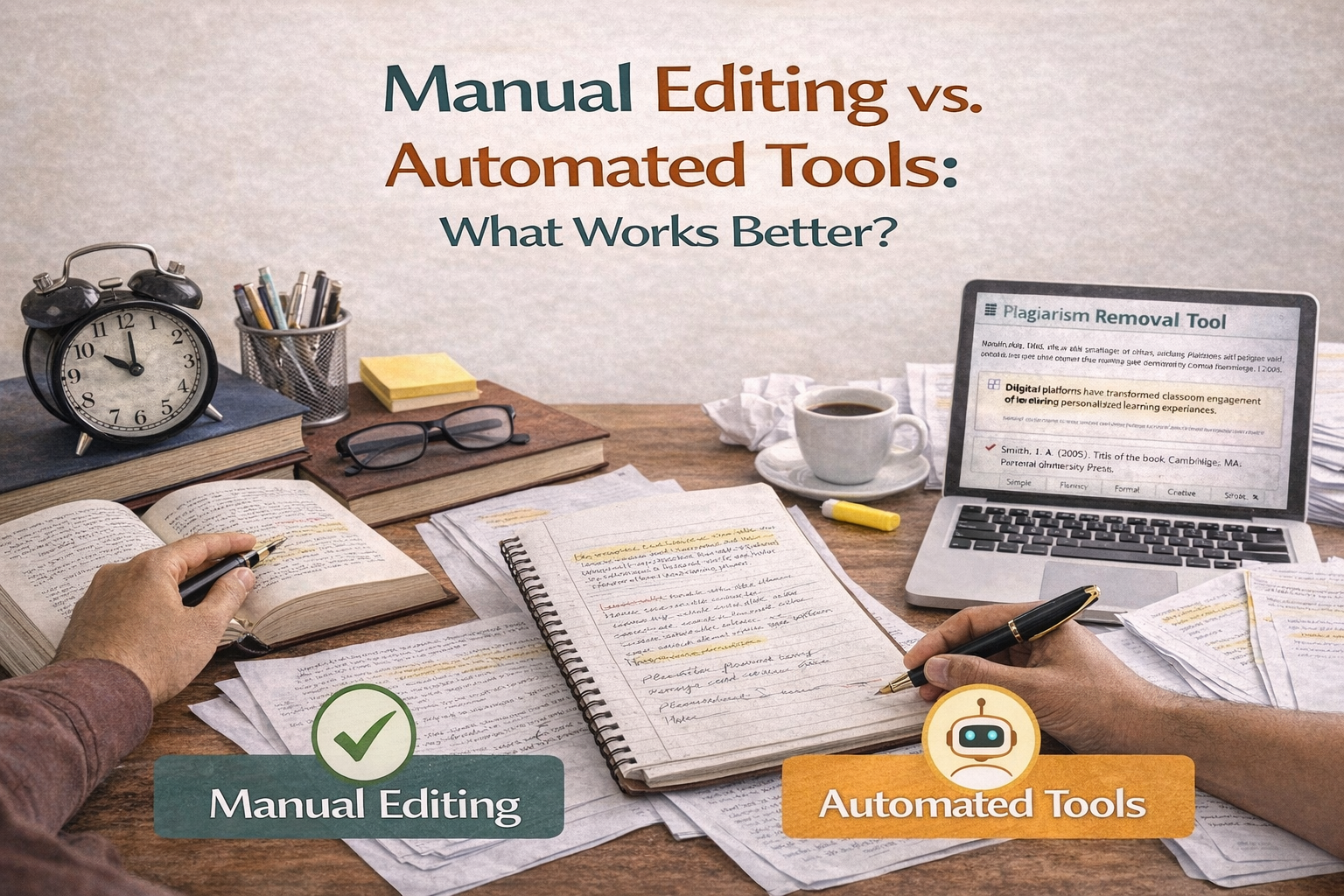
In the race to submit plagiarism-free research papers and theses, scholars often face a critical decision: should they rely on manual editing or depend on automated tools for plagiarism removal? With increasing scrutiny in Indian academia, the answer isn’t straightforward. While software offers speed and convenience, manual editing brings depth, nuance, and intellectual control—qualities vital for any serious researcher.
Understanding what each approach offers—and where it falls short—can help scholars choose the right strategy for their specific needs. This blog compares manual and automated plagiarism removal methods, focusing on their application in the Indian research ecosystem.
What Are Automated Plagiarism Removal Tools?
Automated tools are online services or software platforms that rephrase plagiarised content using AI algorithms. These tools scan texts, identify matched segments, and offer rewritten alternatives. Popular platforms include QuillBot, Grammarly, and various paraphrasing engines available with Turnitin access.
They are widely used in India, especially by students facing tight submission deadlines or lacking proficiency in academic English.
Strengths of Automated Tools
- Speed and Efficiency: Tools can rephrase large chunks of text instantly.
- Detection Compatibility: Many are designed to evade standard plagiarism detection software.
- User-Friendly: Even first-time users can operate them with minimal guidance.
- Affordable Plans: Several platforms offer student discounts or free trials.
Limitations of Automated Tools
- Loss of Meaning: Automated rewriting may dilute the original idea or alter technical accuracy.
- Poor Grammar or Syntax: Outputs often require manual correction for flow and readability.
- Inability to Handle Complex Sentences: Tools struggle with nuanced academic writing, especially in literature reviews or theoretical discussions.
- Ethical Concerns: Some universities consider AI-rewriting a grey area, and supervisors may reject tool-modified texts.
What Does Manual Editing Involve?
Manual editing refers to the human-led process of identifying plagiarised content and rewriting it meaningfully. It includes summarizing, paraphrasing, synthesizing information, and ensuring correct citations. It requires subject knowledge, writing skill, and familiarity with plagiarism detection patterns.
Manual editing is preferred by many Indian scholars for PhD theses, funded research projects, and journal publications where academic rigour is non-negotiable.
Strengths of Manual Editing
- Retains Original Intent: Human editors understand context and preserve meaning while rephrasing.
- Improves Writing Quality: Enhances overall academic tone, coherence, and logic flow.
- Customisable Style: Adaptable to university-specific formats or supervisor preferences.
- Ethically Sound: Encourages original thinking and deeper engagement with the literature.
Limitations of Manual Editing
- Time-Consuming: Editing a lengthy document manually can take days or weeks.
- Requires Skill: Not all researchers are confident in paraphrasing or academic rewriting.
- Subjectivity Risk: Without external feedback, manual edits may miss hidden similarities.
When to Use What?
- For Quick Fixes: Use automated tools to identify problematic areas, but always review and refine the output.
- For Final Submissions: Rely on manual editing, especially if the work is going to be evaluated by experienced reviewers or supervisors.
- For High-Stakes Work: Theses, dissertations, and journal papers benefit most from manual intervention.
- For Language Support: Automated tools can help non-native English speakers get started, but human revision is still essential.
What Indian Universities Prefer
In Indian academia, manual editing is highly valued. Supervisors, peer reviewers, and thesis committees can usually detect overly mechanised language, especially in research-heavy sections. Most universities recommend a similarity index below 10–15%, and achieving this through human editing often results in more sustainable, meaningful output.
Institutions like UGC and NAAC are also increasingly integrating plagiarism awareness and writing workshops, signalling a long-term preference for manual skill-building over automation.
Conclusion
Both manual editing and automated tools have their place in plagiarism removal, but neither is perfect on its own. In the Indian academic context, where originality, clarity, and ethical writing are held in high regard, a balanced approach works best. Use automated tools for support—but rely on manual editing for credibility, precision, and long-term academic growth. At the end of the day, nothing replaces a scholar’s own critical thinking and writing voice.