
Introduction
For many Indian PhD scholars, especially those writing in English as a second language, paraphrasing is one of the most commonly used — and misunderstood — academic practices. It often starts as a genuine attempt to express an idea in one’s own words, but without proper guidance, it can easily slip into plagiarism. The line between the two is thin, and not always clearly explained in Indian academic environments.
In private universities, where students may come from diverse professional and linguistic backgrounds, paraphrasing becomes a tool for survival. Yet, many are unsure: how different must a sentence be from the original? If the source is mentioned, is it still plagiarism? Can AI paraphrasers be trusted? These are real concerns, not just theoretical issues — and the consequences of getting it wrong can be serious.
This blog explores the critical difference between paraphrasing and plagiarism, especially in the Indian PhD context. Understanding this distinction is not just about passing a software check — it’s about maintaining academic integrity while expressing complex ideas in your own voice.
What Counts as Paraphrasing — and What Doesn’t
Paraphrasing means restating someone else’s idea in your own words while giving credit to the original author. It’s a vital part of academic writing because no research happens in isolation. You build upon existing studies — but with proper acknowledgement.
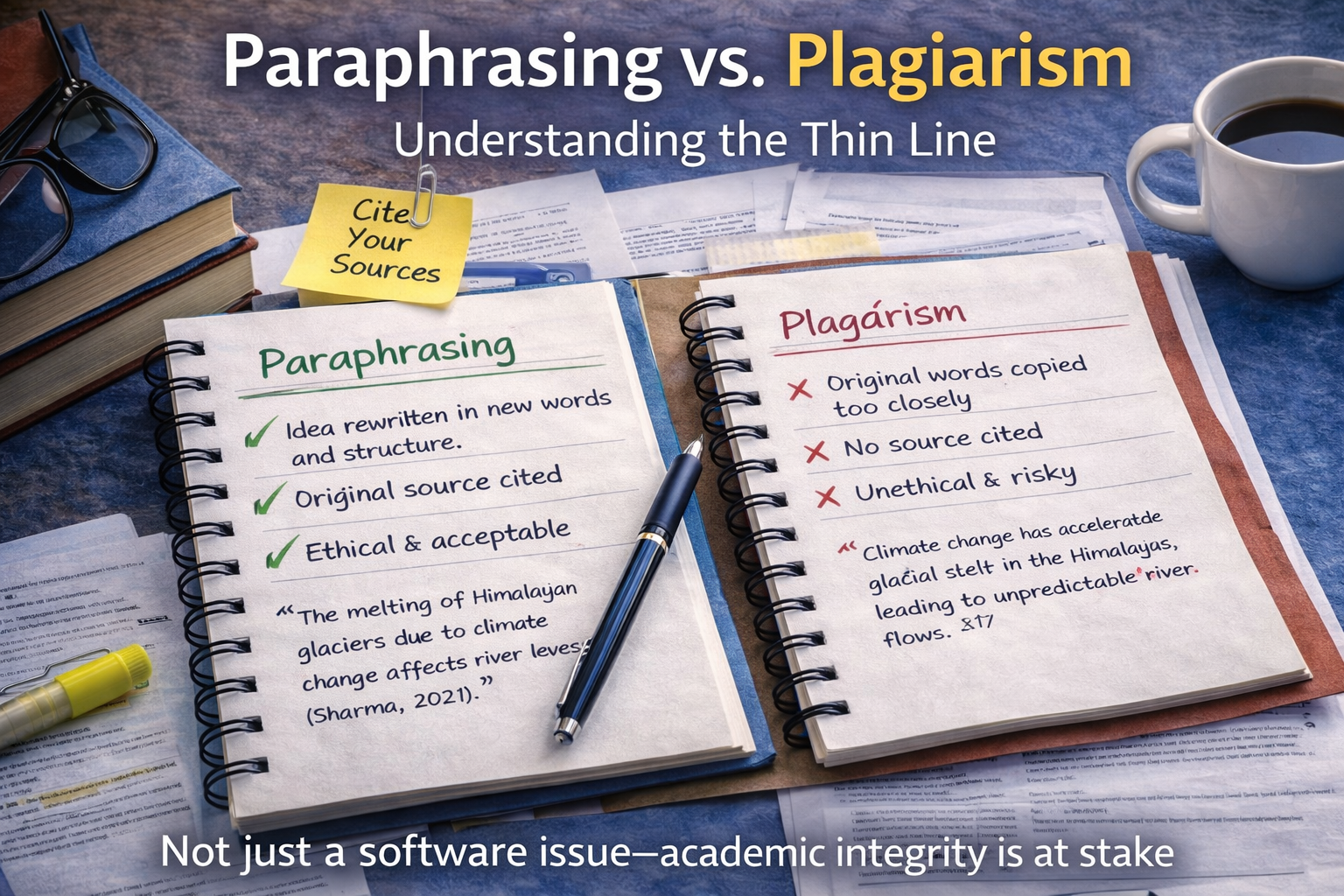
Here’s a basic example:
Original: “Climate change has accelerated glacial melt in the Himalayas, leading to unpredictable river flows.”
Paraphrased with citation: Recent studies suggest that the melting of Himalayan glaciers has intensified due to climate change, affecting the consistency of river water levels (Sharma, 2021).
This is acceptable because:
- The sentence structure has changed
- The words are different
- The source is cited
Now, here’s what doesn’t count as valid paraphrasing:
- Changing only a few words: Replacing “accelerated” with “increased” or “unpredictable” with “irregular” is not enough.
- Keeping sentence structure the same: Even if the vocabulary is new, the format matters. Tools like Turnitin can detect structural copying.
- Omitting the citation: No matter how well you reword, if the idea isn’t originally yours, it must be credited.
In Indian universities, many scholars unknowingly commit plagiarism by submitting close paraphrases without citation, especially in literature reviews. This is why paraphrasing must be learned — not assumed.
The Indian Academic Context — Where the Confusion Starts
Paraphrasing may seem like a small skill, but it becomes a major challenge in the Indian research environment for several reasons:
- Lack of early academic training: Many students first encounter citation and paraphrasing norms at the PhD level. Undergraduate and master’s education often doesn’t prepare them.
- Language translation: Scholars who think in Hindi, Tamil, or other regional languages may mentally translate ideas, then adapt sentences from English sources. This often leads to unintentional mimicry.
- Heavy reliance on source texts: Due to pressure to “sound academic,” many Indian scholars copy structure or phrases from research papers, assuming that complex language equals good scholarship.
- Use of AI and freelancers: Some scholars use AI tools or hire editors who paraphrase poorly — changing words but keeping the skeleton of the sentence intact.
In all these cases, what was meant as paraphrasing may be flagged as plagiarism. And in most Indian universities, plagiarism above 10–15% (depending on the policy) can delay submission, trigger reviews, or even affect your viva.
How to Paraphrase Ethically and Effectively
Ethical paraphrasing isn’t about avoiding detection — it’s about honest scholarship. Here are some practical approaches tailored to the Indian PhD experience:
- Understand the source first: Before paraphrasing, read the paragraph, pause, and summarise it mentally. Then write in your own words. Don’t look at the source while writing.
- Cite even when paraphrasing: A citation is not only for direct quotes. If the idea belongs to someone else, it needs a reference, even if no words are copied.
- Keep your own voice: Academic writing doesn’t have to sound robotic or filled with jargon. Use a tone and language level you’re comfortable with — and build confidence in expressing ideas clearly.
- Use tools only for review, not rewriting: AI paraphrasers like QuillBot or ChatGPT can be useful for improving sentence flow — but if you use them to rewrite full paragraphs, you risk plagiarism or distortion. Always review the output and make sure it reflects your understanding.
- Practice with feedback: Ask your guide or a peer to review a paraphrased section and give feedback. Over time, your paraphrasing will improve — just like any other research skill.
Ethical paraphrasing not only protects your thesis from plagiarism software — it also improves your grasp of the subject. When you paraphrase with care, you actually learn more deeply.
Conclusion
The line between paraphrasing and plagiarism is indeed thin — but not invisible. For Indian PhD scholars navigating complex writing expectations, language shifts, and tight deadlines, understanding this distinction is crucial. Paraphrasing is not about rearranging words; it’s about making ideas your own, while honouring the work they came from.
In the end, research is a conversation — not a performance. You’re not expected to know everything or invent everything from scratch. But you are expected to think, understand, and write honestly. When you paraphrase ethically, you’re not just avoiding penalties — you’re participating in that conversation with clarity and respect.