
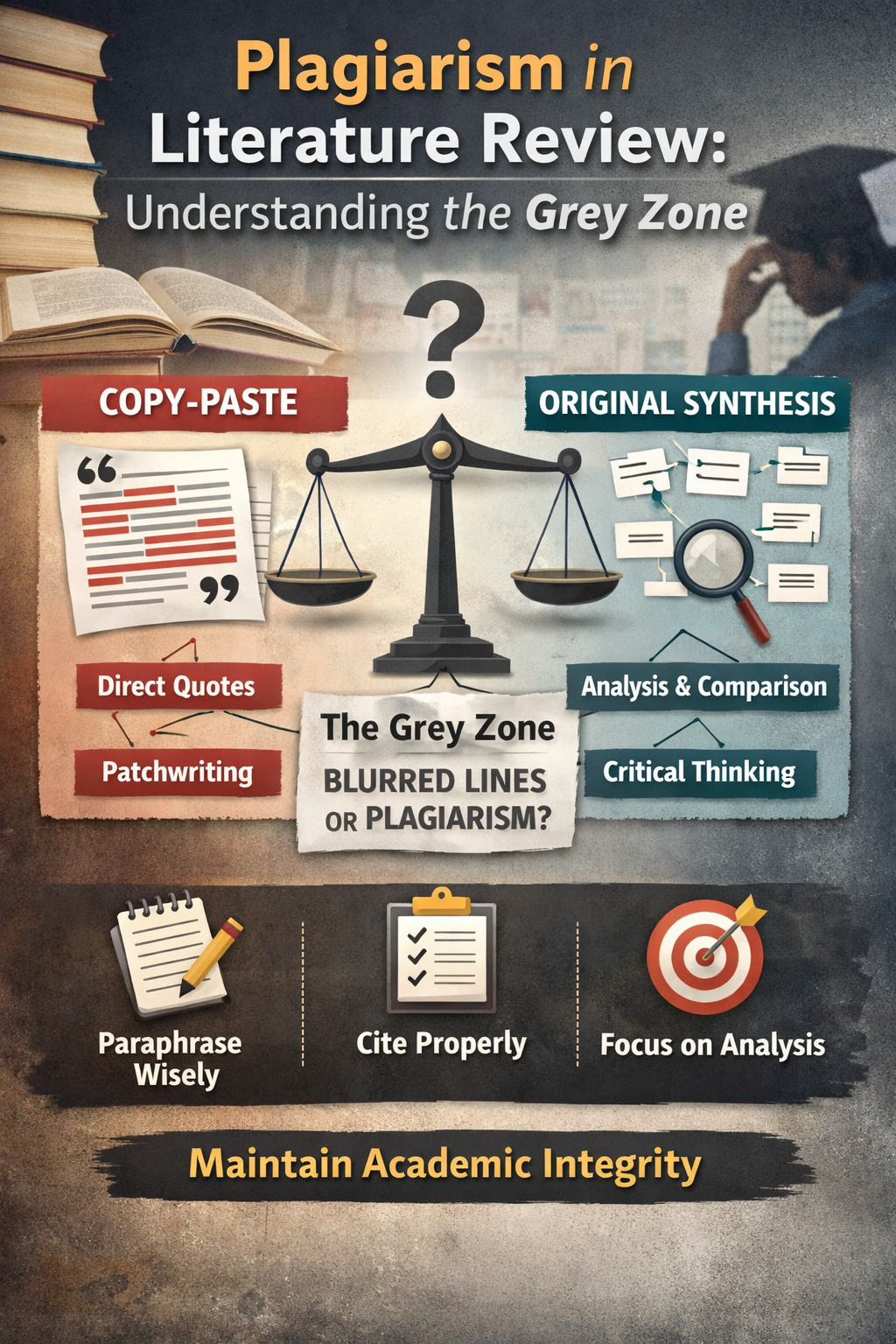
Plagiarism in Literature Review: Why It’s a Grey Zone
Introduction
For many research scholars, the literature review is the first major section of their thesis or dissertation. It requires reading, summarising, and connecting existing studies to build a foundation for new research. Yet, this stage is also where plagiarism often sneaks in—sometimes without the writer even realising it. In India, where doctoral candidates in both public and private universities juggle multiple responsibilities, the literature review can feel like a race to compile as much information as possible. But in doing so, scholars may unintentionally copy the structure, wording, or even the flow of existing research. This is why plagiarism in literature reviews is often seen as a “grey zone”—it’s not always a case of deliberate dishonesty, but it still challenges the principles of originality and academic integrity.
Why the Literature Review Is More Vulnerable
Unlike the methodology or results section, the literature review relies entirely on existing work. Scholars must refer to other researchers’ ideas, findings, and frameworks, which makes overlap inevitable to some extent. In the Indian academic context, many first-time researchers are trained to think of the literature review as a summary of past studies, rather than a critical analysis. This can lead to over-reliance on direct quotes or closely paraphrased sentences.
In private universities, where PhD students often come from diverse professional backgrounds, the skill of synthesising literature may not be equally developed. A working professional entering doctoral admission in India might excel in their field but lack experience with academic writing conventions. Without proper guidance, they might assume that simply changing a few words or rearranging sentences is enough to avoid plagiarism, when in fact, it can still be detected as similarity.
Another challenge is the pressure to cite “authoritative” sources in bulk. Students may feel that the more references they include, the stronger their literature review will appear. In trying to meet these expectations, they might copy sections from multiple sources without truly integrating them into their own analysis.
Understanding the Grey Zone
Plagiarism in literature reviews is often called a grey zone because there is no universal threshold for acceptable similarity here. Even global plagiarism detection tools can flag common technical terms, standard definitions, or well-known theories as overlap, despite these being unavoidable. The real concern arises when entire paragraphs mirror the structure and language of the original sources, even if citations are included.
In some cases, scholars unknowingly commit what is called “patchwriting”—replacing a few words in a sentence while keeping the original structure intact. This is especially common in fields with complex or technical language, where rephrasing without altering meaning is challenging. While patchwriting can be a part of the learning process, it still falls into plagiarism if overused in a final draft.
Supervisors and institutions often have different interpretations of what counts as acceptable in a literature review. In one private university, a 20% similarity score in this section might be considered fine if it includes properly cited material. In another, the same percentage might lead to revisions or penalties. This inconsistency adds to the uncertainty for students.
How to Approach Literature Reviews Without Crossing the Line
The best way to avoid plagiarism in a literature review is to focus on synthesis rather than summary. Instead of writing about each study separately, scholars should look for patterns, agreements, and gaps across multiple sources. For example, rather than copying the exact phrasing of an author’s conclusion, a researcher can compare how different authors arrived at similar findings and present that observation in their own words.
In Indian private universities, some supervisors now encourage students to keep two separate sets of notes while reading sources—one for direct quotations (with page numbers) and another for paraphrased ideas. This habit reduces the risk of accidentally blending copied text into the thesis.
Training in paraphrasing, citation styles, and academic argumentation is equally important. Scholars who understand why originality matters are less likely to rely on heavy textual borrowing. Many global institutions mandate such training before a student begins writing; adopting similar practices across Indian universities could greatly reduce grey-zone plagiarism.
The Role of Policy and Mentorship
A clear institutional plagiarism policy should address the unique challenges of literature reviews. This means recognising that some level of similarity is unavoidable but clarifying when it becomes unacceptable. Policies could, for example, differentiate between overlaps due to technical terminology and overlaps due to copying of analytical content.
Supervisors also have a crucial role in helping students navigate this grey zone. By reviewing early drafts of the literature review, they can point out where a student’s writing is too close to the source and guide them toward better synthesis. Encouraging peer review within research groups can also help, as scholars often spot unintentional similarities in each other’s work.
Conclusion
Plagiarism in literature reviews may be a grey zone, but it is not an unsolvable problem. With clear institutional guidelines, early mentorship, and a focus on critical synthesis, scholars can produce literature reviews that are both well-referenced and genuinely original. For Indian PhD students—especially those in private universities balancing work, study, and personal commitments—understanding this balance is essential. The literature review is more than a list of past research; it is the space where a scholar shows how existing knowledge connects to their own. Navigating it with integrity ensures that the foundation of the thesis is as strong and credible as the research that follows.