
Introduction
The rise of AI tools has made research feel faster — but not necessarily better. For Indian PhD scholars trying to meet deadlines, manage jobs, or navigate limited supervisor support, tools like ChatGPT and academic summarizers seem like a gift. They generate content instantly, create summaries of complex material, and offer quick drafts for literature reviews or methodology sections.
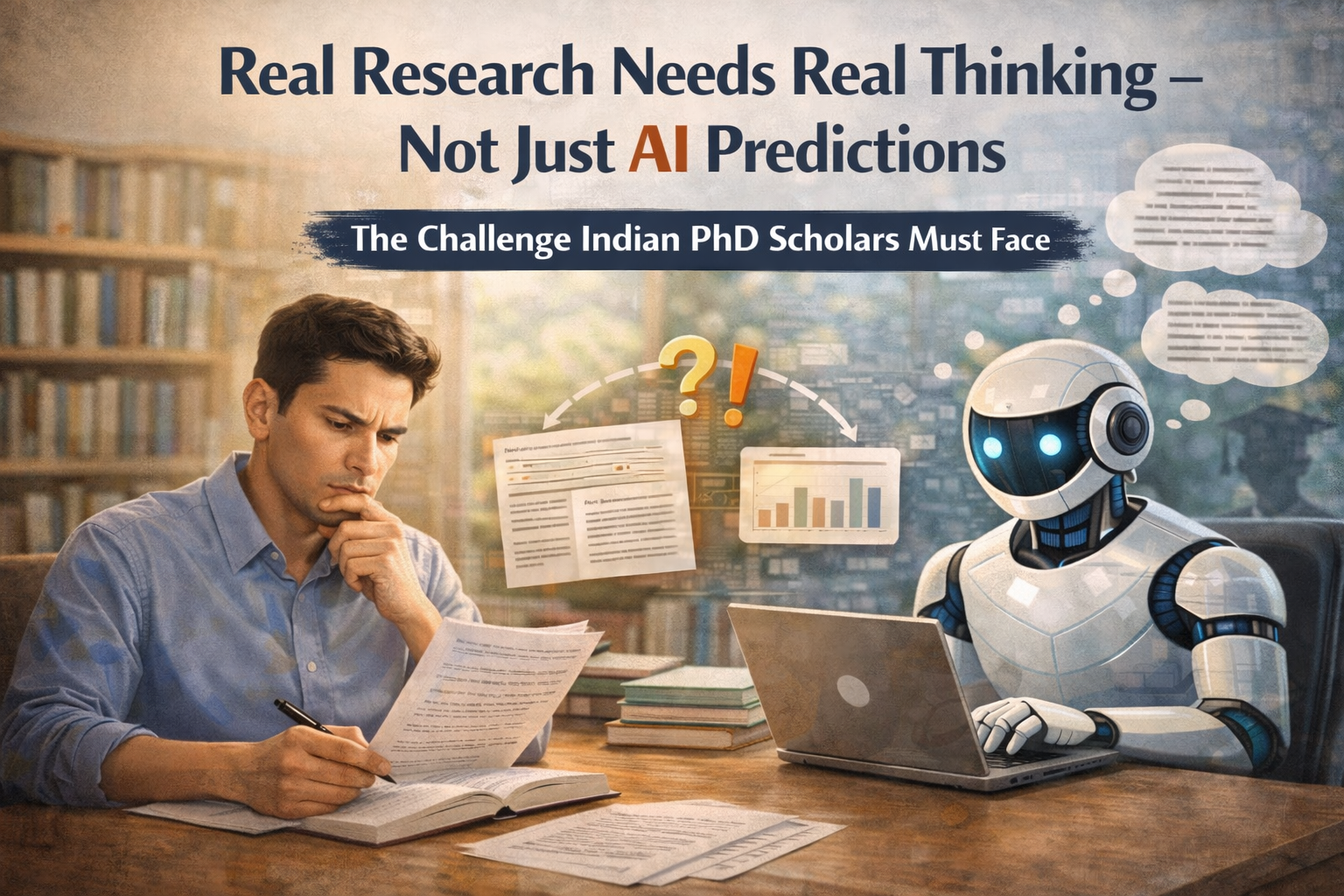
But real research doesn’t run on speed. It runs on thought — slow, messy, uncertain, and deeply personal. And that’s the part AI can’t do. Whether you’re studying gender policy, environmental science, or digital marketing, your work demands decisions, not just predictions. You must compare, question, argue, and reflect — tasks that no algorithm can perform in your place. For Indian scholars aiming to produce credible, original work, it’s important to remember that research is not content creation. It’s a thinking process — and thinking takes time.
What AI Predicts — And What It Can’t Understand
AI works through prediction. It doesn’t know your topic. It doesn’t care about your data. It doesn’t ask questions, get confused, or feel the tension of a conflicting theory. It simply gives you the most statistically likely response to your prompt based on patterns it has learned. That’s why the results are smooth but shallow. You’ll often see perfectly structured paragraphs that say very little.
For example, ask AI to write a discussion on “the impact of online education in rural India,” and you’ll likely get something like: “Online education has transformed learning in rural areas, offering access and flexibility…” But where is the analysis? Where is the challenge, the exception, the regional specificity? That’s where real research begins — when you stop generalising and start interpreting.
A PhD scholar from a private university in Maharashtra shared that she used AI to draft part of her introduction. While the grammar looked fine, her supervisor returned it with a comment: “Too flat. Where are you in this?” That single sentence reflects what good academic reviewers look for — your presence, your thought, your engagement. AI may offer language. But only you can offer meaning.
Indian Research Contexts Demand Grounded Thinking
Unlike Western academic settings where access to resources is often assumed, Indian scholars face uneven infrastructure, limited databases, and inconsistent supervisor interaction. In such a system, research becomes even more personal. Many doctoral projects emerge from real-life challenges — caste and gender dynamics, rural development schemes, small-business ecosystems, or urban planning failures. These themes require sensitivity, lived knowledge, and careful framing.
AI cannot replace that. It cannot understand cultural nuances, field challenges, or linguistic subtleties. A scholar working on Dalit women’s education in Bihar, for instance, cannot rely on AI to interpret field interviews. The text may be grammatically correct, but the insight — the real thinking — will be missing.
Even in more technical fields like engineering or management, Indian PhD work often involves localised data, region-specific applications, and policy-relevant interpretations. If you allow AI to write these sections, you risk sounding generic. And that’s exactly what reviewers reject — especially in viva settings where scholars are expected to defend not just what they wrote, but why they wrote it.
Thinking Is the Real Skill You’re Developing
A thesis isn’t just a document. It’s a long training in how to think through a problem, structure an argument, and interpret results. AI shortcuts may save time today, but they leave you underprepared tomorrow — when you’re asked to publish a paper, apply for a postdoc, or guide others through research.
One doctoral scholar in economics from Bengaluru shared that after experimenting with AI-generated summaries, he realised he could not answer even basic clarification questions in his progress review meeting. He had skipped the step of thinking. That wake-up call pushed him to slow down, read the material himself, and develop his arguments with care. It took more time — but gave him back his confidence.
AI tools can support your process — helping with paraphrasing, checking spelling, even suggesting synonyms. But they can’t choose between two conflicting frameworks. They can’t explain why your results differ from earlier studies. And they certainly can’t help you answer: What does this mean in the Indian context?
Using AI Without Losing Yourself
Avoiding overuse doesn’t mean avoiding AI altogether. You can still use it ethically and wisely. Let it help you clean a sentence, rephrase a confusing paragraph, or double-check grammar. But never hand over your thinking to a tool. If a paragraph comes from AI, rewrite it in your own words. If a citation is suggested, verify it. If the structure feels too polished but too distant, reframe it.
The more present you are in your thesis, the more it reflects not just academic knowledge, but research maturity. And that’s what guides, reviewers, and future employers want to see — a scholar who can think, not just submit.
Conclusion
In the race to complete a thesis, it’s easy to reach for shortcuts — especially when the tools seem smart, fast, and efficient. But the true value of research lies not in what you submit, but in what you learn to think through. AI can support your writing, but it cannot do your thinking. And in Indian academia, where doctoral work is increasingly evaluated for originality, insight, and contextual relevance, that difference matters more than ever.
Your ideas, doubts, arguments, and discoveries — those are what make your thesis real. Without them, you’re not doing research. You’re just rearranging words. And no AI tool can give you the satisfaction of thinking something through — and knowing you truly understood it.