
Introduction
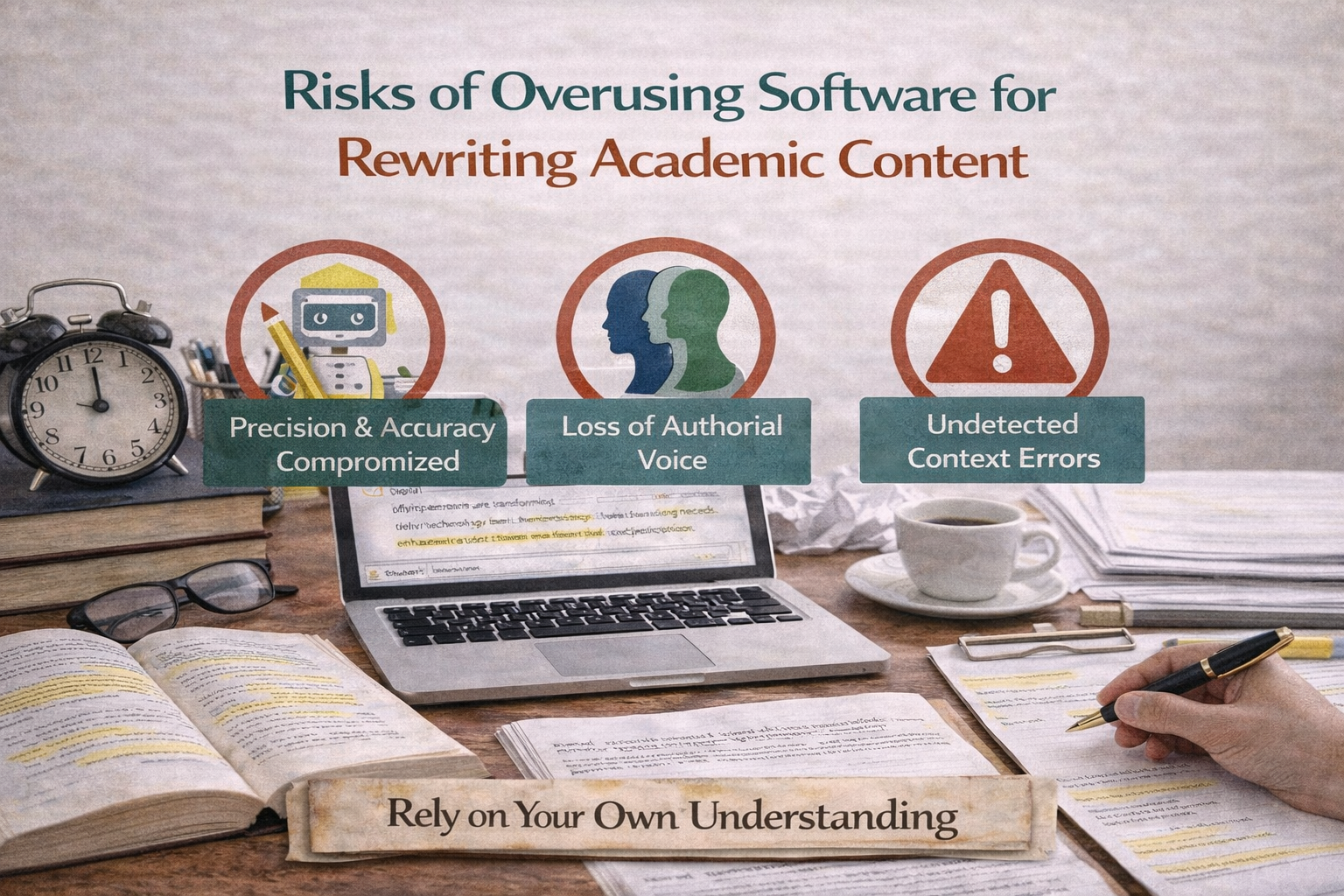
In recent years, Indian PhD scholars have gained easy access to a variety of rewriting tools, from QuillBot to Grammarly’s rephrasing features. These platforms promise faster editing and plagiarism removal, which can be appealing for students managing both academic work and personal responsibilities. The risks of overusing software for rewriting academic content, however, are often underestimated, especially in the pressure-filled months before thesis submission.
For many doctoral candidates, particularly in private universities where flexibility in deadlines is balanced by strict plagiarism thresholds, the rewriting stage can feel like a technical hurdle rather than an intellectual task. But rewriting in academia is not just about avoiding similarity—it’s about maintaining meaning, precision, and the unique voice of the scholar. Relying too heavily on automated rewriting software can compromise all three, sometimes without the writer even realising it until their work is reviewed by a supervisor or examiner.
How Over-Reliance on Tools Affects Academic Integrity
Automated rewriting software works by altering sentence structure, replacing words with synonyms, and sometimes splitting or merging phrases. While this can lower a similarity score, it does not always account for the specialised language and conceptual accuracy required in academic writing. For example, a PhD in management might use the term “market penetration strategy” in a literature review. A rewriting tool might simplify this to “way to enter markets,” which loses the specific theoretical context recognised in research discourse.
When this happens repeatedly across chapters, the final document can appear inconsistent in tone and clarity. Examiners in Indian doctoral admission processes, who are often seasoned academics, can detect when portions of a thesis do not align with the candidate’s style or understanding. This raises not only academic questions but also reputational concerns—especially in oral defence sessions where the scholar must justify phrasing and terminology.
Another hidden risk is that overusing such tools can reduce the scholar’s engagement with the material. Instead of deeply processing the meaning of a source and expressing it in their own words, they may depend on the tool to “do the work.” Over time, this can affect their ability to discuss or defend their own research, a challenge many mid-career professionals returning to study face when balancing academic and work demands.
Why Moderation Works Better Than Dependence
For doctoral candidates in India, especially in private universities where support systems may be more flexible, rewriting is an opportunity to refine thought and argumentation. Using tools as an aid rather than a replacement keeps the scholar in control of their writing. Grammarly, for instance, can be valuable for detecting awkward phrasing or grammar inconsistencies, but the rewriting should originate from the scholar’s own comprehension of the text.
A practical approach is to first rewrite a section manually, drawing from one’s understanding of the research, and then use software to check for clarity or minor linguistic improvements. This ensures that the meaning remains intact while the language is polished. It also helps maintain consistency of tone, which automated tools cannot guarantee.
In India’s academic context, where family members often take pride in a scholar’s research achievements, producing original work carries a cultural significance beyond compliance with plagiarism software. Scholars who personally engage with rewriting not only meet university requirements but also deepen their subject expertise, which becomes invaluable during viva voce, conference presentations, or when publishing in journals.
Conclusion
Rewriting tools can be helpful companions in the editing process, but overusing them for academic content risks damaging the clarity, accuracy, and authenticity of a thesis. PhD work demands more than text that passes a similarity check—it requires the scholar’s intellectual imprint in every chapter. For Indian doctoral candidates, especially those navigating the balance between flexibility and rigor in private universities, moderation in tool use ensures that rewriting remains both a technical and an intellectual achievement. In the long run, it is the thoughtful integration of one’s own understanding with selective software assistance that produces work worth defending.