
Introduction
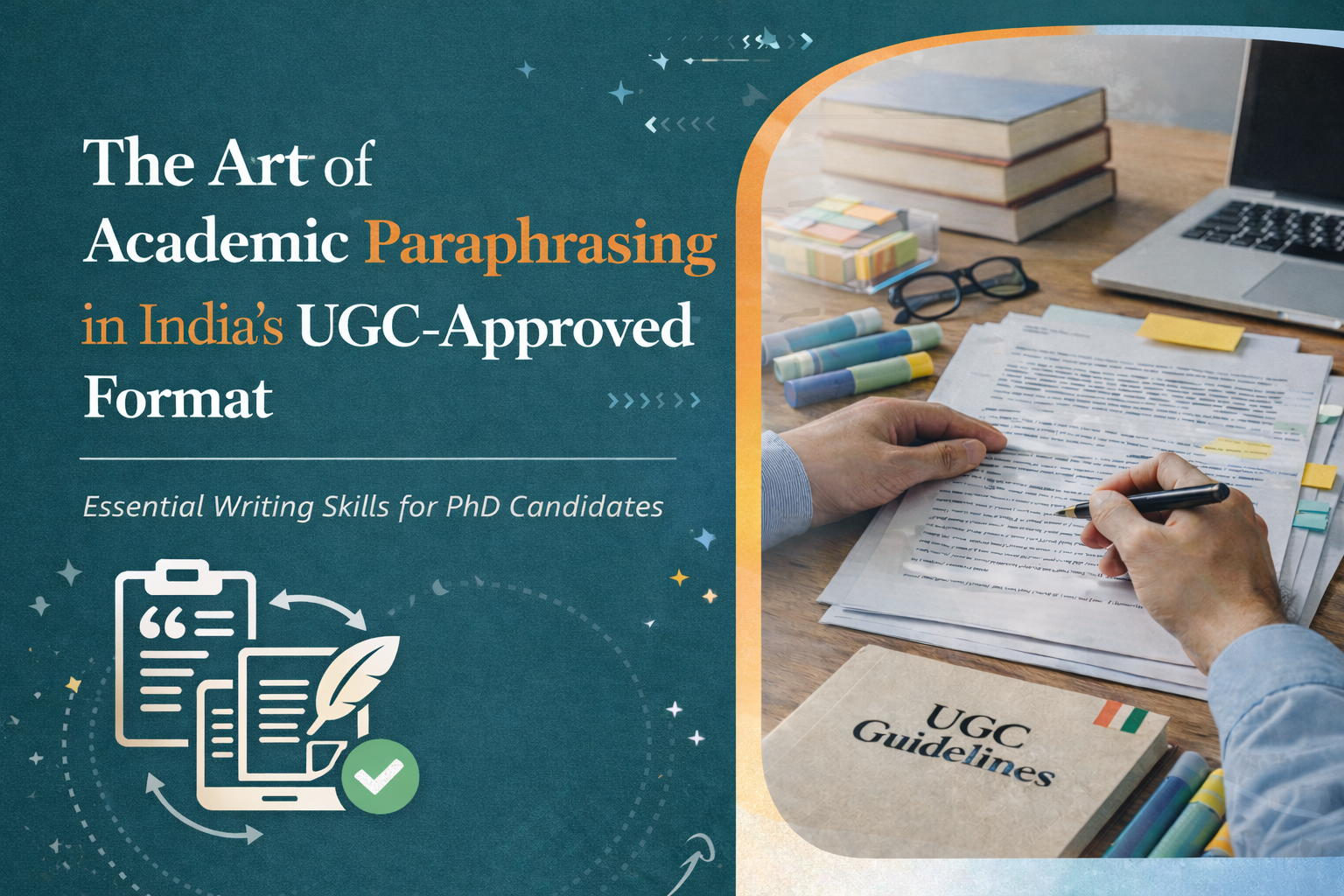
For Indian PhD candidates, paraphrasing is more than a writing skill—it is a safeguard against unintentional plagiarism and a way to meet the similarity thresholds outlined in UGC-approved guidelines. While students in private universities often have the flexibility to seek professional editing support, the responsibility for ensuring compliance still rests with the researcher. In the pressure of meeting submission deadlines, especially for working professionals balancing research with careers, paraphrasing can become either a rushed mechanical task or a deliberate academic exercise.
The art lies in rewriting content so that it reflects the candidate’s own scholarly voice while retaining the accuracy and depth of the original source. Achieving this balance is what makes paraphrasing in India’s UGC-approved format both challenging and rewarding.
Understanding UGC Expectations on Paraphrasing
The UGC’s plagiarism regulations recognise that academic writing relies on building upon existing knowledge, which naturally involves referencing other scholars. The guidelines focus not only on originality percentages but also on proper citation and acknowledgement. In practice, this means that a well-paraphrased section can still include extensive references as long as the language and sentence structure are distinctly the candidate’s own.
In Indian academic culture, supervisors often encourage paraphrasing over direct quoting, especially in literature reviews and theoretical frameworks. This is because paraphrasing demonstrates comprehension and analytical ability, whereas long quotations can suggest over-reliance on external material. For doctoral admission in India, showing mastery of this skill signals readiness for independent research.
Techniques for Maintaining Accuracy While Rewriting
Effective academic paraphrasing starts with fully understanding the source material. Reading a paragraph several times before attempting to rewrite it ensures that the candidate is not merely swapping words with synonyms but actually reconstructing the meaning. For example, if the source states that “online learning increases accessibility for rural students,” the rephrased version might say: “Access to education in rural areas improves through the adoption of online learning platforms.” The concept remains identical, but the sentence structure and phrasing are the writer’s own.
It is also helpful to change the sequence of ideas within a sentence, integrate related points into a single sentence, or break complex sentences into simpler ones. This restructuring aligns with UGC-approved practices because it reduces direct text matching while keeping the original sense intact.
Integrating the Researcher’s Own Voice
In India’s doctoral context, paraphrasing is not meant to erase the candidate’s perspective—it is an opportunity to insert it. After restating a source’s idea, the researcher can add a short analytical remark, connecting it to the specific focus of the thesis. For instance, after paraphrasing a study on teacher training programs, a candidate might note: “Such initiatives align with the current push for skill-based education in Indian private universities.”
This method not only reshapes the paragraph but also shows how the candidate is actively engaging with the literature rather than passively reporting it. Over time, this habit of blending paraphrased content with personal insights leads to a more cohesive and original thesis.
Avoiding Over-Compression and Misrepresentation
One of the risks in paraphrasing is oversimplifying complex ideas to the point of misrepresentation. In Indian academia, this is viewed seriously because it can distort the original meaning and weaken the research argument. The goal is to retain all key elements of the source while adapting the language and structure.
For example, when paraphrasing a methodology description, omitting steps or merging them too broadly can mislead readers about the original process. This is why, particularly in research-heavy sections, paraphrasing must be approached with patience and a willingness to cross-check against the original.
Aligning with UGC-Approved Documentation Styles
Even the most well-crafted paraphrase can cause plagiarism concerns if it is not correctly cited. UGC-approved formats generally follow styles such as APA, MLA, or Chicago, and universities—especially private ones—often have specific preferences. Correct in-text citations and a complete reference list are essential, not only for academic integrity but also for passing similarity checks without unnecessary disputes.
This alignment is more than a technicality—it reflects a researcher’s respect for the scholarly community. In a thesis defence or viva voce, being able to explain how paraphrased sections meet UGC standards can also strengthen the candidate’s position.
Conclusion
The art of academic paraphrasing in India’s UGC-approved format is about more than avoiding plagiarism—it is about demonstrating ownership of one’s research journey. By understanding the source material, restructuring ideas thoughtfully, integrating personal insights, and adhering to citation rules, PhD candidates can meet regulatory requirements while producing work that genuinely reflects their intellectual contribution. This balance, once mastered, becomes not just a compliance skill but a hallmark of mature academic writing.